Choosing a Stainless Steel Mesh Filter in 2026 requires more than comparing mesh counts or online prices. Industrial filtration systems now face tighter efficiency, durability, and traceability expectations. Grand View Research estimates that the global industrial filtration market will continue expanding through 2030, driven by water treatment, chemicals, food processing, and manufacturing. Market forecasts differ, however. Treat them as directional evidence, not guaranteed purchasing targets.
Material selection remains critical. The World Stainless Association reported global stainless steel crude production of approximately 58.4 million tonnes in 2023. This scale reflects stainless steel’s continuing importance in demanding industrial environments. Yet, not every grade performs equally. Grade 304 suits many general applications, while 316L offers stronger resistance against chlorides and aggressive cleaning chemicals. A neat specification sheet can still mislead.
Real operating conditions should guide the decision. Check fluid temperature, pressure, viscosity, contamination type, and cleaning method. Then compare micron rating, wire diameter, open area, and pressure drop. ASTM E11 provides recognized guidance for woven wire sieve cloth and opening tolerances. That reference improves specification accuracy, but it does not replace application testing. Small details matter. A filter that looks suitable may clog quickly when particles are soft, oily, or irregular. This guide examines practical selection methods, supplier evidence, lifecycle cost, and common mistakes. It also questions a frequent assumption: finer filtration is not always better. Sometimes, it increases maintenance without improving the final process.
Understanding Stainless Steel Mesh Filter Types and Construction
How to Choose Stainless Steel Mesh Filter in 2026?
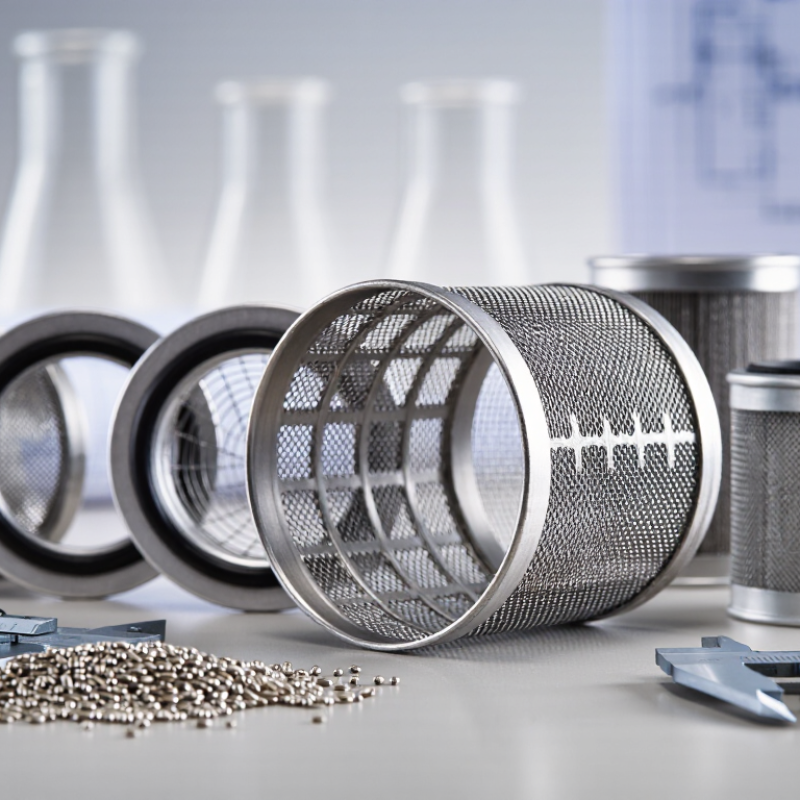
Understanding construction matters more than choosing the finest-looking filter. Woven wire mesh uses interlaced wires, creating consistent openings for particle control. Plain weave suits general filtration, while twill weave supports finer openings and stronger pressure resistance. Sintered mesh combines multiple layers through controlled heat and pressure. Its layered structure improves stability and backwashing performance. Some filters also include perforated support plates, welded seams, and reinforced edges. These details prevent deformation during repeated use. A filter can look robust but still fail at its joints.
Tips: Check the micron rating, wire diameter, flow direction, and operating temperature. Ask for material certificates and dimensional inspection records. Compare the open area, not only the mesh count. A high mesh count may reduce flow and increase clogging. Keep the application fluid, pressure range, and cleaning method clearly documented.
Construction should match the working environment. A single-layer screen may suit light particle removal, but demanding systems often need multilayer support. Inspect the surface for uneven openings, loose wires, blocked passages, and rough welds. Field experience shows that poor edge finishing can damage seals and create bypass paths. I would not choose by appearance alone. A perfect specification on paper may fail in a dirty process. That possibility deserves honest review. Consider service life, cleaning frequency, and replacement access before approving the final design.
How to Choose Stainless Steel Mesh Filter in 2026?
Understanding Stainless Steel Mesh Filter Types and Construction
Nominal aperture is a key selection factor for stainless steel mesh filters. The chart below shows
commonly referenced wire-cloth openings by mesh count. Actual performance also depends on wire diameter,
weave type, filtration direction, pressure, and the fluid being filtered.
Plain weave is commonly used for general-purpose filtration, while twilled weave can provide greater
strength at finer mesh counts. Dutch weave uses different warp and weft wire arrangements to produce
finer, more controlled openings. Always confirm the required micron rating and mechanical load before
selecting the final stainless steel mesh construction.
Matching Mesh Size and Filtration Accuracy to Your Application
How to Choose Stainless Steel Mesh Filter in 2026?
Matching Mesh Size and Filtration Accuracy to Your Application
Mesh count alone can mislead. It describes openings per inch, but wire diameter also controls the actual passage size. Two filters with identical mesh counts may deliver different filtration results. Check the supplier’s micron opening data, not only the mesh number.
Match filtration accuracy with the particles your process must remove. A coarse filter may suit pump protection, while a finer filter can capture dust, catalyst residue, or small metal fragments. For example, a 100-micron opening may protect a spray nozzle without restricting flow excessively. A 25-micron filter offers tighter separation but creates higher pressure loss.
Measure the process honestly. Note fluid viscosity, temperature, flow rate, pressure, and particle shape. Round particles behave differently from fibers. Choose a filter with enough open area for stable flow and easier cleaning. In practical testing, a slightly coarser mesh sometimes performs better because it resists rapid clogging. I once treated finer filtration as automatically superior. That choice increased maintenance and reduced output.
Confirm whether the stated accuracy is nominal or absolute. These terms are not interchangeable. Ask for test conditions, wire material, and dimensional tolerances. Stainless steel grades also affect corrosion resistance and cleaning life. Inspect the filter after operation; uneven deposits can reveal poor flow distribution or an unsuitable mesh. Small details matter.
Evaluating Steel Grades, Corrosion Resistance, and Temperature Limits
How to Choose Stainless Steel Mesh Filter in 2026?
Choosing a stainless steel mesh filter starts with the working environment, not the mesh opening. Grade 304 suits dry air, water, and many general filtration duties. Grade 316 or 316L offers better resistance to chlorides, salt spray, and mild chemical exposure. However, no stainless grade is completely corrosion-proof. I have seen 316 mesh develop staining when trapped salt remained between folded layers.
Temperature limits require careful checking. Grade 304 commonly performs well in moderate heat, while 316L may lose strength sooner during prolonged high-temperature service. Grade 310 is designed for hotter oxidizing conditions, but it may be unsuitable for certain wet chemical environments. The filter’s support frame, welds, and sealing material can fail before the mesh does. Check continuous temperature, short exposure temperature, and thermal cycling separately. Heat changes dimensions.
Inspect the actual process before ordering. Record fluid composition, chloride levels, pressure, flow direction, and cleaning chemicals. Request material certificates and corrosion data from a qualified supplier. A fine mesh can clog quickly, even when its steel grade is correct. I once focused too heavily on corrosion resistance and underestimated pressure drop. That was a costly design mistake. Test a sample under real operating conditions when possible. A clean-looking laboratory result may not represent a filter exposed to vibration, deposits, and repeated heating.
Selecting Filter Shape, Flow Capacity, and Installation Method
How to Choose Stainless Steel Mesh Filter in 2026?
Selecting the correct filter shape starts with the housing, not the catalog image. Cylindrical elements suit pipelines and high-volume suction systems. Flat discs fit compact strainers and laboratory assemblies. Basket shapes provide more dirt-holding capacity. Measure the available length, diameter, sealing surface, and cleaning clearance before ordering. A 2024 MarketsandMarkets report estimates the global industrial filtration market will reach about USD 56 billion by 2029. That growth reflects stricter process-control needs, but it does not make every mesh filter suitable.
Flow capacity depends on mesh opening, wire diameter, filter area, fluid viscosity, and contamination load. A larger mesh opening usually reduces pressure loss, but it may allow unwanted particles through. Ask suppliers for tested flow curves, pressure-drop values, and operating temperature limits. ISO 16889 uses multi-pass testing to evaluate filter performance under controlled conditions. Still, test data may not represent your actual oil, water, or chemical mixture. That is where field experience matters. Leave safety margin.
Installation method can prevent expensive mistakes. Threaded filters work well for small lines and routine replacement. Flanged units support larger pipelines and easier alignment. Clamp connections allow fast cleaning, especially in hygienic processing areas. Check flow direction, gasket material, drain access, and maintenance space. A 2023 industry survey from the International Society of Automation reported that maintenance and reliability remain major priorities in industrial operations. I would not choose the finest mesh automatically. It may clog quickly, increase energy use, and create an avoidable service problem.
How to Choose Stainless Steel Mesh Filter in 2026? - Selecting Filter Shape, Flow Capacity, and Installation Method
| Filter Shape |
Recommended Mesh Range |
Typical Opening Size |
Indicative Flow Capacity* |
Best Use |
Installation Method |
Main Selection Consideration |
| Flat Screen |
20–200 mesh |
0.85–0.075 mm |
Approximately 3–45 L/min per 100 cm² of effective area |
Strainers, removable panels, tank outlets, and low-pressure filtration |
Clamped, bolted, or fitted into a retaining frame |
Requires adequate support to prevent deformation under differential pressure |
| Cylindrical Screen |
20–150 mesh |
0.85–0.10 mm |
Approximately 10–150 L/min, depending on diameter and length |
Pipeline strainers, suction filters, pump protection, and continuous flow |
Inserted into a housing and sealed with a gasket or O-ring |
Provides more filtration area than a flat screen within a compact housing |
| Basket Filter |
10–100 mesh |
2.00–0.15 mm |
Approximately 25–500 L/min, subject to basket size and fluid viscosity |
Industrial liquid lines, cooling-water systems, and coarse-to-medium particle removal |
Installed inside a removable filter vessel with a cover and sealing ring |
Suitable when frequent cleaning and high dirt-holding capacity are required |
| Conical Screen |
20–100 mesh |
0.85–0.15 mm |
Approximately 15–250 L/min, depending on cone diameter and length |
Temporary startup protection, pump inlet screening, and process-line debris removal |
Fitted between pipe flanges or placed inside a temporary strainer body |
Easy to remove, but not normally selected for permanent high-dirt-load service |
| Wedge-Supported Mesh |
40–200 mesh |
0.425–0.075 mm |
Approximately 5–120 L/min per 100 cm² of effective area |
Higher-pressure liquid filtration and applications requiring stronger screen support |
Welded, bolted, or mounted inside a rigid support frame |
Better resistance to collapse and easier surface cleaning than unsupported fine mesh |
| Multi-Layer Mesh Pack |
20–400 mesh |
0.85–0.038 mm |
Approximately 2–80 L/min per 100 cm² of effective area |
Fine filtration, hydraulic systems, laboratory equipment, and process-water polishing |
Spot-welded or sintered into a cartridge, disc, or cylindrical element |
Offers fine particle control but creates a higher pressure drop than single-layer mesh |
Selection Notes:
Mesh opening should be selected according to the smallest particle that must be retained, not mesh count alone. Flow capacity depends on effective filter area, fluid viscosity, particle loading, temperature, and allowable pressure drop. The flow figures above are indicative clean-water ranges at low differential pressure and should be verified by application testing before final specification.
| Decision Factor |
Practical Guideline for 2026 Selection |
| Particle Size |
Choose an opening smaller than the target particle. For example, a 100-mesh screen has a nominal opening of about 0.15 mm, although actual retention also depends on particle shape. |
| Flow Rate |
Increase the screen area or use a cylindrical/basket design when the required flow is high. Avoid selecting a fine mesh solely because it provides a smaller opening. |
| Pressure Drop |
Allow additional capacity for dirt loading. A larger filter area generally reduces pressure drop and extends the cleaning interval. |
| Cleaning Method |
Select removable flat, basket, or cylindrical elements for manual cleaning; select supported or multi-layer elements when backwashing or repeated cleaning is expected. |
| Installation Space |
Use a cylindrical cartridge where radial space is limited, a basket where top-access maintenance is available, and a flat screen where installation depth is restricted. |
| Material Compatibility |
Common stainless steel grades include 304 for general water and mildly corrosive service and 316/316L for higher chloride exposure or more demanding chemical environments. Confirm compatibility with the actual fluid. |
Comparing Durability, Cleaning Needs, and Long-Term Operating Costs
How to Choose Stainless Steel Mesh Filter in 2026?
Durability begins with the operating environment, not the catalog price.
Grade 304 suits many dry, neutral applications. Grade 316L better resists chlorides, moisture, and frequent chemical washing. Wire diameter, weld quality, and open area also influence fatigue life. In maintenance inspections, I check dents, stretched openings, and broken welds before blaming the filter material.
Cleaning needs directly affect long-term operating costs.
A fine mesh captures more particles, but it may create faster pressure rise. That means more shutdowns, labor, and pump energy. DOE’s Operations & Maintenance Best Practices guide reports that preventive maintenance can reduce costs by roughly 12–18% compared with reactive maintenance. A practical cleaning plan should record pressure drop, rinse frequency, and inspection results. Keep records.
Corrosion deserves careful attention.
The NACE IMPACT study estimated global corrosion costs at about 3.4% of global GDP, or nearly 2.5 trillion dollars annually. Not every filter failure comes from corrosion. Poor cleaning, trapped solids, and thermal cycling can be equally damaging. I sometimes see buyers choose the finest mesh available, then discover that cleaning takes twice as long. That assumption can fail. Compare purchase price, cleaning hours, replacement intervals, disposal, and energy use across the expected service life. A slightly larger opening may reduce pressure loss, while a stronger weave may survive repeated washing better. The best choice is rarely the cheapest filter.
Conclusion
Choosing the right Stainless Steel Mesh Filter in 2026 requires more than simply selecting a mesh size. Start by understanding the filter’s construction, including woven or welded mesh, support layers, and overall structure. Match the opening size and filtration accuracy with the particles, fluid viscosity, flow rate, and cleanliness requirements of your application. Steel grade is also important, as different materials offer varying levels of corrosion resistance, mechanical strength, and temperature tolerance.
Next, consider the filter’s shape, available installation space, connection method, and expected flow capacity. A practical design should support stable performance without creating excessive pressure loss. Durability and maintenance are equally important: choose a filter that can be cleaned efficiently and reused safely when appropriate. By comparing service life, cleaning frequency, replacement needs, and energy or labor costs, you can identify a cost-effective solution that delivers reliable filtration and consistent operation over the long term.