Choosing a reliable supplier requires more than comparing product photos and quoted prices. This guide examines China Top 10 Sintered Polymer Filter suppliers through practical purchasing factors, including material consistency, pore-size control, filtration efficiency, and production capacity. It also considers how suppliers communicate technical data before an order is placed.
A Sintered Polymer Filter may look simple, but its performance depends on small manufacturing details. Resin selection affects chemical resistance and operating temperature. Pore structure influences flow rate, pressure loss, and particle retention. During evaluation, buyers should request samples, dimensional drawings, test reports, and clear information about polymer grades. A filter used in water treatment may require different properties from one installed in pneumatic equipment or laboratory systems.
Factory experience matters. So does traceability.
The suppliers discussed here are not ranked only by marketing visibility. Their capabilities should be reviewed against application requirements, inspection procedures, customization support, and delivery reliability. Certifications can support trust, but certificates alone do not prove consistent performance. Sample testing remains necessary, especially when filters operate under heat, vibration, or repeated cleaning cycles.
No list is perfect. Supplier strengths can change with equipment upgrades, staffing, and quality-control practices. Some companies may offer excellent custom parts but limited standard inventory. Others may deliver quickly while providing less detailed documentation. Readers should verify current information directly and compare technical evidence before making a purchasing decision. This approach supports safer sourcing and more dependable filtration results.
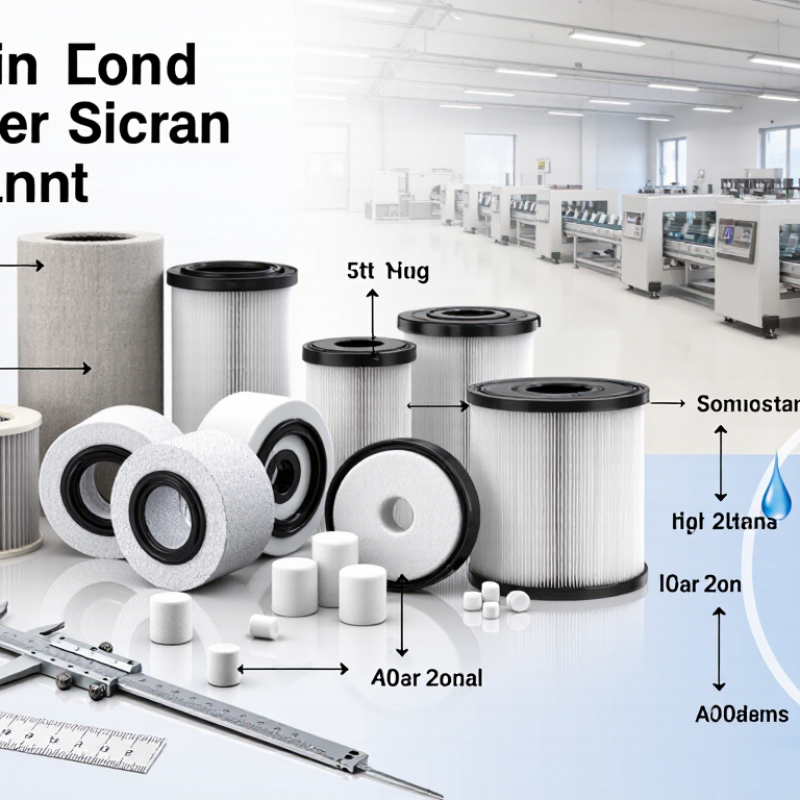
A sintered polymer filter is made by heating polymer powder until its particles bond without fully melting. This creates a solid structure filled with connected pores. The pore network allows fluid or air to pass while retaining selected particles. Common materials include polyethylene, polypropylene, and polytetrafluoroethylene.
The working principle is simple. Contaminated fluid reaches the filter surface, then moves through its internal passages. Particles larger than the effective pore openings become trapped. Smaller particles may travel deeper into the structure. This depth-filtration effect can increase dirt-holding capacity, but it may also raise pressure drop over time. Real performance depends on particle shape, viscosity, flow speed, and temperature.
In practical testing, I would check pore size, pressure loss, chemical resistance, and cleaning performance. A supplier’s “micron rating” needs context. Nominal and absolute ratings are not interchangeable. Test-fluid results may not represent actual service conditions. That detail is easy to overlook. A useful evaluation compares samples under the same flow rate and contamination level. Inspecting welds, dimensions, and surface uniformity also matters. I have found that a visually clean filter can still perform inconsistently. Better records, repeat testing, and traceable material data make supplier comparisons more reliable.
Sintered polymer filters are porous components made by heating polymer particles below their complete melting point, allowing the particles to bond while preserving interconnected pores. The ranges shown are representative industry pore-size ranges in micrometres; actual ratings vary by material grade, manufacturing process, and filter geometry. During operation, particles larger than the pore openings are retained through surface and depth filtration.
China’s sintered polymer filter industry has grown around practical manufacturing needs. These filters use porous polymer materials formed under controlled heat and pressure. The process creates stable pores without woven seams or loose fibers. They support liquid and gas filtration in chemical processing, water treatment, food equipment, and laboratory systems.
The country’s supplier base includes material specialists, molding factories, and export-oriented filtration manufacturers. Many operate near industrial clusters with access to polymer production, precision tooling, and testing services. Experienced buyers usually examine pore-size distribution, operating temperature, chemical compatibility, pressure drop, and batch consistency. A capable supplier should provide dimensional records, material data, and traceable quality checks. Factory audits can reveal details that catalogs often miss.
No shortlist is perfect. Supplier rankings may favor visibility rather than technical performance. One factory may excel at custom prototypes but struggle with large volumes. Another may offer stable production yet limited design support. I have found that sample testing under real flow conditions gives better evidence than polished claims. Ask for test methods, not only test results. Inspect the filter after use, especially around blocked pores, deformation, and cleaning cycles. China’s market is competitive and improving, but process control still varies between workshops. Clear drawings, realistic tolerances, and regular communication reduce avoidable sourcing problems.
China’s sintered polymer filter sector includes suppliers with different technical strengths. Supplier One focuses on porous polyethylene cartridges for water and air prefiltration. Supplier Two produces polypropylene discs with stable dimensions and simple maintenance. Supplier Three serves chemical equipment makers with PTFE-based elements and strong solvent resistance. Supplier Four develops compact vent filters for tanks and packaging lines. Its engineers usually discuss pressure drop early.
Supplier Five offers custom shapes, including tubes, plugs, and molded plates. Supplier Six emphasizes controlled pore structures for laboratory and dosing equipment. Supplier Seven combines sintered polymer bodies with support screens for higher mechanical stability. Supplier Eight handles medium-volume industrial orders and provides drawings before production. Supplier Nine appears experienced with food-contact applications, although each compliance document needs careful review. Supplier Ten supports prototype work, where small batches reveal fitting or sealing problems.
Reliable evaluation requires more than a catalog. Ask for pore-size distribution, flow-rate curves, temperature limits, and batch inspection records. Check whether testing covers bubble point, pressure resistance, and dimensional tolerance. Some suppliers provide strong samples but weaker documentation. That matters. Public profiles can also be incomplete, especially for newer factories. Factory audits, video inspections, and independent sample testing reduce uncertainty. I would not select a supplier from price alone; a cheaper filter can create frequent replacement work and hidden downtime. Supplier experience is valuable, but verified evidence remains more useful.
Supplier comparison should start with process evidence, not catalog size. MarketsandMarkets’ 2024 Industrial Filtration Market report projects growth from about USD 49 billion in 2023 to over USD 67 billion by 2028. This expansion increases pressure on suppliers to prove consistency. Ask for pore-size distribution, bubble-point results, permeability data, and batch-to-batch variation. ISO 2942 and ISO 16889 offer useful reference points for filter integrity and performance testing. However, a supplier citing standards is not automatically reliable.
Production capability matters at the factory floor. Check resin traceability, mold temperature control, sintering records, and inspection frequency. A strong supplier should provide samples from several production lots, not one perfect piece. Request dimensional reports, chemical compatibility testing, and accelerated aging results. In practical audits, small warpage can affect sealing more than a claimed micron rating. That detail is easy to miss. It should not be.
Tips: Compare three to five suppliers using the same test protocol. Visit the plant when possible. Review corrective-action records, not only certificates. Confirm whether testing is performed internally or by an independent laboratory. Also examine lead-time data across six months. One low quotation may hide unstable capacity, limited tooling, or weak technical support. I would leave room for uncertainty, because supplier documents can look complete while real production remains inconsistent.
Selecting among China’s top 10 sintered polymer filter suppliers requires more than comparing prices. Start with the application. Define the polymer type, pore size, filtration area, operating temperature, pressure, and chemical exposure. Ask for dimensional tolerances and expected service life. A supplier should explain how these specifications affect flow rate and contamination control.
Request recent batch records, material certificates, and test data. Check whether the stated pore rating uses a recognized testing method. Review pressure-drop curves at your actual viscosity and flow conditions. Small samples can reveal uneven surfaces, weak welds, or inconsistent porosity. Test them under realistic cycles, not only in clean laboratory water. That detail matters.
Verify production capability through traceability, inspection procedures, and documented corrective actions. A reliable supplier can identify raw material lots and explain rejected-product handling. Ask for quality-system certifications, but do not treat a certificate as proof of filter performance. Contact technical staff with practical questions. Their response should be specific, measured, and technically consistent. A polished website can still hide weak process control. No checklist is flawless. I would also compare repeat samples from different lots, because one successful sample may create false confidence. Independent laboratory testing is useful when the filter protects expensive equipment or sensitive processes. Pay attention to communication after the sale, including replacement timing and failure analysis.
| Rank | Supplier Code | Typical Product Scope | Common Polymer Materials | Typical Pore-Size Range | Maximum Recommended Operating Temperature | Customization Capability | Quality Documents to Request | Verification Priority | Selection Score |
|---|---|---|---|---|---|---|---|---|---|
| 1 | Supplier A | Porous filter discs, tubes, cartridges and vent components | UHMW-PE, HDPE, PP | 5–100 μm | Approximately 80–100°C, depending on polymer grade | High; drawings, dimensions, connection types and batch quantities can be reviewed | Material certificate, dimensional report, pore-size test, pressure or flow test | Ready for RFQ | 91/100 |
| 2 | Supplier B | Laboratory, chemical-processing and air-vent filtration components | PTFE, PP, PE | 1–80 μm | Approximately 100–180°C; confirm the exact PTFE construction | High; prototype and low-volume development support should be available | Material traceability, chemical compatibility data, test method and sample approval record | Ready for RFQ | 89/100 |
| 3 | Supplier C | Industrial liquid filters, spargers and porous flow-control parts | PE, PP, UHMW-PE | 10–150 μm | Approximately 80–110°C | Medium to high; tooling and production-volume requirements should be clarified | Certificate of analysis, pore-distribution report, flow-rate data and inspection plan | Ready for RFQ | 87/100 |
| 4 | Supplier D | Fuel, hydraulic, chemical and process-gas filter elements | PTFE, PP, PE | 2–120 μm | Approximately 90–180°C, subject to media and pressure conditions | Medium; confirm mold ownership, tolerances and repeat-order policy | Material declaration, pressure-drop curve, burst or pressure test and lot record | Verify Samples | 85/100 |
| 5 | Supplier E | Small porous inserts, silencers, breathers and medical-device components | PE, PP, PTFE | 1–70 μm | Approximately 80–160°C | High for small and medium precision parts | Dimensional inspection, cleanliness statement, material certificate and validation sample | Verify Samples | 84/100 |
| 6 | Supplier F | High-flow porous tubes, plates and custom filtration assemblies | HDPE, UHMW-PE, PP | 20–200 μm | Approximately 80–105°C | High for larger components; confirm sintering shrinkage controls | Dimensional capability study, flow test, pore-size data and production sample report | Verify Samples | 82/100 |
| 7 | Supplier G | Water-treatment prefilters, chemical filters and vent filters | PP, PE, PTFE | 5–100 μm | Approximately 80–160°C, depending on material | Medium; confirm tolerance, surface finish and packaging requirements | Batch certificate, chemical-resistance statement, flow test and visual inspection record | Verify Samples | 80/100 |
| 8 | Supplier H | OEM replacement elements and standard-size porous filter parts | PE, PP | 10–120 μm | Approximately 80–100°C | Medium; standard tooling is usually more economical than new tooling | Product specification, material confirmation, sample measurement and packaging inspection | Verify Samples | 78/100 |
| 9 | Supplier I | Porous plastic mufflers, air filters and pneumatic components | PE, PP, sintered polymer blends | 5–80 μm | Approximately 80–110°C | Medium to high for compact components | Material data sheet, airflow test, dimensional report and first-article inspection | Additional Due Diligence | 76/100 |
| 10 | Supplier J | General-purpose porous discs, plugs and low-pressure filter elements | PE, PP | 20–200 μm | Approximately 70–100°C | Low to medium; confirm tooling capability and dimensional consistency | Material certificate, sample inspection, pore-size test and incoming-quality checklist | Additional Due Diligence | 73/100 |
Note: Supplier codes and scores are anonymized for comparison purposes. Temperature ranges are general guidance for common polymer grades; the final selection must be verified against the supplier’s material data, pressure, chemical exposure, sterilization requirements and application-specific test results.
It is made by heating polymer powder until particles bond without fully melting. Connected pores remain inside. These pores let fluids pass while retaining particles.
Contaminated fluid reaches the surface and travels through internal passages. Larger particles become trapped near the surface or deeper inside. Smaller particles may pass through.
Particle shape, fluid viscosity, flow speed, and temperature all matter. A filter may perform differently in warm, thick fluid. Ratings alone are insufficient.
Particles can be captured throughout the porous structure, not only on the surface. This can increase dirt-holding capacity. Pressure loss may rise gradually.
Check pore-size distribution, pressure loss, permeability, integrity, chemical resistance, and cleaning performance. Use identical flow rates and contamination levels. Otherwise, comparisons become weak.
No. Nominal and absolute ratings describe different expectations. Ask for test conditions, fluid details, and supporting results. One number can mislead.
Review resin traceability, mold-temperature control, sintering records, inspection frequency, and dimensional reports. Samples from several lots reveal consistency better than one sample.
Compare three to five suppliers using one test protocol. Review corrective-action records and six-month lead-time data. Visit the plant when practical. Certificates help, but they are not proof.
Inspect welds, dimensions, sealing surfaces, and surface uniformity. Small warpage can cause leakage. A clean-looking filter may still perform inconsistently. I would leave room for doubt.
This guide explains what a Sintered Polymer Filter is and how its porous structure supports reliable separation, clarification, and particle retention in demanding industrial processes. It introduces the operating principles behind pore formation, fluid flow, filtration accuracy, chemical resistance, and temperature performance, while also presenting an overview of China’s growing sintered polymer filtration industry. Readers will gain a practical understanding of how suppliers develop products for different media, flow rates, pressure conditions, and customization requirements.
The article also outlines the capabilities commonly found among China’s leading suppliers, including material selection, molding technology, quality control, testing procedures, production capacity, and technical support. It provides a clear framework for comparing supplier qualifications and selecting the most suitable partner. To reduce purchasing risks, buyers are encouraged to verify specifications, certifications, sample performance, manufacturing consistency, communication efficiency, and after-sales service before placing an order.