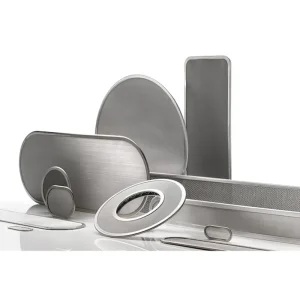
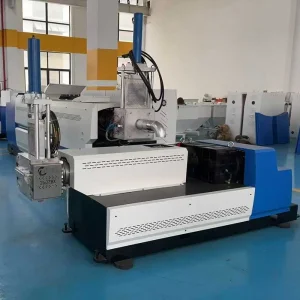
Explore our elite range of polymer melt candle filters, leaf disc elements, extruder wire mesh, and complete plastic granulating systems engineered by Pujiang HG Plastic Machinery Co., Ltd.
Navigating stringent circular economy mandates, European Union directives, and FDA/EFSA food-grade standards through advanced mechanical washing and continuous melt filtration technology.
In the global landscape of sustainable polymer processing, post-consumer Polyethylene Terephthalate (PET) recycling has evolved from basic downcycling applications into a ultra-high-precision industrial science. Modern global consumer packaged goods (CPG) conglomerates are bound by aggressive legislative targets—such as the European Single-Use Plastics Directive requiring 25% recycled content in PET beverage bottles by 2025 and 30% by 2030, alongside similar mandates across North America and Asia-Pacific. Consequently, sourcing machinery from famous bottle flakes recycling machine exporters has become a critical strategic priority for enterprise recyclers.
Achieving true "Bottle-to-Bottle" (B2B) closed-loop circularity requires transforming heavily contaminated post-consumer baled bottles into pristine, food-grade rPET flakes and pellets. The challenge lies in eliminating volatile organic compounds (VOCs), adhesive residues, polyolefin caps (PP/PE), paper/PVC labels, and fine sand down to single-digit parts per million (ppm). Pujiang HG Plastic Machinery Co., Ltd. stands at the forefront of this industrial transition, providing integrated recycling plants, high-efficiency friction washers, hot caustic scrubbing tanks, continuous melt filtration screen changers, and SUS 304/316 stainless steel candle filter elements designed for maximum operational uptime.
From raw baled bottle breaking to micro-filtration: A step-by-step technical breakdown of high-throughput industrial washing and granulating lines.
Heavy-duty hydraulic de-balers break compressed PET bales. A multi-stage rotary drum trommel removes loose stones, dirt, bottle caps, and small metals prior to wet processing.
High-speed mechanical de-labeling machines strip sleeve labels (PVC/PETG/OPP) without damaging bottle necks, followed by pneumatic zig-zag air classifiers.
Heavy-rotor granulators equipped with water injection reduce whole bottles into uniform 10–14mm flakes while simultaneously initiating surface cleaning and reducing blade wear.
Thermal reactors operating at 85–90°C with 1–2% NaOH chemical scrubbing digest glue contaminants, oils, and stubborn organic residues from flake surfaces.
Exploiting density differentials (Water SG 1.0 vs PET 1.38 vs Polyolefins 0.92), floating PP/PE caps and label remnants are separated from sinking heavy PET flakes.
High-speed centrifuges and thermal dryers reduce surface moisture below 0.5%. Dual-camera NIR optical sorters eject non-PET polymers (PVC, PLA, PS) and opaque colors.
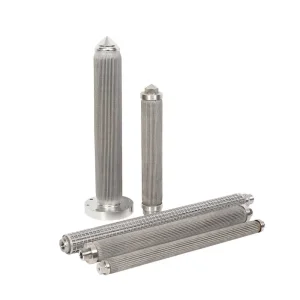
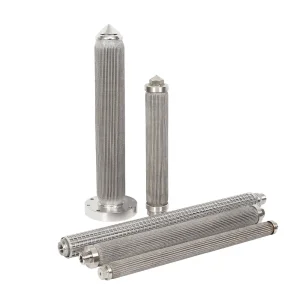
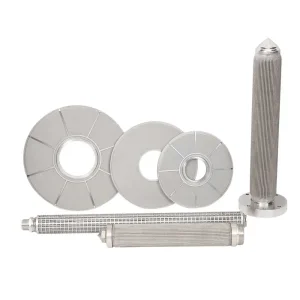
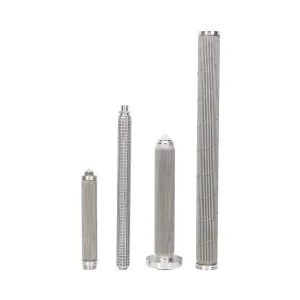
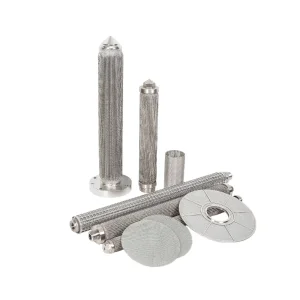
Degassing twin-screw extruders melt the clean flakes. The melt passes through HG's high-precision SUS 304 polymer candle filter elements to capture sub-micron carbonized gels.
Strand or underwater die-face pelletizers generate amorphous rPET pellets, which undergo Solid State Polycondensation (SSP) to restore intrinsic viscosity (IV ≥ 0.80 dL/g).
Understanding the technical requirements required across different commercial rPET outputs.
| Application Grade | Target Intrinsic Viscosity (IV) | Max PVC Contamination | Max Moisture Content | Filtration Precision Required | Core Machinery Requirement |
|---|---|---|---|---|---|
| Food-Grade Bottle-to-Bottle (B2B) | 0.76 – 0.84 dL/g | < 10 ppm | < 0.5% (Pre-SSP) | 20 μm – 40 μm (Candle Filters) | Hot Caustic Washer + NIR Sorter + Vacuum Extruder + SSP |
| High-Tenacity Filament (POY/FDY) | 0.68 – 0.74 dL/g | < 30 ppm | < 0.8% | 15 μm – 30 μm (Leaf Disc Filters) | Intense Friction Wash + Micro Melt Screen Filtration |
| Recycled Staple Fiber (PSF) | 0.58 – 0.65 dL/g | < 100 ppm | < 1.0% | 80 μm – 150 μm (Wire Mesh Filters) | Standard Cold/Warm Wash + Single Screw Granulator |
| Thermoforming Sheet (APET/RPET) | 0.70 – 0.78 dL/g | < 50 ppm | < 0.6% | 40 μm – 70 μm (Extruder Screens) | Multi-vented Extruder + Continuous Screen Changer |
| Industrial PET Strapping | 0.72 – 0.80 dL/g | < 150 ppm | < 1.2% | 100 μm – 200 μm (Mesh Elements) | Heavy Duty Shredder + High Torque Extruder |
Why leading exporters specify SUS 304/316 pleated candle filters and leaf discs for post-consumer polymer reprocessing.
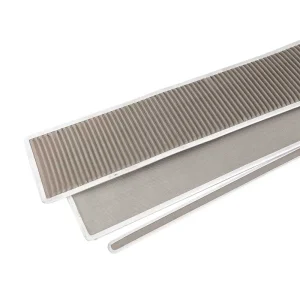
During the thermal extrusion of recycled PET bottle flakes, un-melted foreign polymers (such as residual silicone, aluminum micro-fragments, paper fibers, and degraded cross-linked PET gels) pose severe risks to spinning spinnerets and preform injection molds. Standard wire mesh screens quickly blind or break under high differential pressure (ΔP). Stainless steel SUS 304/316 candle filter cartridges provide expanded effective filtration surface area (up to 500% larger than flat screens), maintaining continuous melt flow while capturing sub-micron particulate matters.
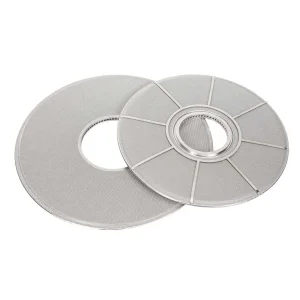
Polymer melt filtration operates under extreme conditions—temperatures exceeding 280°C to 300°C and hydraulic pressures rising above 200 bar. Pujiang HG Plastic Machinery Co., Ltd. utilizes vacuum-sintered stainless steel fiber felt and multi-layer woven wire mesh construction. This structural integrity prevents filter medium migration, withstands harsh backwashing cycles, and allows chemical or pyrolytic cleaning for repeated element reuse.
Ensuring international recyclers meet local environmental, food safety, and electrical machinery standards.
Our washing systems and melt filtration machinery are designed to achieve challenge test decontamination protocols matching FDA Non-Objection Letter (NOL) criteria and EFSA scientific standards for food-contact recycled plastics.
Equipment designs incorporate digital batch tracking, energy consumption monitoring, and mass-balance flow meters to enable seamless GRS certification and carbon footprint audits for end clients.
From factory floor layout design and electrical integration (UL/CE/CSA compliant) to remote PLC diagnostics and localized spare part hubs, HG ensures operational stability across 80+ export markets.
Pioneering smart automation, zero liquid discharge water systems, and AI-driven continuous filtration.
Integration of hyperspectral imaging sensors directly into washing line chutes to detect subtle chemical polymer variances (e.g., PETG, PLA, barrier layers) at processing speeds above 5 metric tons per hour.
Closed-loop process water treatment systems incorporating micro-flotation (DAF) and continuous ultrafiltration to recycle up to 98% of washing water while minimizing thermal energy loss.
Next-generation continuous backflush screen changers engineered with zero-pressure-shock mechanisms, dramatically reducing melt loss during backwashing cycles in ultra-clean pelletizing plants.
Addressing key engineering queries regarding bottle flake throughput, PVC separation, and polymer melt filter longevity.
Industrial PET bottle flakes recycling lines are manufactured in standard throughput capacities ranging from 1,000 kg/h up to 6,000 kg/h. For large-scale exporters and commercial recyclers, 2,000–3,000 kg/h lines offer the optimal balance between power consumption, caustic chemical consumption, footprint, and capital expenditure.
Achieving sub-10 ppm PVC content relies on a three-stage separation defense: First, dry mechanical de-labeling eliminates whole PVC sleeve labels. Second, multi-stage sink-float tanks separate polyolefins. Finally, high-resolution Near-Infrared (NIR) optical flake sorters scan individual flakes, firing precision air jets to blast away PVC, PLA, and discolored particles.
Pleated polymer candle filter elements made from SUS 304 or 316 stainless steel offer exponentially larger filtration surface areas within a compact filter housing. This drastically reduces differential pressure (ΔP), extends filter cartridge lifespan up to 10-fold, minimizes polymer thermal degradation, and prevents line stoppage during heavy contamination spikes in recycled feeds.
Yes, high-grade SUS 304/316 sintered felt and pleated candle filter elements supplied by Pujiang HG Plastic Machinery Co., Ltd. are engineered for multiple cleaning cycles. Common industrial cleaning techniques include TEG (Triethylene Glycol) boiling, vacuum pyrolysis ovens, and ultrasonic bath cleaning, fully restoring initial flow permeability.
Depending on local post-consumer bottle bale acquisition costs, power tariffs, and the purity tier of the output (such as food-grade rPET vs. staple fiber grade), typical plant ROI is achieved within 14 to 26 months. Utilizing robust machinery with high-durability polymer filters significantly lowers ongoing maintenance and unscheduled downtime costs.
Explore our full line of OEM and ODM polymer filtration solutions engineered for optimal melt clarity and extruder protection.