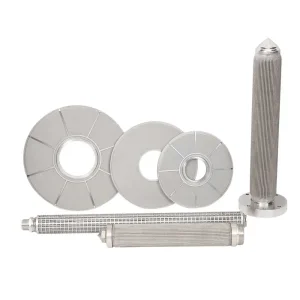
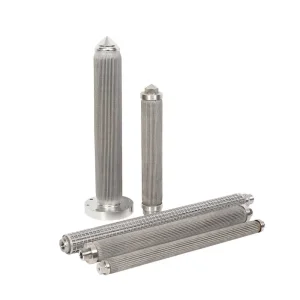
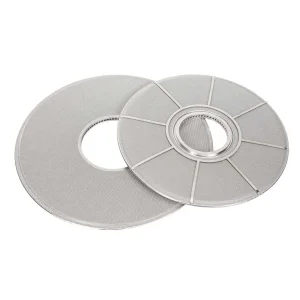
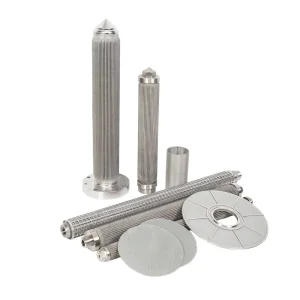
Explore our flagship continuous polymer filtration components engineered for high-temperature and high-viscosity melt systems.
Technical Whitepaper on High-Viscosity Polymer Rheology, Gel Decontamination, and Differential Pressure ($\Delta P$) Optimization in Continuous Extrusion Systems.
In modern polymer processing, petrochemical synthesis, and high-performance film extrusion, continuous melt filtration represents the single most critical quality assurance bottleneck. As synthetic polymers—such as Polyethylene Terephthalate (PET), Polypropylene (PP), Polyamide (PA), and Polycarbonate (PC)—are processed under extreme thermal dynamic loads (often exceeding 300°C and 200 bar), the accumulation of micro-gels, carbonized degradation products, and inorganic particulates can compromise structural integrity and optical clarity. Partnering with a famous disc filtration manufacturer is essential for plant engineers seeking to maintain continuous operating cycles without costly line shut-downs or spin-pack failures.
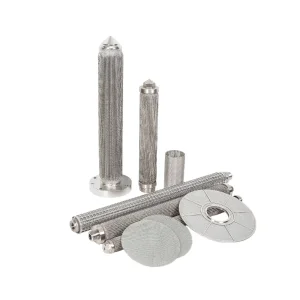
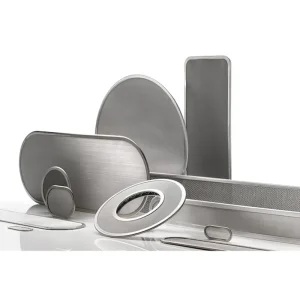
Disc filtration systems, particularly metallic leaf disc structures composed of multi-layered stainless steel wire mesh or sintered metal fiber felt, offer an unparalleled surface-area-to-volume ratio. Unlike conventional cylindrical filter cartridges, leaf discs are arranged in parallel along a central collector shaft inside a pressure vessel. This structural paradigm maximizes active filtration surface area within a compact footprint, effectively lowering melt velocity across the media face. By maintaining low superficial velocity, shear-induced degradation of high-molecular-weight polymers is minimized, preventing gel breakdown and ensuring stable viscosity profile through the extruder head.
Technical Gain Insight: The mathematical governing principle of melt filtration relies on an adapted form of Darcy’s Law for non-Newtonian pseudoplastic fluids: $\Delta P = \frac{\mu Q L}{K A}$, where $\Delta P$ is differential pressure, $\mu$ represents dynamic melt viscosity under prevailing shear rate, $Q$ is volumetric flow rate, $L$ is media thickness, $K$ is intrinsic permeability, and $A$ is active filtration area. By maximizing active area $A$ through specialized leaf disc geometries, plant operators achieve a proportional drop in $\Delta P$, extending process run-times by up to 300% relative to conventional candle elements.
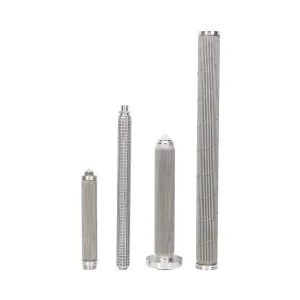
Furthermore, leading global manufacturers engineer disc filtration media using specialized metallurgy, including 316L stainless steel, Hastelloy C-276, and Nickel-Chromium alloys. These materials resist intergranular corrosion caused by acidic additives, catalyst residues, or fluoropolymer processing aids. High-precision laser-welded hub assemblies eliminate internal bypass channels, ensuring 100% of the polymer stream traverses the calibrated micron matrix.
Market dynamics driving the adoption of high-performance polymer leaf disc filtration systems across global supply chains.
Strict global mandates requiring recycled resin content (rPET, rPP) have dramatically increased solid contaminant loads in extrusion lines. High-capacity disc filtration is crucial to capture variable particulate pollution while maintaining yarn tensile strength and film barrier integrity.
The rapid growth of lithium-ion battery separators (wet/dry process), display-grade BOPET films, and flexible printed electronics demands near-zero defect rates. Sintered metal fiber disc filters deliver absolute filtration down to 3 microns to eliminate pinhole defects.
Spunbond and meltblown hygiene lines operating at speeds exceeding 1,000 meters per minute require stable melt pressure. Advanced disc filters provide continuous melt homogeneity, preventing filament breaks and spin-head downtime.
When specifying filtration hardware for large-scale extrusion and polymerization complexes, engineering teams evaluate structural tradeoffs between leaf disc filters, candle filter cartridges, and traditional screen pack changers:
| Architecture Type | Effective Filtration Area per Vessel | Differential Pressure ($\Delta P$) Growth Rate | Dirt-Holding Capacity ($g/m^2$) | Ultrasonic Cleanability Cycle Count |
|---|---|---|---|---|
| Hard-Hub Leaf Disc Filter | Maximum ($>45 m^2$) | Very Low (Linear) | High ($180 - 240 g/m^2$) | 15 - 20 Cycles |
| Soft-Hub Leaf Disc Filter | High ($>35 m^2$) | Low | Moderate ($140 - 180 g/m^2$) | 10 - 12 Cycles |
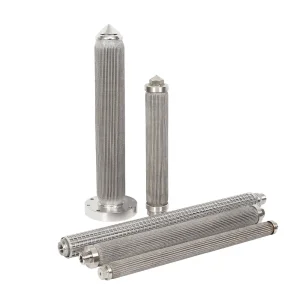
| Pleated Metallic Candle Filter | Moderate ($>20 m^2$) | Moderate | High ($160 - 220 g/m^2$) | 12 - 15 Cycles |
| Flat Extruder Screen Mesh | Low ($< 2 m^2$) | High (Exponential) | Low ($20 - 40 g/m^2$) | Disposable (Single-use) |
Underlying metallurgical manufacturing standards that define world-class disc filtration elements.
Constructed from microscopic stainless steel fibers vacuum-sintered into a three-dimensional labyrinth. Delivers high porosity (up to 85%) and minimal resistance to polymer flow while trapping non-rigid gel contaminants.
Utilizing Dutch Twilled weave patterns bonded with protective support layers. Provides rigid structural spacing, precise pore size distribution, and resistance to deformation under dynamic differential pressure spikes.
Robotic TIG/Laser welding connects multi-layer mesh sectors to precision-machined central drainage hubs. Tolerances within ±0.02mm prevent polymer bypass and facilitate leak-free stacking on central core rods.
Targeted industrial integration across polymer manufacturing, film lines, nonwovens, and recycling facilities.
In biaxially oriented polypropylene (BOPP) and polyethylene terephthalate (BOPET) lines producing ultra-thin dielectric capacitor films, even sub-micron metallic inclusions can cause dielectric breakdown. Sintered fiber leaf disc filters rated at 3μm absolute eliminate non-melting gels, preventing web breaks during transverse orientation stretching.
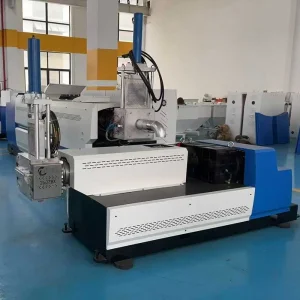
Mechanical recycling of post-consumer HDPE and PP containers introduces cross-contaminants, paper fibers, and aluminum speck particles. Continuous leaf disc filtration paired with automatic screen changers enables continuous operation, maintaining melt purity for high-grade pelletization without frequent line stops.
Production of spunbond nonwovens for medical filtration and hygiene applications demands uniform filament denier. High-temperature leaf discs remove thermal degradation products prior to spinnerets, reducing hole plugging and ensuring uniform web formation across multi-beam systems.
In direct-spun polyester fiber complexes, large-capacity Continuous Polymer Filtration (CPF) vessels house hundreds of leaf disc filters. The multi-disc configuration accommodates massive flow rates ($>10,000 kg/hr$) while maintaining low fluid retention times to prevent thermal polymer degradation.
Rigorous quality verification protocols, international compliance standards, and engineering services.
Operating as a world-class famous disc filtration manufacturer requires unwavering adherence to international quality management and material safety frameworks. Polymer filter elements destined for food-contact packaging, medical-grade plastics, or pharmaceutical applications must meet stringent regulatory benchmarks to safeguard end-user safety.
Innovations shaping the future of polymer melt filtration, eco-friendly regeneration, and smart monitoring.
R&D advances in sub-micron metal fiber spinning are enabling leaf discs with porosity exceeding 88%, dramatically reducing pressure drop while maintaining absolute filtration thresholds down to 1 micron for bio-degradable PLA/PHA resins.
Integration of Internet-of-Things (IoT) pressure and temperature sensor arrays on CPF filter vessels allows AI algorithms to predict precise filter cake saturation rates, optimizing backwashing cycles and preventing unexpected polymer shearing.
Transitioning from chemical solvent cleaning to controlled vacuum pyrolysis furnaces combined with high-frequency ultrasonic fluid agitation restores used leaf discs to over 98% of original flow permeability, lowering operating expenditure.
Expert answers to critical engineering queries regarding leaf disc filter design, selection, and maintenance.
Leaf disc filters provide a significantly higher filtration surface area per unit vessel volume. Because polymer melt flows parallel across multiple disc sectors stacked on a central shaft, the superficial velocity across the media face is substantially lower than in cylindrical candle filters. This reduced fluid velocity minimizes shear stress on pseudoplastic polymer chains, prevents non-rigid gel extrusion through the pores, and yields a lower rate of differential pressure ($\Delta P$) buildup, resulting in longer continuous production cycles.
Hard-Hub leaf discs feature precision CNC-machined metallic hub collars welded directly to the inner circumference of the filter sector. This creates a rigid metal-to-metal seal when stacked on the central collector tube under high tie-rod tension, eliminating the need for separate spacer gaskets and ensuring superior alignment under pressure up to 210 bar. Soft-Hub discs rely on elastomeric or copper gaskets placed between individual sector hubs; while cost-effective for lower-pressure applications, soft-hub systems carry a higher risk of inter-disc thermal leakage in high-temperature melt environments.
For high-clarity films such as BOPET, BOPP, and optical BOPA, the micron rating is determined by the maximum allowable defect size relative to the final stretched film thickness. Typically, the absolute filtration rating should be 1/5th to 1/10th of the final un-stretched cast sheet thickness. For standard optical applications, 3μm to 10μm 316L sintered metal fiber felt media is recommended due to its high gel-trapping efficiency and tortuous pore path.
Yes, high-quality stainless steel leaf discs manufactured by a famous disc filtration manufacturer can be cleaned and reused between 10 to 20 times depending on media type. The standard industrial cleaning protocol involves: 1) Vacuum Pyrolysis or Fluidized Bed thermal degradation to burn off residual polymer matrix at controlled temperatures (~450°C); 2) High-frequency ultrasonic bath cleaning with mild aqueous detergent to dislodge inorganic ash; 3) Reverse-flow acid/alkali chemical passivation; 4) Deionized water rinse, hot air drying, and bubble point testing (ISO 4003) to confirm structural integrity before re-installation.
Sintered metal fiber felt consists of non-woven, randomly laid metallic micro-fibers bonded at their intersection points under high vacuum sintering. This creates a three-dimensional depth structure with up to 85% open porosity, compared to ~30-40% open area in woven wire mesh. Consequently, fiber felt offers up to double the dirt-holding capacity, significantly lower pressure drop at equivalent micron ratings, and superior capture of deformably flexible micro-gels that would otherwise shear through two-dimensional woven mesh openings.
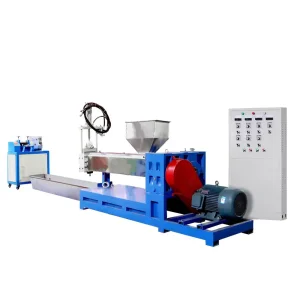
Comprehensive catalog of filter cartridges, screen meshes, and pelletizing machinery available for global export.