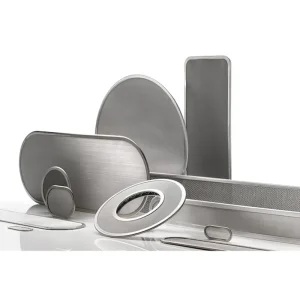
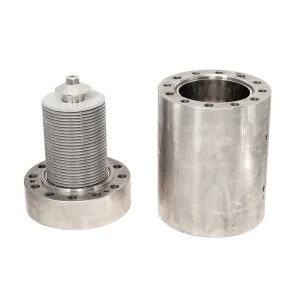
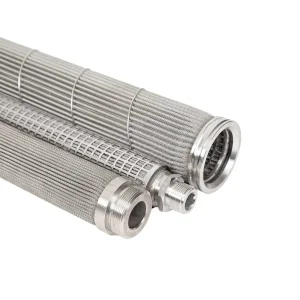
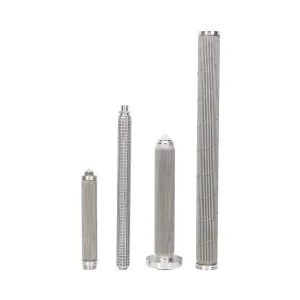
Explore our OEM/ODM high-viscosity candle filters, screen mesh elements, and precision leaf discs designed for demanding melt extrusion environments.
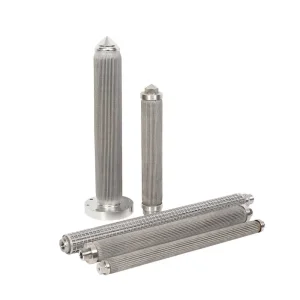
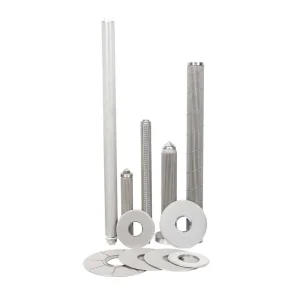
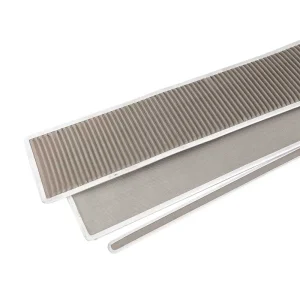
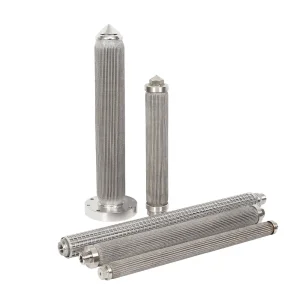
An engineering analysis of modern polymer processing, thermal degradation challenges, non-Newtonian melt rheology, and the crucial role of custom ODM stainless steel filter manufacturing.
In global polymer manufacturing, chemical fiber spinning, and continuous film extrusion (BOPP, BOPET, BOPA), the operational reliability of the filtration system directly impacts product yield, optical purity, and tensile strength. As extruders drive higher throughputs under aggressive temperature ranges (250°C to 340°C) and extreme system pressures exceeding 300 bar, standard disposable filter media fail prematurely due to compaction, thermal degradation, and structural collapse.
As a recognized ODM Stainless Steel Filter Factory & Exporter, our engineering philosophy revolves around solving the physical bottlenecks of non-Newtonian polymer fluid dynamics. Viscous polymer melts exhibit non-linear shear thinning behavior. When forced through poorly designed filter media, localized dead zones form within the filter chamber. These stagnant zones lead to extended residence times, thermal polymer degradation, carbonization, and the formation of destructive hard gels that ruin downstream spinnerets or ultra-thin film casting dies.
Custom multi-layer porous gradient media trap soft deformable polymer gels through depth filtration, preventing gel break-through into extruded films and synthetic fibers.
Engineered core support structures and optimized pleat geometry minimize initial clean pressure drops, doubling operational cycle times before backwash or cleaning is required.
Constructed exclusively from vacuum-annealed AISI 316L, 304, and super-alloy metals, resisting corrosive additives, monomer vapors, and extreme thermal cycling.
Choosing the optimal physical media geometry determines filter longevity, pore-size distribution integrity, and total cost of ownership across industrial melt continuous operational cycles.
| Filter Media Class | Structural Architecture | Porosity % Range | Dirt Holding Capacity | Primary Melt Application |
|---|---|---|---|---|
| Sintered Stainless Steel Fiber Felt | Non-woven 3D random matrix bonded at high vacuum temperatures | 75% - 85% | Very High (Up to 3x mesh) | High-viscosity polymer melt, PET spinning, BOPET film, micro-gel entrapment |
| Multi-Layer Sintered Wire Mesh | Diffusion-bonded plain/twill weave wire cloth laminate layers | 35% - 50% | Medium-High | Extruder screen changers, BOPP packaging film, PC/PMMA optical sheets |
| Square Woven Wire Cloth Mesh | Standard SUS 304/316 precision wire mesh single/multi-disc rimmed | 30% - 45% | Standard Depth | Plastic recycling granulators, polyolefin compounding, coarse resin strainers |
| Sintered Metal Powder Porous Media | Isostatically compressed micro-spherical stainless steel powder | 40% - 55% | High Surface Area | Gas dispersion, high-pressure liquid catalyst recovery, aggressive chemical fluids |
By optimizing the height, count, and radius of chevron or cylindrical pleats, our ODM manufacturing increases effective filtration surface area by up to 500% within standard housing dimensions.
Vacuum sintering welds individual wire crossover points at atomic levels. This eliminates wire fraying or fiber detachment, safeguarding high-purity medical and food-grade polymers.
All-welded stainless steel construction tolerates repeated TEG (Triethylene Glycol) boiling, vacuum pyrolysis, and ultrasonic bath cleaning, restoring dirty elements to 98%+ original permeability.
From precision European film stretchers to heavy-duty Asian post-consumer plastic granulators, tailored stainless steel filtration elements ensure uninterrupted production.
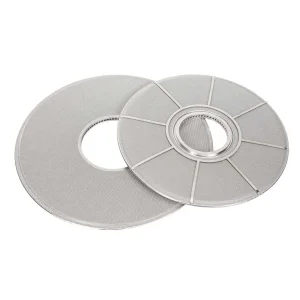
Ultra-thin optical packaging and capacitor films require zero pinholes or particulate inclusion. Leaf disc filters assembled in hub bundles provide continuous, low-shear filtration down to 3 microns absolute.
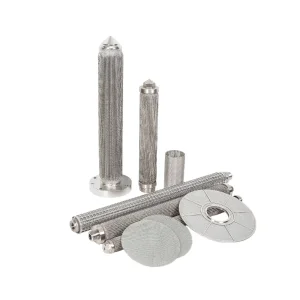
In Polyester (PET), Polyamide (PA6/PA66), and Polypropylene (PP) POY/FDY spinning lines, custom sintered candle filters maintain uniform pressure head to prevent filament breakage at high speeds.
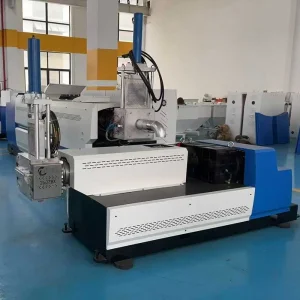
Recycling heavily contaminated PCR/PIR polymers requires rugged stainless steel wire mesh screen packs capable of holding substantial paper, aluminum, and cross-linked debris without blowouts.
High-temperature hydrocarbon chemical synthesis relies on heavy-wall SUS 316L sintered metal powder cartridges for fluid catalyst separation, acid bath filtration, and gas purification.
High viscosity TPU, EVA, and rubber formulations demand high-strength perforated support cores capable of withstanding extreme shear friction without structural collapse.
Optical grade PC sheet extrusion demands zero contamination. Multi-pass sintered stainless steel elements isolate gel agglomerates to guarantee flawless light transmission.
Every ODM stainless steel filter element shipped from our facility undergoes comprehensive structural, bubble point, and metallurgical verification.
Validates maximum pore size rating and media structural integrity. Ensures zero manufacturing defects or micro-cracks exist in filter element welds.
Full raw material heat-number verification via XRF Positive Material Identification (PMI). We guarantee genuine SUS 304, 316L, and Hastelloy grades.
Standardized precision production workflows including automated seam laser welding, argon arc end-cap joining, and cleanroom vacuum packaging.
Pioneering next-generation metallic filtration technologies to support biodegradable polymers, zero-emissions continuous backwashing, and AI-assisted flow dynamics.
Developing ultra-fine stainless steel fiber matrices capable of sub-micron filtration for bio-polymers (PLA, PHA), expanding sustainable plastic circularity.
Integrating Computational Fluid Dynamics (CFD) modeling into custom ODM housing design to eliminate stagnant polymer zones and reduce thermal degradation risk.
Advancing low-energy vacuum pyrolysis furnace regeneration guidelines to extend the reusability lifecycle of complex pleated candle elements up to 20 cycles.
Clear authoritative answers to common inquiries regarding material selection, micron rating calculation, custom ODM drawing support, and thermal cleaning protocols.
While SUS 304 offers excellent general strength, AISI 316L contains 2-3% Molybdenum, providing superior resistance to pitting, crevice corrosion, and organic acids present in high-temperature polyester (PET) and polyamides. Furthermore, 316L has lower carbon content (<0.03%), which prevents intergranular chromium carbide precipitation during high-temperature welding.
Sintered metal fiber felt features a 3D non-woven matrix offering high porosity (up to 85%) and superior dirt-holding capacity, making it ideal for high-viscosity depth filtration and gel trapping. Sintered wire mesh consists of woven wire cloth layers bonded together, providing precise surface filtration, rigid pore dimensions, and exceptional cleanability.
Required filtration surface area is calculated based on polymer melt flow rate (kg/hr), melt viscosity (Pa·s), maximum allowable clean differential pressure drop (ΔP), and target operational campaign length. Our technical team utilizes fluid rheology calculations to recommend optimal pleat counts and cartridge dimensions.
Standard regeneration involves a multi-stage cleaning process: 1) Thermal pyrolysis or vacuum burnout furnace (450°C) to break down organic polymers; 2) TEG (Triethylene Glycol) bath boiling; 3) Ultrasonic bath cleaning with neutral detergents; and 4) Clean water back-flushing followed by bubble point testing.
Yes. As a dedicated ODM factory, we manufacture custom candle filter end-caps, threaded NPT/BSP connections, bayonet locks, 222/226 O-ring adapters, and custom flange interfaces to directly drop into housings from major global equipment brands without hardware modifications.
Our leaf disc filter elements feature precision-machined inner and outer hub seals with controlled metal hardness. Under bolt-torque loading and operating temperature expansion, the metallic seals compress uniformly to form a gas-tight, zero-bypass metal-to-metal seal.
Each export shipment includes a comprehensive Quality Dossier containing Material Test Reports (EN 10204 3.1), XRF Material Certificate, ASTM E128 Bubble Point Test Certificate, Dimensional Inspection Sheet, and Certificate of Conformance (CoC).
Standard technical CAD/3D modeling approval takes 48 hours. Initial prototype manufacturing for custom candle or leaf disc filters typically requires 2 to 3 weeks, while full production runs are delivered within 4 to 6 weeks depending on alloy availability.
Browse additional high-precision extruder screen packs, melt filter cartridges, and granulating filtration solutions.