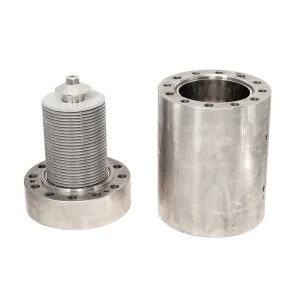
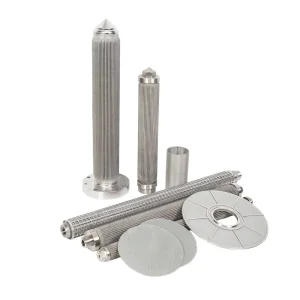
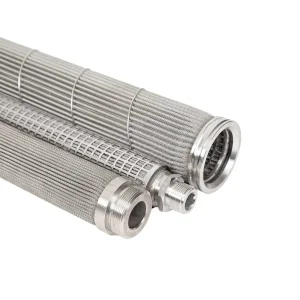
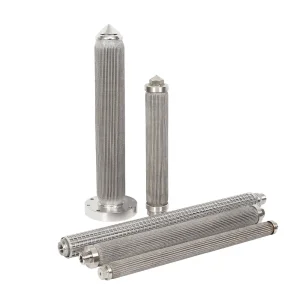
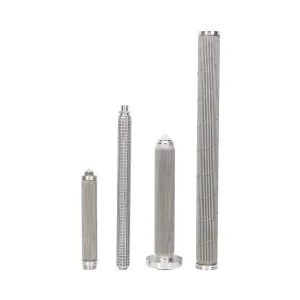
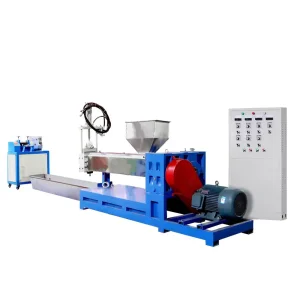
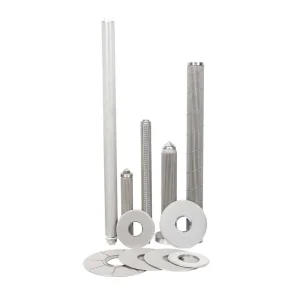
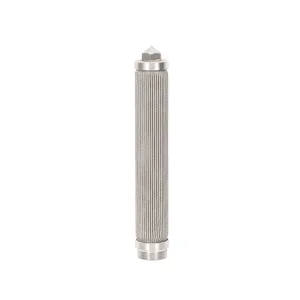
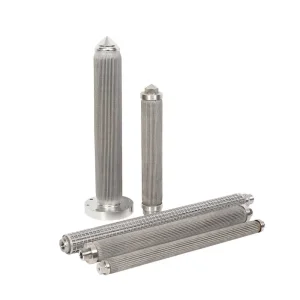
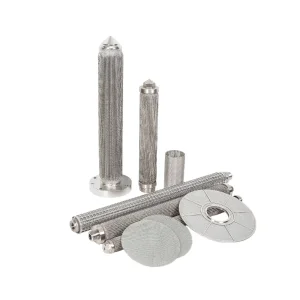
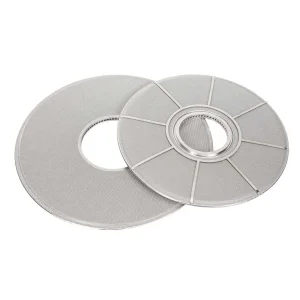
Explore our precision-engineered OEM polymer candle filters, SUS 304/316L filter elements, and custom melt filtration hardware engineered for zero-defect extrusion.
In modern polymer processing—spanning Polyester (PET), Polyamide (PA6/PA66), Polypropylene (PP), Polyethylene (PE), and Polycarbonate (PC)—the melt filtration medium acts as the final defense mechanism against structural defects, spinneret clogging, and film rupture. Operating under extreme continuous parameters (pressures up to 300 bar, temperatures exceeding 350°C, and melt viscosities ranging from 10 to 10,000 Pa·s), an OEM Polymer Filter Medium must maintain structural rigidity while delivering micro-level dirt holding capacity (DHC).
Manufactured by non-woven laying and high-temperature vacuum sintering of microscopic stainless steel fibers (down to 2μm in diameter). Provides up to 85% 3D gradient porosity, giving ultra-low initial differential pressure ($\Delta P$) and exceptional gel capture efficiency.
Diffusion-bonded combinations of woven square mesh, Dutch weave cloth, and protective reinforcement layers. Offers precise pore geometric integrity, zero fiber migration risk, and absolute rating control under high-shear flow conditions.
Engineered via isothermal compaction and sintering of spherical SS 316L or Hastelloy powders. Delivers rigid pore architecture for extreme differential pressure resistance (burst strength >210 bar) and high chemical resistance.
The global filtration medium market is undergoing structural technological shifts driven by decarbonization mandates, the rise of circular post-consumer recycled (PCR) plastics, and the relentless demand for thinner, high-strength packaging films.
Global sustainability mandates require polymer processors to incorporate 30% to 100% PCR content into packaging and textile filaments. Recycled melt streams contain complex organic gels, paper residues, and inorganic cross-contaminants. Consequently, procurement is shifting toward hybrid multi-layer sintered filter media that combine high-capacity outer fiber felts with ultra-durable inner woven meshes capable of enduring frequent hydraulic backwashing.
With the rapid expansion of EV lithium-ion battery wet separator film (PE/PP) production and 8K display optical BOPET films, microscopic hard particles or soft deformable gels can cause catastrophic pinholes and web tears. Advanced OEM polymer filter mediums now feature gradient micro-porous structures capable of retaining deformable gels under shear rates exceeding $1,000 \text{ s}^{-1}$.
Plant downtime on continuous polymerization and high-capacity polyolefin extrusion lines costs upwards of $50,000 per hour. Modern filter media geometry—specifically pleated candle elements and leaf disc filters—is designed to maximize active surface area per housing volume ratio (up to $0.5 \text{ m}^2$ per candle element), extending continuous on-stream operational cycles from 30 days to over 180 days.
Industrial buyers are rejecting single-use filter media in favor of fully cleanable SUS 316L sintered media. OEM media engineered with high metallurgy purity can withstand over 20-30 pyrolysis/TEG (Triethylene Glycol) boiling and ultrasonic cleaning cycles without suffering structural pore collapse or grain-boundary oxidation.
Through intent mining across global engineering design firms (EPCs) and polymer manufacturing conglomerates, procurement criteria have evolved from basic price-per-unit metrics to total cost of ownership (TCO) and risk mitigation.
| Filter Medium Type | Primary Structure | Filtration Precision | Gel Retention | Delta P ($\Delta P$) Profile | Recommended OEM Application |
|---|---|---|---|---|---|
| Sintered Metal Fiber Felt | Random non-woven micro-fibers | 3.0μm – 60μm absolute | Superior (3D matrix depth capture) | Ultra-Low Initial / Linear Rise | Optical BOPET, BOPA, High-Purity Synthetic Spun Filament |
| 5-Layer Sintered Wire Mesh | Diffusion-bonded square & Dutch mesh | 5.0μm – 200μm geometric | Moderate (Surface retention) | Low Initial / Steeper Rise | Rigid Plastic Extrusion, Masterbatch Granulation |
| Sintered Powder Metal | Compacted spherical metal particles | 1.0μm – 25μm rigid pore | High (Surface/bridging) | Moderate Initial / Rigid Curve | High-Pressure Gas & Monomer Reactor Defense |
| Multi-Layer Woven Wire Cloth | Layered plain/twilled weaves | 20μm – 500μm coarse | Low (Particulate only) | Minimal Initial Drop | PCR Recycling Extrusion, Coarse Pelletizing Screen Changers |
Procurement directors inspect joint integrity rigorously. OEM elements featuring knife-edge metallic seals or precision-machined SUS316L tapered seats eliminate polymer bypass under 250 bar hydraulic pressure.
Continuous pressure pulsations from gear pumps cause micro-flexing. High-tier filter media integrate heavy inner perforated cores and outer protective cages to prevent pleat collapsing and media tearing.
Low-grade stainless steel corrodes under additives like halogenated flame retardants or acidic catalysts. Authentic OEM media utilize certified low-carbon SUS 316L / Hastelloy C276 to prevent metal ion contamination.
As the global manufacturing landscape faces geopolitical shifts, China's industrial equipment hubs—particularly the Zhejiang manufacturing cluster led by specialized entities such as Pujiang HG Plastic Machinery—have transitioned into high-tech, Industry 4.0 smart manufacturing centers.
Computer-controlled vacuum sintering furnaces maintain temperature uniformity within $\pm 1^{\circ}\text{C}$ at $1150^{\circ}\text{C}$, ensuring perfect inter-atomic metallization bonding across multi-layer media without melting micro-fibers.
Full 6-axis robotic TIG and fiber-laser longitudinal seam welding guarantees absolute concentricity, zero thermal strain deformation, and pore-free seam integrity across candle length tolerances within $\pm 0.2\text{mm}$.
Every OEM production batch undergoes automated non-destructive bubble point pore testing (ISO 4003) and air permeability testing (ISO 4022) to certify that zero oversized pores exist prior to shipment.
By unifying raw material wire drawing, precision weave manufacturing, vacuum sintering, and robotic assembly within a single localized ecosystem, Chinese manufacturers offer global OEMs up to 40% lead-time reductions and significant cost advantages without sacrificing ISO-certified quality compliance.
Filter medium performance depends heavily on the thermodynamic and rheological context of the application. Below are standard industrial configurations deployed across major production centers worldwide.
Process Challenge: High-speed tentering frames running at 500 m/min require absolute melt cleanliness. A single 10μm gel can cause a web break, costing hours of re-threading downtime.
OEM Solution: High-surface-area leaf disc filter assemblies using 3μm-5μm SUS 316L sintered fiber felt media. The smooth hydraulic profile avoids stagnant melt zones, preventing polymer degradation and thermal carbonization.
Process Challenge: Continuous melt spinning of micro-denier filaments demands uniform pressure distribution across thousands of pack body spinneret holes.
OEM Solution: Pleated candle filter cartridges inserted into Continuous Polymer Filtration (CPF) vessels. Pleated geometry provides 3.5x more surface area than flat cylindrical cartridges, delivering stable low shear stress on the polymer melt.
Process Challenge: Heavy contaminant loading (paper, dirt, aluminum flakes) in recycled PE/PP pelletizing extruders leads to rapid screen blinding.
OEM Solution: Robust 5-layer sintered mesh screen belts and heavy-duty disc filters optimized for continuous hydraulic slide-plate screen changers, handling continuous pressure spikes up to 200 bar.
Process Challenge: High melt temperatures (up to 380°C) combined with abrasive glass fiber reinforcement or corrosive additives.
OEM Solution: Customized nickel-alloy (Hastelloy C-276) or thick-gauge SUS 316L powder-sintered filter cylinders delivering structural rigidity and immunity to chemical attack.
Review our complete OEM series of polymer melt filter cartridges, leaf discs, and recycling processing machinery components.
Expert answers to technical procurement, metallurgical compatibility, structural customization, and operational maintenance questions regarding high-viscosity melt filtration.
Optimize your melt filtration performance, minimize production downtime, and lower unit consumable costs with our ISO-certified filter elements.
Request Technical Specs & OEM Quotation