Explore our top-tier OEM/ODM filtration elements engineered in accordance with ISO 9001 and strict international metallurgical benchmarks.
In high-temperature, high-viscosity, and corrosive fluid processing environments, traditional fiber filters and single-layer woven wire screens frequently fail due to wire migration, media deformation, rapid pore clogging, and structural degradation. Modern industrial filtration has experienced a radical shift toward sintered metal mesh filtration technology. Sintered wire mesh is manufactured by stacking multiple layers of woven stainless steel wire mesh (typically 304, 316L, 310S, or nickel alloys) and bonding them through high-temperature vacuum sintering—a solid-state diffusion process that fuses the wire contact points without melting the physical weave geometric structure.
By controlling the orientation, wire diameter, mesh count, and stacking sequence of individual layers, specialized custom sintered metal mesh filter factories craft porous metal media with precise porosity, uniform pore size distribution, superior mechanical strength, and exceptional corrosion resistance. Unlike single-layer wire screens, sintered multi-layer metal mesh functions as a rigid porous matrix capable of handling differential pressure (ΔP) up to 210–250 bar without dimensional displacement or pore size enlargement.
Vacuum diffusion bonding fuses metallic lattices at contact nodes. This eliminates wire displacement under hydrodynamic shear stresses and prevents particle bypass in ultra-clean polymer lines.
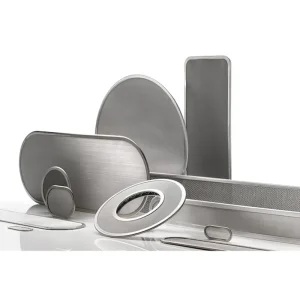
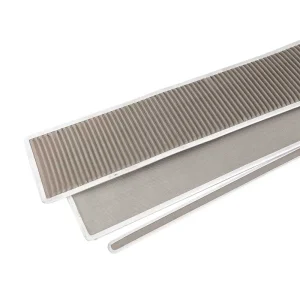
Engineered multi-layer configurations combine protective outer meshes, fine control filtration layers, and heavy structural drainage bases, creating a multi-stage depth filtration mechanism within a single sintered sheet.
Sintered metal media withstand aggressive thermal pyrolysis, chemical acid/alkali washing, and high-frequency ultrasonic cleaning, providing thousands of operational hours with near-zero media replacement cost.
During the sintering furnace process (operated at temperatures reaching 1,100°C to 1,250°C under high-vacuum pressure of 10-3 to 10-5 Pa), chromium and nickel atoms diffuse across wire boundaries. This micro-structural grain growth bridges individual wire layers into a monolithic porous body while preserving void fraction ratios between 35% and 65%.
As multinational chemical process industries, polymer synthesis conglomerates, and clean energy developers scale up operational efficiency, procurement strategies for critical process components have shifted from short-term CapEx minimizing to long-term Total Cost of Ownership (TCO) optimization. Unexpected line shutdowns on a continuous PET/BOPET film extrusion line or a spunbond nonwoven fiber facility can incur revenue losses exceeding $50,000 to $150,000 per hour. Consequently, global buyers demand filter elements with deterministic performance metrics, absolute micron ratings, and zero structural defect rates.
The global push for PCR (Post-Consumer Recycled) and PIR (Post-Industrial Recycled) plastics (ABS, PE, PP, PET, PS) introduces complex, abrasive contaminants into extruders—such as degraded gel particles, paper fibers, aluminum foils, and cross-linked polymers. Standard wire mesh fails rapidly under heavy dirt loading. Sintered metal wire mesh and pleated candle filter elements provide the deep void space and high shear resistance necessary to maintain stable melt pressure, enabling recyclers to produce virgin-grade pellets.
In green hydrogen production, Proton Exchange Membrane (PEM) electrolyzers and Alkaline Electrolyzer units rely on micro-porous sintered metal transport layers (PTL) and stainless steel sintered wire mesh filter discs to facilitate gas-liquid separation (H₂/O₂ degassing from KOH electrolyte or deionized water) under elevated temperature and differential pressures. Custom pore distribution engineering directly influences current density and stack operating efficiency.
Below is the engineering structure profile for standard 5-layer sintered metal mesh manufactured by specialized exporter factories:
| Layer Index | Primary Layer Function | Standard Mesh Count | Wire Diameter Nominal | Structural Role |
|---|---|---|---|---|
| Layer 1 (Top) | Protective Layer | 18 × 18 mesh to 60 × 60 mesh | 0.22 mm – 0.40 mm | Mechanical impact shield against coarse debris & turbulence |
| Layer 2 (Core) | Control / Precision Filter Layer | 100 × 100 mesh to 635 × 635 mesh | 0.02 mm – 0.08 mm | Determines absolute micron rating (1 μm – 100 μm) |
| Layer 3 | Dispersion & Flow Buffer Layer | 100 × 100 mesh to 200 × 200 mesh | 0.05 mm – 0.10 mm | Uniformly distributes fluid flow velocity across filter area |
| Layer 4 | Support Drainage Layer | 12 × 12 mesh to 40 × 40 mesh | 0.40 mm – 0.70 mm | Prevents compaction of fine control layer under pressure |
| Layer 5 (Base) | Heavy Reinforcement Frame Layer | 8 × 8 mesh to 20 × 20 mesh | 0.70 mm – 1.20 mm | Imparts high flexural modulus and structural rigidity |
China has evolved into the world's most complete manufacturing ecosystem for sintered porous metal media. Modern Chinese sintered metal mesh factories (such as Pujiang HG Plastic Machinery Co., Ltd. and industrial metallurgy clusters in Zhejiang, Jiangsu, and Hebei) combine high-precision wire weaving, high-vacuum sintering, automated laser welding, and rigorous quality testing.
From ultra-fine stainless wire drawing and annealing to custom weaving, sintering, and machining, end-to-end control eliminates raw material bottlenecks and reduces production turnaround times by up to 40% compared to Western suppliers.
Exporting factories enforce strict compliance with ISO 4003 (Bubble Point Testing for porous metals), ISO 2942, and ISO 16889. Automated optical inspection (AOI) guarantees zero mesh count anomalies and flawless laser-welded seams.
Advanced automated pleating, CNC hub turning, and robotic TIG/plasma welding deliver OEM drop-in replacement filter elements at 30% to 50% lower capital outlay without compromising metallurgical integrity.
In BOPET (Biaxially-oriented Polyester) and BOPP packaging film production, polymer melt is pumped at pressures exceeding 200 bar and temperatures above 280°C. Organic gels, carbonized black spots, and foreign particulate matter must be removed down to 5 μm to avoid film web breakages during high-speed transverse stretching.
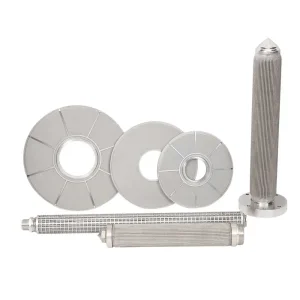
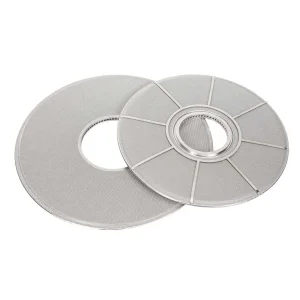
Custom Solution: Segmented Sintered Leaf Disc Filters (rigid center hub design with inner/outer sealing rings) and pleated candle cartridges. Using 316L sintered metal fiber felt combined with outer protective sintered wire mesh allows for high porosity (up to 75-80%), extending continuous run time from 15 days to over 45 days per shift.
Polypropylene (PP) spunbond nonwoven lines and Polyester (PET) continuous yarn spinning machines require ultrafine melt filtration upstream of spinneret packs. Any clogging of the spinneret micro-holes leads to broken filaments and nonwoven weight variance.
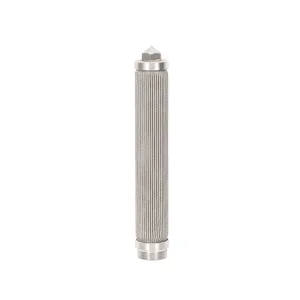
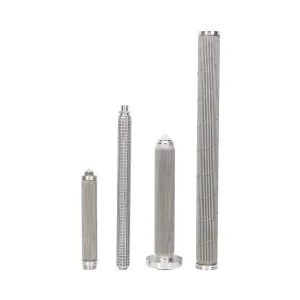
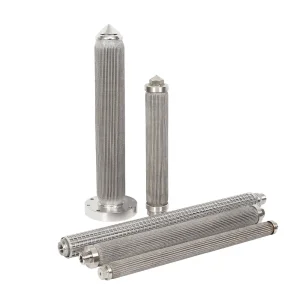
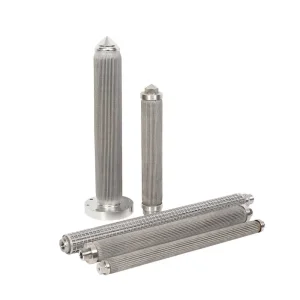
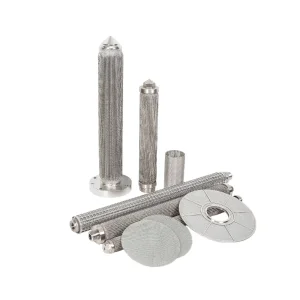
Custom Solution: Pleated SUS 304/316L Candle Filter Elements engineered with high surface area corrugation. Pleating multiplies the available filtration area by 300% to 500% compared to cylindrical candles of equivalent outer diameter, reducing initial differential pressure (ΔP) and extending pack lifespan.
In fluid catalytic cracking (FCC) units, hydrocracking, and chemical synthesis reactors, valuable noble metal catalysts (platinum, palladium, nickel) must be retained and recovered from liquid slurry streams under corrosive and elevated thermal conditions.
Custom Solution: Heavy-duty, backwashable cylindrical sintered metal mesh filters fabricated from Hastelloy C-276, 310S, or Inconel 600. The reverse pulsed gas or fluid flow dislodges filter cakes efficiently without structural fatigue of the metal matrix.
Selecting the appropriate custom sintered wire mesh filter requires balancing multiple fluid dynamic and metallurgical parameters. Engineers and procurement officers should evaluate the following criteria before finalizing manufacturing specifications:
High-viscosity liquids (e.g., polymer melts with viscosity of 1,000 to 10,000 Pa·s) create rapid pressure drops. Engineers must calculate face velocity and select larger surface area geometries (pleated candles or stacked leaf discs) to keep face velocity below 0.01 – 0.05 cm/s, preventing gel extrusion through the pores.
Sintered Wire Mesh: Highest structural strength, precise pore geometry, easy to clean.
Sintered Fiber Felt: High dirt holding capacity, high porosity (~80%), ideal for fine filtration.
Sintered Powder Metal: Thick wall depth filter, robust against thermal shock, higher flow resistance.
To maximize ROI, exported sintered metal filters should be cleaned using a validated 4-step regeneration sequence: (1) Thermal pyrolysis or TEG solvent bath to breakdown organic polymer residues; (2) Alkaline chemical immersion; (3) Ultrasonic bath agitation in deionized water; (4) High-pressure air/water backflushing followed by bubble point integrity re-certification.
Woven wire mesh consists of un-bonded intersecting wires that can shift under physical pressure, fluid shear, or vibration, altering the effective micron size. Sintered wire mesh undergoes high-vacuum diffusion bonding, permanently fusing wire contact points. This creates a rigid, non-deformable matrix with permanent pore dimensions, higher mechanical strength, and zero wire shedding.
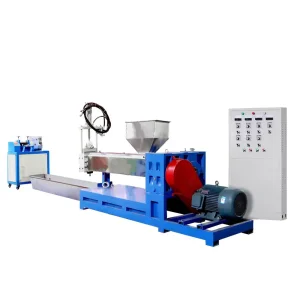
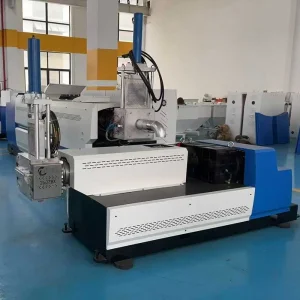
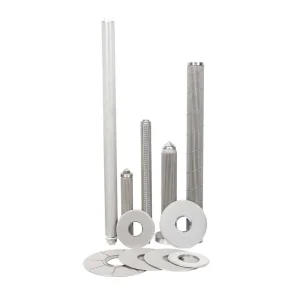
Explore further specialized filter cartridges, leaf discs, screen mesh packs, and high-efficiency plastic granulating machinery.