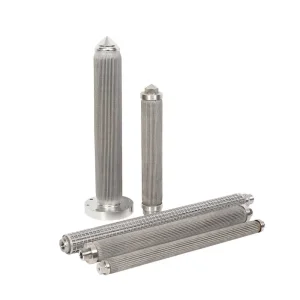
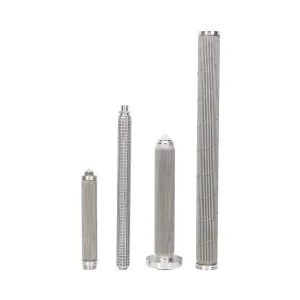
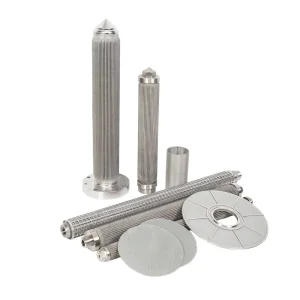
Explore our primary range of custom-engineered polymer candle filter elements, screen mesh assemblies, and recycling granulating machinery built for extreme temperature and differential pressure environments.
In modern synthetic fiber extrusion, nonwoven web formation, and polymer film casting, the structural integrity of the polymer melt stream dictates end-product viability. A standard modern high-speed spin pack operates at thermal boundaries ranging from 260°C to 340°C and hydrostatic pressures up to 35 MPa. Within this hyper-demanding physical domain, the role of a precision spinning filter transitions from simple mechanical straining to critical fluid rheology management.
The global demand for high-performance spinning filters is governed by the rapid expansion of micro-denier synthetic yarn (Polyester PET, Polyamide PA6/PA66, Polypropylene PP, Spandex, and Acrylic) alongside technical nonwovens used in medical filtration, automotive substrates, and geotextiles. As spinneret capillary diameters shrink down to 0.15 mm–0.30 mm, even microscopic particulate contaminants—such as cross-linked degraded gels, un-melted catalyst residues, titanium dioxide ($TiO_2$) delustrant agglomerates, and metallic shear flakes—cause immediate filament breakage ("spinneret drips" or "spinning breaks").
Consequently, global manufacturing plants require custom spinning filter media capable of capturing sub-micron particulate matters without generating unmanageable differential pressure drops ($\Delta P$) or inducing premature shear degradation of sensitive polymer chains.
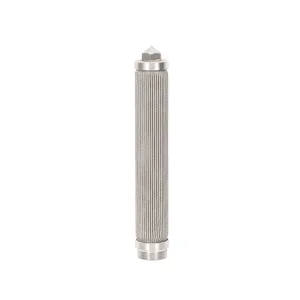
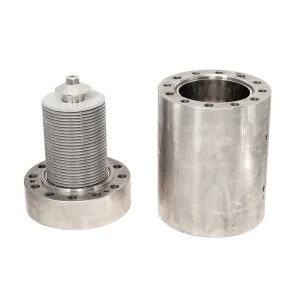
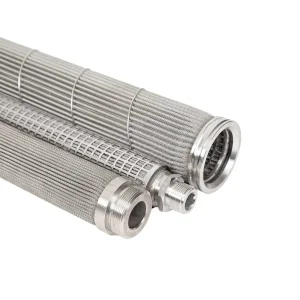
An optimized spinning filter cartridge or pack visualizes multi-layer depth filtration physics. The engineering objective is to maximize the active surface area while ensuring a gradual, depth-graded pore size gradient from the outer upstream protective layer to the inner downstream fine-filtration layer.
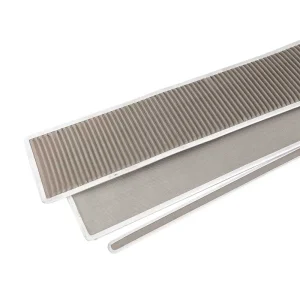
Choice of filter media dictates operational longevity and gel retention dynamics. The three primary structural geometries engineered in custom Chinese export facilities are:
Constructed by non-woven laying of microscopic stainless steel fibers (typically 316L grade with diameters ranging from 2 to 25 microns) followed by high-vacuum sintering. Sintered felt exhibits up to 80-85% open porosity, offering 3x to 5x lower initial pressure drop and significantly higher dirt-holding capacity compared to woven wire mesh.
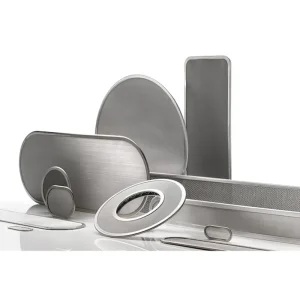
Composed of precision-woven stainless steel wire mesh (Square weave, Plain Dutch weave, or Twilled Dutch weave) diffusion-bonded together. Wire mesh offers rigid pore geometry, precise micron cutoff thresholds (down to 5 microns), and high mechanical stability under severe reverse flow impulse during TEG cleaning.
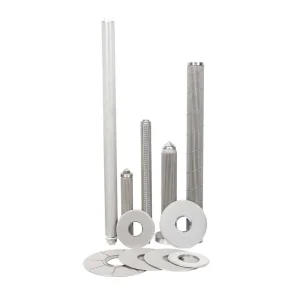
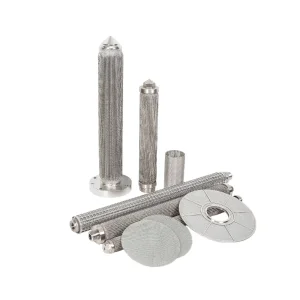
Utilized in continuous polymer filter housings (CPF), leaf discs consist of double-sided filter plates mounted on a central perforated core hub. They deliver maximum square meters of filtration surface per unit volume of housing, minimizing polymer dwell time and reducing thermal degradation risks.
| Filter Media Type | Structural Composition | Porosity Range | Typical Micron Rating | Gel Trapping Capacity | Thermal Cleanability |
|---|---|---|---|---|---|
| Sintered Metal Fiber Felt | Random non-woven SS 316L micro-fibers | 75% - 85% | 3 μm - 60 μm | Exceptional (Depth Retention) | High (Up to 15 cycles) |
| Multi-Layer Sintered Mesh | Laminated Dutch weave wire cloth | 35% - 50% | 5 μm - 150 μm | Moderate (Surface Layer) | Outstanding (Rigid Structure) |
| Pleated Metal Candle Elements | Accordion-pleated sintered felt / mesh | 70% - 80% | 5 μm - 100 μm | High (Maximum Area) | High (Requires delicate TEG) |
| Sintered Metal Powder Media | Porous spherical SS 316L / Alloy 20 | 40% - 55% | 0.5 μm - 20 μm | Extreme (Sub-micron capture) | Moderate (High risk of pore blinding) |
The international supply chain for polymer filtration equipment has shifted dramatically toward specialized Chinese manufacturing clusters, specifically in Zhejiang and Jiangsu provinces. Leading Chinese factories, such as Pujiang HG Plastic Machinery Co., Ltd., have synthesized decades of metallurgical research with state-of-the-art automated manufacturing ecosystems.
Modern Chinese facilities operate high-capacity, multi-zone vacuum sintering furnaces capable of maintaining temperatures up to 1350°C at extreme vacuum levels ($10^{-3}$ Pa). This guarantees absolute metallurgical bonding across stainless steel wire strands without surface oxidation or carbon contamination.
By integrating wire drawing, mesh weaving, powder metallurgy, micro-laser welding, and precision CNC end-cap machining under a single roof, Chinese manufacturers eliminate intermediate supplier markups, achieving a 25% to 40% cost reduction relative to European competitors.
Custom engineered filter element prototypes—whether featuring proprietary threading like M28x1.5, specialized NPT connections, or unique flange geometry—can be designed, CAD-modeled, sample-welded, and bubble-point verified within 7 to 10 working days.
Precision spinning filters perform targeted roles depending on the fluid dynamics and chemical nature of the polymer matrix. Below are the primary industrial environments where custom spinning candle filters and leaf discs are mandatory:
In high-speed polyester or polyamide filament extrusion spinning at speeds up to 6,000 m/min, minor fluctuations in melt homogeneity or gel presence cause filament breakages. Candle filters with 15μm-25μm sintered felt elements installed inside the spin pack cavity prevent capillary blockage, extending spin pack operational life from 15 days to over 45 days.
Wide-width polypropylene nonwoven production beams require uniform pressure distribution across thousands of micro-nozzles. Continuous leaf disc filter changers equipped with SUS316L wire mesh strain out carbonized gel particles before the melt enters the coat-hanger die, avoiding pinholes in thin hygiene substrates.
Biaxially oriented film lines producing ultra-thin capacitor films or display screen protectors demand absolute zero contamination. Sintered metal felt candle elements rated at 3μm–5μm remove sub-micron gels, ensuring optical transparency and zero dielectric break-down spots.
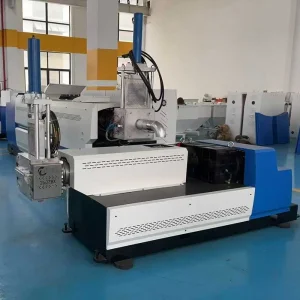
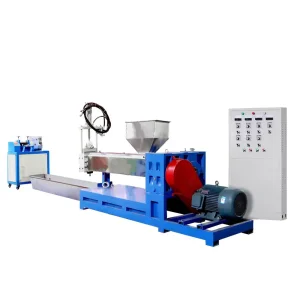
Recycled PET bottle flake melt contains non-melting contaminants (paper ash, PVC traces, aluminum dust). Heavy-duty multi-layer stainless steel extruder screen mesh and continuous hydraulic dual-bolt screen changers provide stable throughput and prevent extruder screw back-pressure spikes.
The continuous push toward sustainability, energy reduction, and smart manufacturing is driving significant innovations within the spinning filter sector:
Application of low-surface-energy ceramic and titanium nitride (TiN) nanocoatings via Physical Vapor Deposition (PVD) onto sintered fibers. This innovation reduces polymer melt shear adhesion, lowering differential pressure build-up rates by up to 20%.
Post-consumer recycled PET resins carry erratic viscosity shifts and high gel counts. Next-generation candle filter cartridges feature gradient density structures (coarse outer pre-filter layer integrated into a fine inner sintered felt) designed specifically to handle volatile recycled feeds.
Enhancements in micro-argon arc welding and end-cap structural geometry allow modern filter elements to survive over 20 consecutive chemical burn-off (TEG calcination) and high-frequency ultrasonic washing cycles without mesh seam fatigue.
For global sourcing managers and plant technical directors, selecting a reliable Custom Spinning Filter Factory requires rigorous evaluation beyond initial unit pricing. The following technical audit checklist should guide RFQ processes:
Ensure the supplier provides Spectro-chemical Mill Test Certificates (MTC) according to EN 10204 3.1 for all stainless steel alloys (SUS304, SUS316L, Hastelloy C-276). Verify low carbon content (<0.03%) to prevent intergranular corrosion during thermal cleaning.
Confirm that the manufacturer tests filter cartridges using ISO 4003 (Permeable sintered metal materials — Determination of bubble test pore size) and ISO 2942 (Fluid power filter elements — Verification of fabrication integrity).
Verify structural resistance to differential collapse pressure under maximum thermal load. Standard candle filter cores must sustain minimum 10 MPa to 21 MPa differential pressure without radial deformation or inner core crush.
Calculate cost based on element operational lifetime, reusability rate, and frequency of spinneret replacement. A premium sintered felt element that extends pack life by 30% delivers a 10x ROI compared to a cheaper, low-quality screen mesh.
Detailed technical answers compiled by our senior metallurgical engineers to resolve common industrial polymer filtration challenges:
Browse our full range of wholesale SUS 304/316 polymer melt filter elements, CPF candle assemblies, extruder screens, and recycling machinery.