Explore our primary array of high-tensile stainless steel candle filter elements, vacuum sintered assemblies, and integrated reprocessing machinery engineered for uninterrupted high-temperature processing.
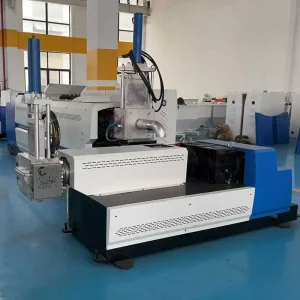
OEM Plastic Recycling Machine Supplier - Granulating Equipment
View Specifications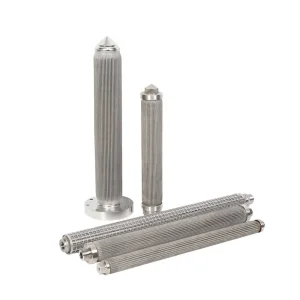
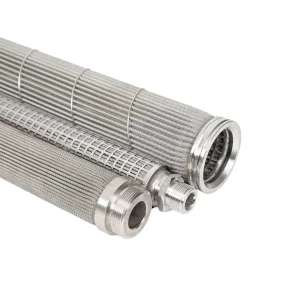
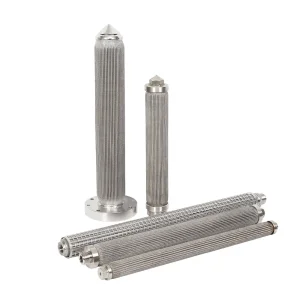
Wholesale Polymer Melt Filter Elements SUS 304 Leading Solutions
View Specifications
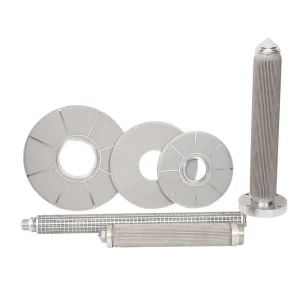
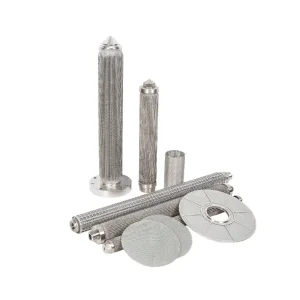
In high-temperature, high-viscosity extrusion, the stainless steel wire filter serves as the definitive thermal and mechanical barrier against un-melted gels, carbon specks, metal flaking, and degraded cross-linked aggregates. Pujiang HG Plastic Machinery bridges deep metallurgical science with fluid mechanical predictability.
Rigid inner perforated cores resist catastrophic collapse under extreme delta P conditions.
Thermostable alloys (SUS 316L, 310S, Hastelloy) withstand prolonged thermal cracking and pyrolysis cycles.
Multi-tier vacuum sintered wire cloth ensures absolute pore rating stability without pore elongation.
Full compatibility with TEG hydrolysis, vacuum pyrolysis, and high-frequency ultrasonic flush recovery.
Unlike conventional square woven wire mesh that undergoes pore migration under cyclical shear stress, diffusion bonding permanently coalesces micro-wires at every crossing node inside high-vacuum furnaces (10-3 Pa at 1150°C). This guarantees immutable geometric pore stability, preventing blowouts during pressure spikes up to 250 bar.
Constructed typically in five calibrated strata: protective outer screen, precise retention barrier, drainage buffer, and double coarse structural foundations that optimize fluid shear dispersion.
For ultra-fine continuous yarn and microdenier chemical fiber spinning, sintered metal fiber web delivers up to 85% void volume porosity—nearly three times higher than planar wire cloth. This dramatic surface area expansion decelerates melt entrance velocity, yielding flat differential pressure accumulation over prolonged run campaigns.
Offers extraordinary dirt-holding capacity (DHC) for trapping sub-micron carbonized polymer fragments and organometallic catalyst residues without precipitating premature line halts.
By incorporating advanced helical pleating geometry, our pleated candle filter cartridges multiply active functional filtration area up to 400% compared to cylindrical sleeves occupying identical housing diameters. The internal drainage mesh prevents pleat pinching when confronted with high-viscosity resins (MFI < 0.5 g/10min).
Significantly trims unit pressure drop (ΔP), diminishes energy consumption on upstream gear pump drives, and mitigates polymer degradation stemming from localized residence time hotspots.
From extreme-tensile biaxially oriented packaging substrates to post-consumer circular plastics, our stainless steel wire filtration architectures are custom-tailored to resolve application-specific melt rheology hurdles.
Operational Context: In longitudinal and transverse mechanical stretching of optical and condenser film (2 μm to 12 μm thickness), a single micro-gel exceeding 10 microns causes immediate web breakage, sparking downtime losses scaling above $10,000 per hour.
The Engineering Solution: HG sintered disc filters (leaf discs) and multi-candle assemblies deploy SUS 316L sintered metal fiber media with calibrated 10 μm to 20 μm absolute ratings. Flat micro-disc topologies eliminate stagnant dead zones, minimizing polymer degradation over continuous 60-day operational runs.
Operational Context: Microdenier filaments extruded through spinnerets featuring thousands of capillary holes (diameters < 0.15 mm) suffer immediate clogging from particulate contamination, provoking yarn unevenness, filament flutter, and uneven dye absorption.
The Engineering Solution: Pleated stainless steel wire candle filters integrated upstream of the spin pack offer maximal filtration surface within compact envelopes. Gradient density multi-layered mesh acts as a depth strainer, trapping micro-fines while maintaining stable inlet pressure to the metering pumps.
Operational Context: Processing rPET bottle flakes, agricultural rPE, and post-industrial PP weaves introduces high-load contaminants: paper labels, sand, wood cellulose, aluminum foil remnants, and crosslinked carbon specks.
The Engineering Solution: Reinforced multi-layer spot-welded mesh packs, continuous auto-screen belt filters, and robust coarse-to-fine candle cartridges fabricated with thick wire diameters. Withstands dynamic back-flushing cycles and mechanical stresses during continuous screen changers.
Operational Context: Corrosive hydrocarbon streams, high-temperature gas cleanup, and polyolefin monomer synthesis subject filtration elements to aggressive acids, chlorides, and thermal shock cycles up to 450°C.
The Engineering Solution: Specialty metallurgy using SUS 310S, 904L, and Hastelloy C-276. Complete absence of elastomeric or epoxy adhesives—all joints are robotically TIG fused or vacuum brazed to guarantee absolute structural integrity and zero chemical leachates.
Pujiang HG Plastic Machinery Co., Ltd. capitalizes on an integrated industrial cluster in Zhejiang, China. From raw austenitic stainless steel drawing to state-of-the-art vacuum sintering furnaces, we ensure end-to-end traceability, drastic lead-time reduction, and 30-50% TCO savings.
| Evaluation Parameter | Pujiang HG Plastic Machinery (China Direct) | European / US Legacy Manufacturers | General Trading Intermediaries |
|---|---|---|---|
| Material Traceability | Certified prime 304/316L/310S heats with spectral analysis (PMI) verified per batch | Compliant, but subject to protracted ingot lead times | Often unverified secondary re-melt scrap; high risk of corrosion |
| Custom Tooling & Prototyping | 7–10 days with in-house CNC lathe, wire EDM, and dedicated laser slicing | 6–10 weeks accompanied by high engineering surcharge fees | Brokered to third-party workshops without tight QA controls |
| Production Lead Times | 15–25 working days for high-volume custom pleated candle elements | 12–18 weeks due to decoupled tier-2 component supply chains | Unpredictable delays; lack of scheduled factory floor ownership |
| Vacuum Sintering Standards | Continuous computer-controlled high-vacuum furnace (10-3 Pa, 1150°C) | High standard, fully automated | Atmospheric conveyor belt sintering; oxidation and brittleness risks |
| Total Cost of Ownership (TCO) | High competitive cost advantage via direct raw ingot access & integrated automation | High premium factoring in regional overhead, labor and corporate branding | Compounded margins with zero post-sales engineering accountability |
HG governs each micro-step: precision shuttleless wire weaving, automated micro-corrugation pleating, computer-controlled longitudinal micro-plasma welding, and multi-axis CNC flange machining. No external sub-contracting friction guarantees uncompromised dimensional adherence.
Global plants operating legacy extrusion lines from Western or Japanese builders can provide spent filter samples or housing layout schematics. Our engineers deploy CMM 3D scanning and bubble-point porosity mapping to provide drop-in retrofits that align perfectly with OEM manifolds.
For contracted enterprise purchasers, HG provides regional inventory stocking protocols with standard mesh sizes, pre-formed pleated cartridges, and standardized disc stacks ready for priority international air or express sea freight dispatch within 48 hours.
As circular recycling demands elevate and nanometer-scale barrier films stretch thermal and pressure tolerances, HG is advancing continuous R&D milestones to empower next-generation extrusion lines.
Integration of multi-density non-woven metal fiber structures engineered to capture progressively smaller particulates layer-by-layer, boosting dirt-holding capacity by 45% compared to uniform pore media.
Application of computational fluid dynamics to design custom filter housing manifolds that completely eliminate dead-flow vortex pockets, slashing polymer color-change purge scrap volumes by 60%.
Development of proprietary anti-adhesion atomic ceramic vapor deposition (CVD) coatings on stainless mesh surfaces, preventing resin char adherence and extending cleaning intervals under extreme temperatures.
Closed-loop, zero-emission cleaning centers utilizing advanced vacuum pyrolysis paired with automated high-energy cavitation tanks, recovering used candle filter elements for up to 15 productive re-use cycles.
Every export batch undergoes empirical verification to meet stringent global standards, including ISO 9001:2015, CE Pressure Equipment Directive (PED 2014/68/EU), and FDA food-contact compliancy.
Prior to shipment, filter elements undergo bubble point testing immersed in isopropyl alcohol to verify absolute micron rating, identify any potential micro-crack or seam gap, and certify complete pore aperture uniformity.
Filter media used for food-contact polymer packaging (PET water bottles, PP food containers) is certified non-toxic and compliant with FDA 21 CFR 177.1520 and EU Regulation 1935/2004, with zero heavy metal leaching.
Shipments include Certificate of Conformity (CoC), raw material mill test reports (MTR), dimensional CMM inspection reports, and customized wooden crating treated per ISPM-15 phytosanitary standards for swift customs entry.
Detailed answers to critical engineering, design selection, and total lifecycle considerations asked by chemical engineers, extrusion plant managers, and procurement specialists.
Conventional wire mesh consists of loose warp and weft wires that rely entirely on mechanical tension. Under high polymer melt pressure (150 to 250 bar) and thermal cycling, the wires shift apart ("wire migration"), leading to sudden aperture enlargement and catastrophic particle leakage. In contrast, sintered wire cloth undergoes atomic diffusion bonding in a vacuum furnace, welding every contact point together. This locks the pore geometry immutably, ensuring consistent micron retention, eliminating wire shedding, and permitting aggressive high-pressure backwashing without media distortion.
Leaf disc filters are favored in continuous BOPET, BOPP, and cast film lines where flat streamlined flow channels and uniform polymer residence time are critical to prevent thermal gel formation. The disc geometry minimizes stagnation zones. Conversely, pleated candle filter cartridges are selected when maximum filtration surface area must be packed into a compact housing footprint, such as in synthetic fiber spinning (spundbond, meltblown, staple fiber) or high-volume recycling lines. Pleated candles provide up to 3 to 4 times the surface area of cylindrical candles, substantially prolonging on-stream life between changeovers.
An optimal multi-stage cleaning protocol includes: (1) Thermal Pyrolysis / Vacuum Calcination: Heating the elements in a controlled oxygen-free vacuum oven to 450°C to carbonize residual polymer into ash; (2) Triethylene Glycol (TEG) Hydrolysis: For polyesters (PET) or polyamides (PA), dissolving organic chains at 280°C; (3) Ultrasonic Cleansing: Immersing in high-frequency ultrasonic tanks with mild alkaline solutions to dislodge micro-ash from internal pore cavities; (4) High-Pressure Reverse Flush & Bubble Point Inspection: Washing from inner core to outer layer, followed by an ISO 4003 bubble point test to certify that the element has regained 95%+ of its original clean pressure drop baseline.
We employ precision coordinate measuring machines (CMM) and optical profiling to map critical connection geometries: sealing bevel angles, threaded tie-rod interfaces, locating dowels, and O-ring/metallic gasket seat tolerances (typically machined within ±0.02 mm). By specifying the exact alloy thermal expansion coefficients matching your original manifold, our drop-in elements guarantee zero bypass leakage and zero mechanical binding during high-temperature thermal expansion at 300°C.
SUS 304 is economical and suitable for non-corrosive commodity polyolefins (PP, PE) at temperatures up to 300°C. SUS 316L contains 2-3% Molybdenum and extra-low carbon, providing superior resistance against organic acids, additives, and halogenated traces present in engineering plastics and rPET. SUS 310S contains high Chromium and Nickel, engineered for sustained oxidation resistance up to 480°C during harsh pyrolysis cleaning. Hastelloy C-276 is deployed for high-chloride or aggressive chemical recovery processes where pitting corrosion would compromise stainless steel webs within weeks.
Discover our secondary portfolio of high-precision leaf disc elements, extruder mesh screen packs, and specialized filtration components manufactured to exact plant tolerances.
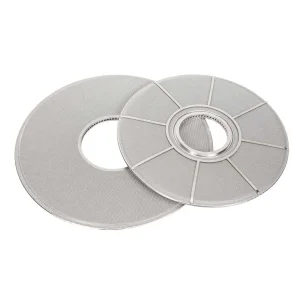
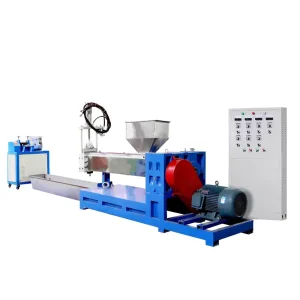
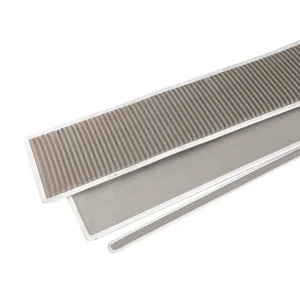
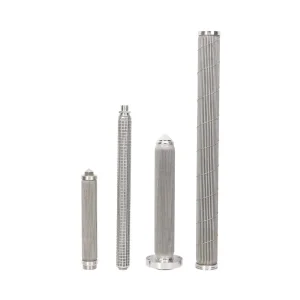
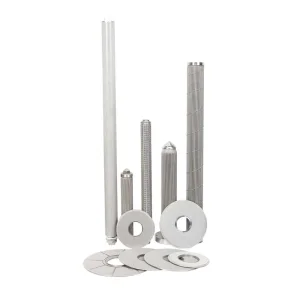
Custom High-Quality Polymer Candle Filter for Viscous Filtration
View Specifications
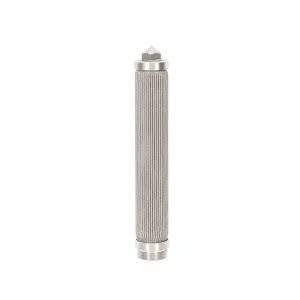
Submit your polymer specifications, throughput (kg/h), target micron rating, and existing housing drawings. Our technical filtration engineers will provide a customized media proposal and free sample prototype plan within 48 hours.