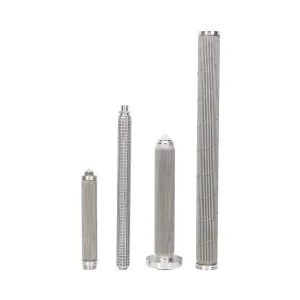
Explore our core engineered filter element series designed for melt polymer processing, extrusion lines, chemical fibers, and plastic recycling.
In modern continuous polymer processing, chemical fiber spinning, film blowing, and petrochemical synthesis, high-grade filtration elements serve as the critical line of defense against particulate contamination, gel formation, degrade agglomerates, and operational downtime. The financial performance of a multi-million-dollar extrusion line or continuous polymer melt plant hinges on the structural integrity, dirt-holding capacity, shear stress profile, and thermal resistance of its stainless steel filter elements.
Global procurement teams and process engineers face unprecedented challenges: rising energy costs, aggressive post-consumer recycled (PCR) resin purity targets, high differential pressures ($\Delta P$ up to 250 bar), and temperatures exceeding 350°C. Selecting verified, direct-from-factory filtration elements suppliers and factories is no longer merely a purchasing decision—it is a core operational risk mitigation strategy.
Engineered micro-porous metal felt and sintered wire cloth remove sub-micron hard contaminants and high-viscosity gels without causing premature pressure spikes across the filter bed.
Multi-layer gradient pore structures distribute contaminant load uniformly across the depth of the filter medium, quadrupling runtime between cleaning cycles.
Constructed from high-grade Stainless Steel 304, 316L, and exotic alloys (Hastelloy C-276) capable of withstanding corrosive solvents, organic acids, and high-pressure steam cleaning.
High-performance melt filtration relies on precise metallurgical craftsmanship. Polymer filtration components must maintain dimensional integrity under intense hydraulic forces while providing maximum effective filtration surface area per unit volume.
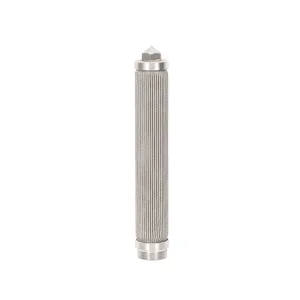
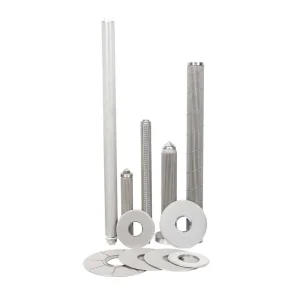
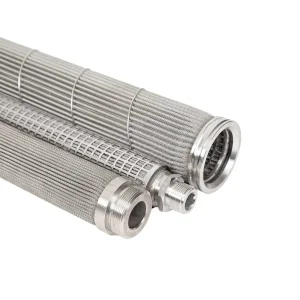
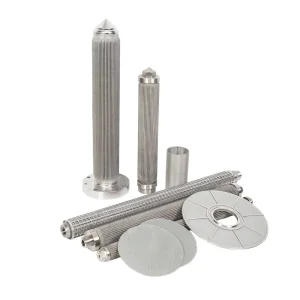
Candle filter elements consist of a perforated inner support core wrapped or sleeved with single or multi-layer stainless steel mesh or sintered metal fiber felt. Available in cylindrical smooth and pleated designs. Pleating increases the active surface area by up to 250% to 400%, dramatically lowering flow velocity per unit area and preserving delicate polymer chain branches from excessive shear degradation.
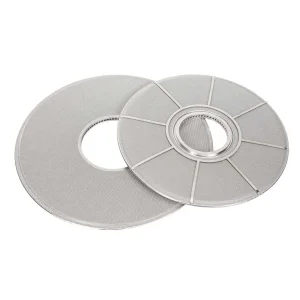
Widely deployed in continuous large-scale BOPP, BOPET, BOPA film lines, and PET resin synthesis plants. Disc filter elements are configured around a central collection hub inside a high-pressure vessel. The outer drainage mesh and internal support core ensure zero deformation during thermal cycling and high-viscosity fluid flow.
| Specification Metric | Sintered Metal Fiber Felt | Multi-Layer Sintered Wire Mesh | Square Woven SS Mesh |
|---|---|---|---|
| Porosity Range (%) | 75% – 85% (High dirt capacity) | 35% – 50% (High mechanical strength) | 30% – 45% (Standard surface filtration) |
| Filtration Mechanism | Deep Matrix & Gel Retention | Surface & Precision Layering | Single-Plane Surface Retention |
| Flow Resistance ($\Delta P$) | Ultra-Low initial pressure drop | Moderate initial pressure drop | Low to Moderate |
| Cleanability & Reusability | Excellent (TEG, Hydrolysis, Calcination) | Superior (Ultrasonic & Chemical Flush) | Good (Manual & Ultrasonic Bath) |
| Primary Application | High Viscosity Melt & Chemical Fiber | Polymer Extrusion & Hydraulic Oils | Recycling Extruder Screen Packs |
Over the past two decades, China has evolved from a bulk industrial parts manufacturer into the global epicenter of precision stainless steel filtration engineering. Leading Chinese manufacturers like Pujiang HG Plastic Machinery Co., Ltd. represent the integration of advanced metallurgical science, automated vacuum sintering technology, and agile OEM/ODM manufacturing capability.
From raw wire drawing and weave mesh selection to vacuum sintering furnace heat treating, precision laser welding, bubble-point testing, and cleanroom packaging—100% produced in-house.
Direct sourcing eliminates intermediate trading markups, delivering European-grade filtration precision at 30% to 50% lower Total Cost of Ownership (TCO).
Custom design blueprints converted into finished physical samples within 7–10 working days, backed by dedicated technical support and CAD engineering assistance.
When global B2B buyers search for filtration elements suppliers and factories, their user intent extends far beyond downloading a basic product catalog. Procurement heads, plant operators, and OEM machinery builders require verifiable engineering data to evaluate potential vendor partners against four primary buyer intents:
Buyers need guarantees against catastrophic element failure (mesh migration, seam burst under high differential pressure). Suppliers must provide material heat certificates (EN 10204 3.1), bubble point test reports (ISO 4003), and burst strength certificates (ISO 2941).
Plants frequently replace original OEM elements (e.g., Maag, Nordson, Kreyenborg, Seebach, Fuji Filter) with drop-in replacements. Accurate dimensional tolerances ($\pm 0.1\text{mm}$) and custom thread/flange sealing options are mandatory.
Initial purchase price is evaluated alongside filter cleaning longevity. Elements that withstand 15 to 20 TEG hydrolysis cleaning cycles drastically reduce annual consumable expenditures.
Unplanned shutdowns cost tens of thousands of dollars per hour. Trusted factories maintain safety stock programs, fast-track air freight delivery options, and structured annual blanket orders.
Driven by global circular economy regulations and the rapid expansion of high-performance polymer applications, the melt filtration sector is undergoing significant technological evolution:
The shift toward recycling Post-Consumer Resin (PCR) introduces complex contaminants (paper fiber, aluminum specks, cross-linked polymers). Modern filter elements utilize asymmetric multi-stage gradient media to trap heavy debris without clogging fine downstream mesh layers.
Next-generation ultrafine stainless steel metal fibers (down to 1.5 micron diameter) enable higher porosity levels (>80%) with lower flow resistance, allowing ultra-thin film lines (BOPET optical films) to operate at higher line speeds without gel passage.
Integration of automated screen changers and self-cleaning candle filter housings with smart differential pressure ($\Delta P$) telemetry. This minimizes manual operator intervention and prevents melt flow fluctuations during filter index cycles.
Filtration requirements vary significantly across manufacturing environments. Below is an engineering overview of customized element configurations designed for specific industrial applications:
Operating Environment: Melt temperatures 280°C – 310°C, operating pressure 150 – 200 bar, strict optical purity requirements.
Optimal Element Configuration: Leaf Disc Filter elements with 316L sintered stainless steel fiber felt (10μm to 20μm absolute rating) featuring hard-edge hubs. Guarantees zero gel pinholes on high-clarity packaging and electronic displays.
Operating Environment: Continuous spinning packs (POY, FDY, Spunbond non-woven lines), ultra-high viscosity melt streams.
Optimal Element Configuration: Pleated SUS 304/316L Candle Filter Cartridges. The pleated geometry maximizes surface area, minimizes shear strain on high IV polymers, and prevents filament breakage at the spinneret nozzles.
Operating Environment: Recycled PP/PE waste flakes, agricultural film granulating, variable contamination levels.
Optimal Element Configuration: Heavy-duty spot-welded or rimmed Stainless Steel Extruder Screen Mesh packs and continuous belt screens. Offers economical contaminant retention for high-throughput plastic granulating lines.
Operating Environment: Raw monomer and prepolymer continuous reactor outlets, aggressive chemical fluids.
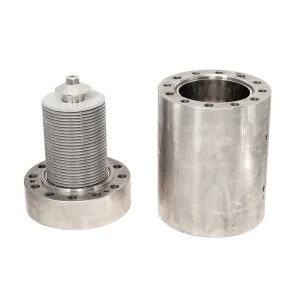
Optimal Element Configuration: High-pressure cylindrical sintered multi-layer wire mesh cartridges with custom Hastelloy C-276 construction for maximum chemical immunity.
To adhere to international quality benchmarks and Google E-E-A-T trust criteria, premium filter element manufacturers enforce stringent laboratory validation protocols prior to dispatch:
Verifies maximum pore size and structural uniformity by immersing elements in isopropyl alcohol and recording the first bubble emergence pressure.
Confirms structural collapse resistance under high differential pressures ($\Delta P$) up to 210 bar, preventing downstream fiber breakdown.
Provides full raw material heat number traceability and chemical composition verification for every lot of SUS304/316L wire and felt.
Get expert answers to technical, procurement, and maintenance questions regarding industrial filtration elements.
Complete product catalog selections available directly from our Zhejiang manufacturing facility.