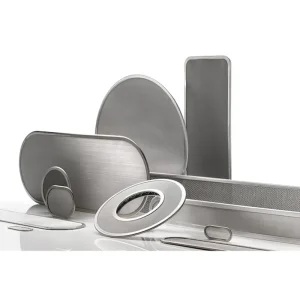
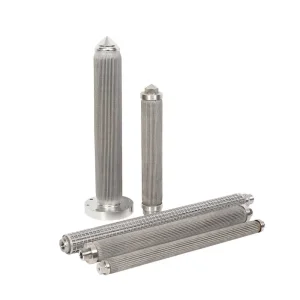
Explore our flagship OEM/ODM stainless steel pleated elements engineered for high-viscosity polymers, nonwoven spinning, and film extrusion lines.
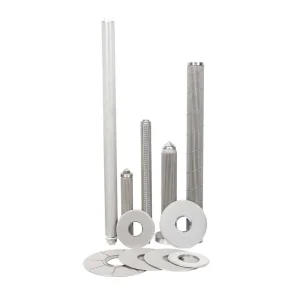
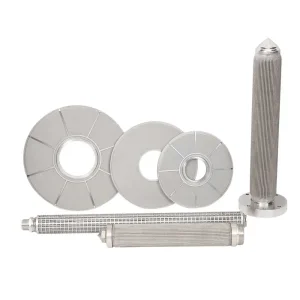
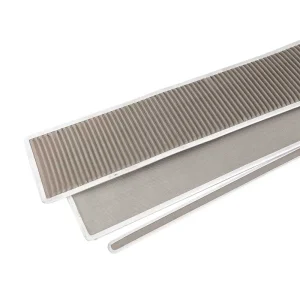
A comprehensive examination of shear stress distribution, pressure drop mechanics, and fluid dynamics in high-viscosity melt filtration environments.
In modern industrial polymer processing—spanning Polyethylene Terephthalate (PET), Polypropylene (PP), Polyamide (PA), and Polycarbonate (PC)—the melt filtration system represents the critical nexus between raw material rheology and end-product mechanical integrity. As polymer melts are extruded under severe pressures (often exceeding 200 to 300 bar) and elevated temperatures (250°C to 340°C), non-homogeneous contaminants such as un-melted gels, degraded black specs, catalyst residues, and metallic particulates pose severe threats to downstream equipment like spinnerets, slit-dies, and orientation rollers.
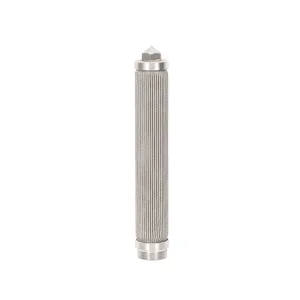
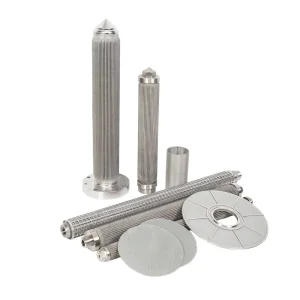
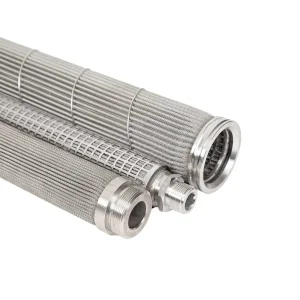
An ODM (Original Design Manufacturer) Polymer Pleated Filter solves these operational challenges by altering the physical geometry of the filter element. Unlike conventional smooth cylindrical candle filters, pleated architecture utilizes precise longitudinal folds of sintered metal fiber felt or multi-layer stainless steel wire mesh around a perforated structural inner core. This geometric modification increases the active filtration surface area per unit envelope volume by 300% to 500%.
According to Darcy's Law for fluid flow through porous media, the differential pressure drop ($\Delta P$) across a filter bed is inversely proportional to the total flow area ($A$):
Where μ represents dynamic viscosity, Q is volumetric flow rate, L is filter layer thickness, k is permeability, and A is total active filtration surface area. By expanding A via specialized pleated designs, an ODM manufacturer lowers ΔP significantly. This minimizes polymer shear degradation, prevents gel extrusion through filter pores, and extends overall filter service life up to fourfold.
Maximizes surface area to keep initial and operational differential pressure drops minimal, reducing power requirements on melt pumps and extruders.
Deep asymmetric pore structures accommodate high mass volumes of hard particulates and deformable micro-gels without premature pore blinding.
Smooth velocity profile across the pleated valleys avoids localized high shear rates that would otherwise shear flexible gel contaminants through the mesh.
Selecting the optimal metallic filtration media structural layout based on polymer melt viscosity, operating thermal profile, and cleanability requirements.
A premier ODM Polymer Pleated Filter manufacturer tailors the internal filter media layout based on specific polymer melt rheology. The two dominant metallic media architectures utilized in industrial continuous polymer filtration (CPF) systems are Sintered Stainless Steel Metal Fiber Felt and Multi-Layer Sintered Woven Wire Mesh.
Produced by lay-down of non-woven micro-denier stainless steel fibers (AISI 316L) subjected to high-temperature vacuum sintering. Creates an 80% to 85% open porosity depth matrix with exceptional dirt-holding capacity for deformable gel particles.
Constructed via precise square or Dutch twill wire weaving. Sintered under high pressure to fuse wire contact points. Delivers sharp absolute micron ratings, rigid aperture stability, and easy ultrasonic/calcination cleaning characteristics.
Combines a coarse wire mesh outer protective layer, an intermediate sintered metal felt depth layer, and a rigid inner mesh drainage core. Provides both depth entrapment and extreme structural burst strength up to 320 bar.
| Performance Parameter | Sintered Metal Fiber Felt | Multi-Layer Wire Mesh | Cylindrical Sintered Mesh | Leaf Disc Filter System |
|---|---|---|---|---|
| Active Filtration Area Ratio | Very High (400% - 500%) | High (300% - 400%) | Baseline (100%) | Very High (Stackable) |
| Porosity Range (%) | 75% – 85% | 35% – 55% | 40% – 50% | 45% – 60% |
| Gel Entrapment Capability | Outstanding (3D Depth) | Moderate (Surface) | Moderate (Surface) | Good (Depth Option) |
| Max Collapse Differential Pressure | 210 – 320 Bar | 250 – 350 Bar | 150 – 250 Bar | 200 – 300 Bar |
| Ultrasonic / TEG Cleanability | Good (Requires TEG/Pyrolysis) | Excellent (Easy Rinse) | Excellent | Excellent |
| On-Stream Service Life Multiplier | 4.0x – 6.0x Standard | 3.0x – 4.5x Standard | 1.0x Baseline | 3.5x – 5.0x Standard |
How Chinese industrial filtration clusters leverage vertical integration, automated precision pleating, and rigorous testing protocols to deliver unmatched global value.
Global engineering procurements across Europe, North America, and Southeast Asia increasingly rely on qualified Chinese ODM manufacturers for critical melt filtration hardware. China's industrial filtration manufacturing ecosystem in Zhejiang and surrounding manufacturing hubs offers distinct technical and structural advantages:
Utilizing high-speed servo-driven pleating equipment capable of maintaining precise pleat height, uniform chevron pitch spacing, and pleat count accuracy. This prevents pleat compression or collapse under high-velocity polymer flow.
Precision longitudinal seam welding and end-cap bonding without the use of adhesives or solders. Clean metallic fusion eliminates polymer entrapment zones and guarantees heat resistance up to 480°C.
In-house quality control equipped with Bubble Point Testers (ASTM F316-03), Scanning Electron Microscopy (SEM), flow permeability rigs, and Spectrometric Alloy Analyzers (ensuring true SUS316L / SUS304 chemical purity).
Analyzing key technology shifts, circular economy demands, bio-polymer integration, and ultra-fine synthetic fiber spinning requirements.
The global shift toward Recycled Polyethylene Terephthalate (rPET) bottle flakes introduces higher levels of micro-contaminants, aluminum specs, and degraded gels. ODM pleated filters provide the deep dirt-holding capacity required to keep rPET melt lines running continuously without rapid pressure spikes.
Biodegradable polymers possess narrower thermal processing windows and tend to degrade rapidly under prolonged residence times. Custom low-internal-volume pleated filters reduce polymer residence time inside filter housings, preventing thermal yellowing and chain scission.
Production of micro-denier hygiene nonwovens and medical barrier fabrics requires ultra-fine filtration down to 5μm absolute. High-density 316L fiber felt pleated candles protect fine spinneret capillaries against clogging, guaranteeing continuous yarn spinning.
Specific engineering configurations engineered for major industrial manufacturing sectors.
Operating Challenge: Fisheyes, pinholes, and optical distortion caused by hard particulates and gels larger than 10 microns.
ODM Solution: Asymmetric 316L sintered metal felt pleated candle filter elements rated at 3μm–5μm absolute filtration, installed in high-capacity continuous polymer filter (CPF) housings.
Operating Challenge: Filament breakage ("drips" and "ropes") leading to costly production downtime on continuous web-forming lines.
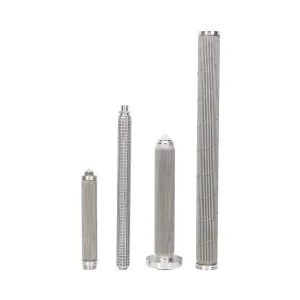
ODM Solution: Custom-length (1000mm to 1500mm) pleated candle filter cartridges with reinforced inner mesh cores to withstand melt pump pressure fluctuations.
Operating Challenge: Frequent screen pack changes caused by heavy contamination in post-industrial and post-consumer PE/PP scrap.
ODM Solution: Heavy-duty stainless steel pleated filter elements integrated into duplex hydraulic screen changers, quadrupling run times between backwashing cycles.
Integrating ODM pleated candle filters into dual-vessel continuous filtration systems for seamless, uninterrupted plant operations.
In large-scale chemical resin synthesis plants (producing up to 50 tons of polymer resin per hour), system downtime for filter element replacement is economically unacceptable. Macro industrial engineering relies on Duplex Vessel Continuous Polymer Filtration (CPF) Systems.
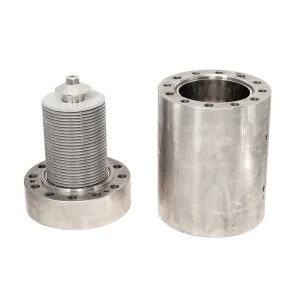
In a CPF setup, two identical stainless steel pressure vessels—each containing a cluster of 6 to 61 pleated candle filter elements mounted onto a central distribution collector plate—operate in parallel. When differential pressure across the active vessel reaches the set terminal limit (typically 100 to 150 bar Delta-P), a hydraulic transfer valve diverts the polymer melt stream smoothly to the secondary clean vessel without stopping the production line or altering downstream pump pressure.
Our engineering team delivers 100% retrofitted filter element designs matching original equipment dimensions for major European and Asian CPF system brands (including Maag, Nordson Kreyenborg, Gneuss, and Kobelco). End-cap fittings include Threaded M42/M36, NPT, Bayonet quick-lock, and double O-ring designs.
Essential quality metrics, material compliance documentation, and audit criteria for global procurement managers.
Direct engineering answers regarding filter design, customization options, maintenance protocols, and cleanability.
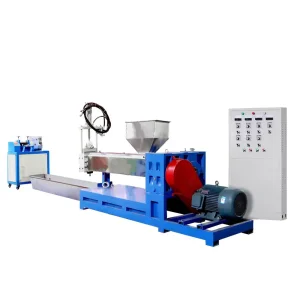
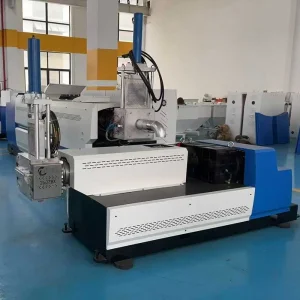
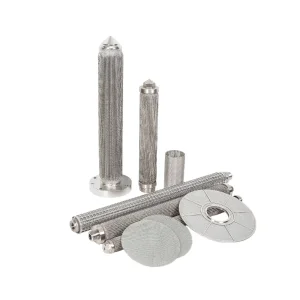
Explore our complete catalog of candle filter elements, CPF replacement cartridges, wire mesh screen packs, and recycling machinery.