Explore our top-tier stainless steel medium filtration assemblies engineered for high viscosity polymer processing, melt spinning, and film extrusion applications.
In modern industrial processing, high-viscosity fluid purification—commonly designated under the umbrella term Medium Filtration—serves as the core technological safeguard across global petrochemical, synthetic fiber, plastic extrusion, and pharmaceutical manufacturing ecosystems. Unlike low-pressure liquid or gaseous filtration media, medium filtration operates within extreme operational boundaries characterized by continuous pressures exceeding 30 MPa, fluid temperatures climbing past 350°C, and melt viscosities ranging from 10 to 10,000 Pa·s.
As global demand accelerates for high-purity thermoplastic polymers (such as BOPP, BOPET, BOPA, and ultra-high-molecular-weight polyethylene), processing facilities cannot tolerate un-melted gels, degraded carbonized particles, or metallic micro-contaminants. A single particulate bypass can cause filament breakage in chemical fiber spinning mills or pinhole defects in micro-thin dielectric films, leading to costly line stoppages, unscheduled maintenance, and high scrap rates.
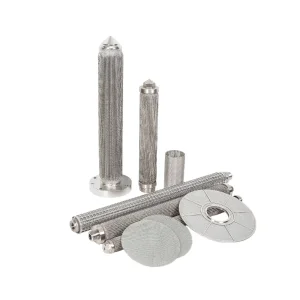
Consequently, global original equipment manufacturers (OEMs) and engineering procurement managers are shifting away from disposable, low-capacity filter elements toward custom-engineered, multi-layer sintered stainless steel candle cartridges, leaf discs, and screen mesh systems. Sintered wire mesh and fiber felt media offer continuous depth filtration, high dirt-holding capacity (DHC), structural integrity under dynamic differential pressures (ΔP), and cleanability for extended service lifecycles.
Stabilizes head pressure in BOPP/BOPET lines. Prevents micro-gels and degraded polymer specks from impairing optical clarity and mechanical tensile strength.
Ensures sub-micron particle retention during continuous polyester (PET), polyamide (PA), and polypropylene (PP) melt spinning to prevent spinneret orifice clogging.
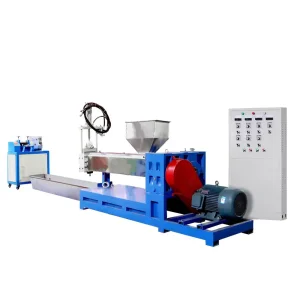
Handles heavy contaminant loads in post-consumer plastic waste stream processing via continuous hydraulic backwash screen changers and heavy-duty wire mesh.
China has established itself as the global epicenter for industrial mesh weaving, metal matrix sintering, and precision automated filter assembly. Facilities like Pujiang HG Plastic Machinery Co., Ltd. combine full vertical integration—from raw wire drawing and vacuum sintering to high-precision CNC end-cap machining and automated laser welding—with stringent quality management protocols.
This integrated manufacturing model provides substantial operational advantages over traditional Western component suppliers:
Using certified AISI 304, 316, and 316L austenitic stainless steel wire mesh and non-woven fiber felts guarantees chemical resistance against acidic thermal degradation and oxidation during high-temperature polymer melt processing.
High-vacuum thermal diffusion bonding fuses wire intersections without solder or binders. This eliminates layer migration under severe pressure spikes and preserves pore size distribution across the entire matrix.
Flexible tooling allows rapid modification of filter geometry, including pleated longitudinal candle dimensions, hexagonal support cores, threaded end-fittings, and outer guard sleeve configurations.
| Filter Medium Type | Absolute Micron Rating (µm) | Porosity Range (%) | Dirt Holding Capacity | Differential Pressure Rating | Cleaning & Reusability |
|---|---|---|---|---|---|
| Sintered SS Fiber Felt | 3 - 60 µm | 75% - 85% | Very High (Depth Retention) | Up to 210 bar | Burnout, Chemical, Ultrasonic |
| Multi-Layer Sintered Wire Mesh | 5 - 200 µm | 35% - 50% | Medium to High | Up to 300 bar | Backwashing, Ultrasonic |
| Woven Wire Cloth (Pleated) | 10 - 500 µm | 30% - 45% | High (Surface Area Focus) | Up to 150 bar | Solvent Rinse, Ultrasonic |
| Extruder Screen Discs | 20 - 1000 µm | 25% - 40% | Standard Surface Retention | Up to 100 bar | Single-use / Low-cost Swap |
Selecting the optimal filter architecture requires aligning polymer flow characteristics with structural geometry. Below is an engineering overview of key medium filtration configurations engineered by leading OEM suppliers:
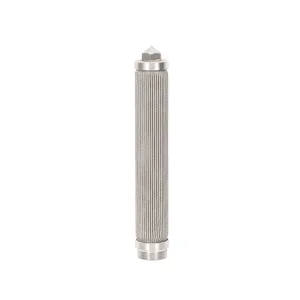
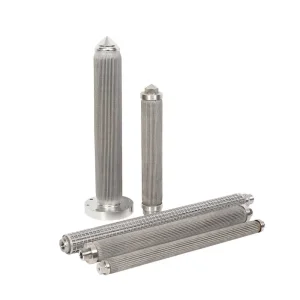
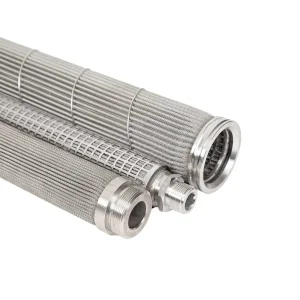
By folding the sintered wire mesh or fiber felt around a perforated stainless steel support tube, pleated candle elements expand effective filtration surface area by 300% to 500% compared to smooth cylindrical designs. This reduction in surface flux lowers initial differential pressure (ΔP), minimizes polymer thermal degradation during long residence times, and extends line run times between cleanings.
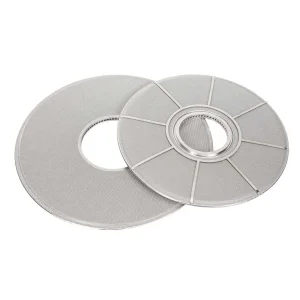
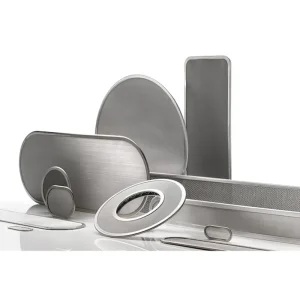
Engineered for high-capacity continuous melt filters, leaf discs are stacked vertically along a central collection mandrel. Incorporating inner drainage screens sandwiched between outer filter layers, leaf discs maintain uniform flow distribution across both sides of the disc, preventing dead zones where heat-sensitive polymers could degrade.
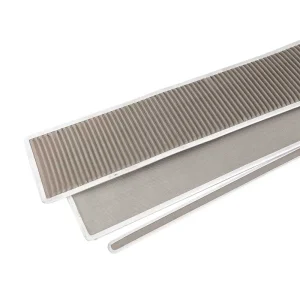
Designed for continuous or manual screen changers in plastic recycling and compounding lines. Available as spot-welded multi-layer mesh packs, rim-bound discs, or continuous mesh belts (auto-downstream changers). Multi-layered spot-welded configurations arrange coarse mesh outer layers to protect fine inner filtration layers from tearing under high hydraulic shear.
As polymer processing equipment evolves toward higher throughput rates, automated backwashing, and closed-loop circular economy models, procurement teams must evaluate medium filtration suppliers against key performance benchmarks:
With sustainability goals driving operational decisions, industrial plants prioritize filter elements capable of undergoing multiple cleaning cycles (TEG hydrolysis, pyrolysis furnace calcination, acid/alkali baths, and ultrasonic agitation). High-grade SUS 316L sintered felt candle elements withstand up to 20 thermal-chemical regeneration cycles without loss of bubble point integrity or pore structure collapse, significantly reducing operational cost per ton of processed polymer.
Modern continuous screen changers utilize hydraulic pistons to reverse melt flow through specific filter channels when differential pressure reaches set thresholds. Sintered wire mesh elements designed for these systems must resist cyclic reverse pressure stress without layer delamination or pore deformation.
Leading OEM factories employ automated optical inspection (AOI) for mesh weave integrity, automated bubble point testing per ISO 4003 to verify max pore size, and pressure-drop testing per ISO 3968. This multi-stage verification ensures batch-to-batch consistency for critical production environments.
Expert responses to critical questions regarding medium filtration media selection, operational parameters, and factory customization options.
Browse our full range of plastic pelletizing machines, custom leaf discs, extruder screen meshes, and engineered filtration components.