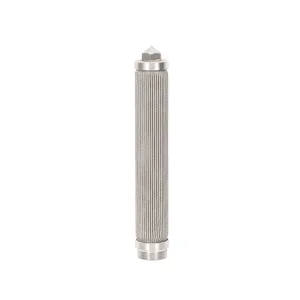
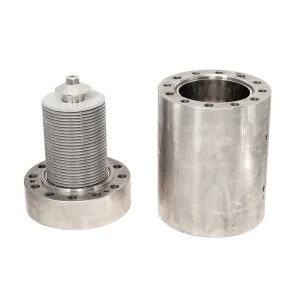
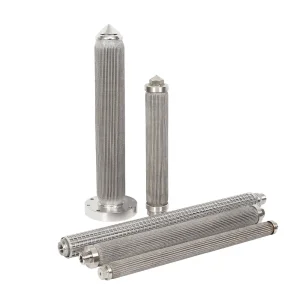
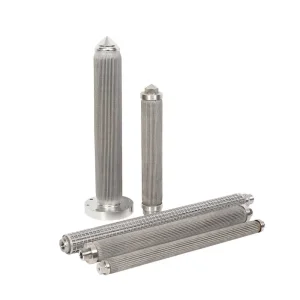
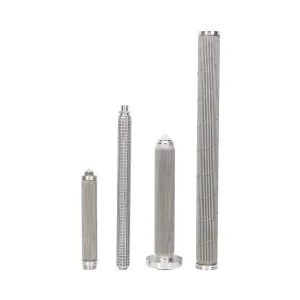
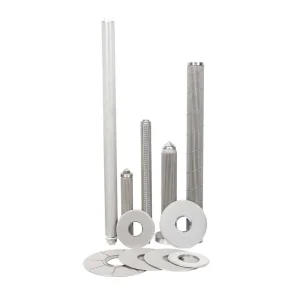
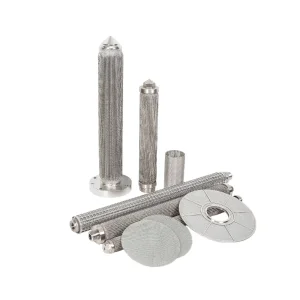
Explore our top-tier stainless steel candle filters, melt pleated filter elements, and extrusion wire mesh cartridges precision-engineered for heavy-duty industrial applications.
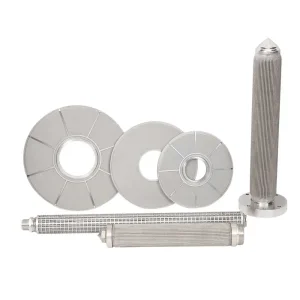
In modern polymer processing, thermal degradation, gel formation, and particulate contamination represent critical failure points that impact yield, tensile strength, and optical purity.
Polymer melt processing involves non-Newtonian fluids operating under high shear rates, extreme temperatures, and pressure levels exceeding 200 bar. Sintered polymer filter elements—specifically candle filters and leaf discs—are critical barriers engineered to capture foreign particles, degraded polymer cross-links, and micro-gels without inducing excessive shear stress or thermal degradation.
Unlike standard mesh strainers, OEM sintered metal fiber felts possess a three-dimensional random matrix structure. This pore gradient offers high void volume (up to 85%), significantly extending on-stream operational life and minimizing differential pressure drops ($\Delta P$) across high-throughput extrusion lines.
In high-speed BOPP (Biaxially Oriented Polypropylene) packaging film extrusion or continuous Spunbond nonwoven fabric lines, a single break caused by un-filtered gel aggregate can result in thousands of dollars in lost throughput per hour. OEM Sintered Polymer Filter elements provide the mechanical integrity necessary to withstand hydraulic shocks during pump shifts and valve transitions.
Information Gain Insight: Transitioning from conventional woven wire mesh screens to multi-layered 316L sintered metal fiber candle filters increases contaminant holding capacity by over 350%, reducing polymer melt pump pulsation and extending filter pack change intervals from days to months.
Comparing the three primary porous media structural classes used by leading OEM polymer filter companies globally.
| Filter Media Type | Porosity Range | Gel Capture Efficiency | Differential Pressure Drop | Cleanability & Reuse |
|---|---|---|---|---|
| Sintered Stainless Steel Fiber Felt (316L) | 75% – 85% | Exceptional (Depth Filtration) | Very Low ($\Delta P$) | High (TEG / Ultrasonic Pyrolysis) |
| Multi-Layer Sintered Wire Mesh | 50% – 65% | Moderate (Surface Boundary) | Low to Medium | Excellent (Backwash Capable) |
| Sintered Metal Metal Powder / Porous Bronze | 35% – 50% | High (Tortuous Pore Path) | Medium to High | Moderate (Solvents Required) |
| Pleated Stainless Steel Candle Cartridge | 70% – 80% | Superior (Maximum Surface Area) | Ultra Low | High (Standard Chemical Bath) |
Under controlled vacuum furnaces at temperatures near the melting point of AISI 316L stainless steel, metallic fibers bond at contact points without melting. This diffusion process guarantees rigid pore geometry and prevents fiber migration into high-purity polymer streams.
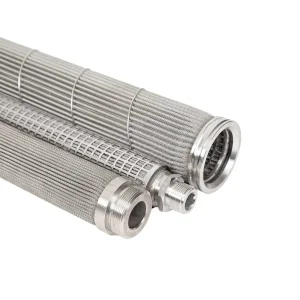
By engineering uniform longitudinal pleats over an inner perforated core, the effective filtration surface area is multiplied by 300% to 500%. This drastic expansion lowers flux rates per unit area, dramatically suppressing gel breakdown and pressure drops.
High-performance polymer processes like PET, PBT, PA66, and Fluoropolymers release volatile compounds and operate at extreme heat. Austenitic steels (SUS 316L/304) and nickel alloys (Hastelloy C-276) provide chemical inertness and structural resilience.
Why top global plastic extrusion equipment manufacturers and chemical fiber enterprises choose OEM sourcing from Chinese specialist factories.
Chinese specialist manufacturers leverage centralized industrial clusters in Zhejiang and Jiangsu, integrating raw stainless steel wire drawing, micro-felt sintering, automated CNC machining, and laser welding under a unified roof. This vertical integration cuts production lead times by 40% and reduces unit costs by up to 50% compared to European OEM equivalents without compromising micron precision.
Whether you require retrofitting legacy Western melt pump filter housings (such as Maag, Nordson, Kreyenborg, or BKG) or developing custom flange interfaces for proprietary extrusion lines, Chinese factories offer flexible engineering support. Rapid prototyping allows custom 3D CAD designs to transition to physical samples within 7–10 working days.
Leading Chinese polymer filter factories operate cleanrooms equipped with Automated Bubble Point Testers (ISO 4003), SEM (Scanning Electron Microscopy) pore size distribution analyzers, and hydrostatic burst pressure rigs. Every batch of candle filters and leaf discs undergoes strict quality validation to prevent downstream fiber breakages or film pinholes.
From ultra-thin optical films to high-capacity plastic pelletizing, explore where sintered polymer filter elements deliver optimal process protection.
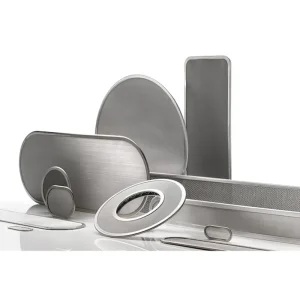
In high-speed biaxially oriented film production lines, micro-gels or carbonized particles cause film tears or optical defects (fish eyes). OEM leaf disc filters (rigid or bundle designs) with 5–20 µm sintered fiber felt guarantee continuous optical-grade melt purity.
Nonwoven fabric spinnerets contain thousands of micro-holes ($0.15\text{ mm}$–$0.3\text{ mm}$). Stainless steel candle filter cartridges intercept ultra-fine particulates in PP melt streams, preventing spinneret hole blockage, filament snapping, and fabric density variations.
Continuous filament yarn (POY, FDY) demands rigorous melt homogeneity. Sintered wire mesh candle filter elements withstand extreme thermal pressure ($300^\circ\text{C}+$) while maintaining precise pore distribution across months of continuous melt spinning.
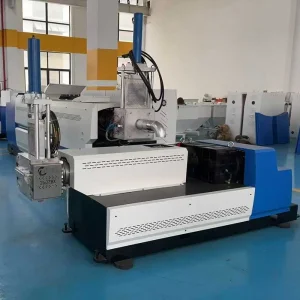
Recycling heavily contaminated PCR/PIR plastics (PE, PP, ABS) places extreme physical demands on filtration. Continuous hydraulic screen changers using multi-layer sintered wire mesh belts efficiently strip out dirt, paper pulp, and non-melting polymers.
In resin output lines (HDPE, LLDPE, Polycarbonate), high-capacity continuous polymer candle filter vessels protect downstream pelletizing cutters, removing catalyst residues and un-reacted resin gels directly from the main reactor outflow.
Medical-grade tubing and optical polycarbonate lenses require zero contamination. Ultra-clean SUS 316L pleated candle filters provide absolute micro-retention down to 3 microns, ensuring total biocompatibility and compliance with medical standards.
Strategic guidelines for procurement managers, engineering directors, and OEM buyers when evaluating sintered polymer filter suppliers.
While initial capital expenditure for stainless steel sintered candle filters is higher than temporary wire screens, the Total Cost of Ownership over a 3-year operating period shows massive cost savings:
Cost Savings Analysis: Sintered 316L candle cartridges can be cleaned and reused up to 15-20 times. Compared to continuous screen replacements, industrial operators achieve up to 62% total operational expense reduction over 24 months through lower scrap rates, fewer line stoppages, and reduced consumable disposal fees.
Emerging technological shifts driving the future design of OEM sintered polymer filter elements across global markets.
As biodegradable polymers (PLA, PBAT) and ultra-thin electronics separator films gain market share, filtration requirements are shifting toward 1–3 micron absolute retention. Next-generation metal nano-fiber felts provide extreme porosity while trapping sub-micron gel nuclei.
Leading OEM manufacturers utilize CFD flow modeling to simulate polymer melt velocity vectors and pressure distributions inside candle filter housings. This eliminates stagnation dead-zones where thermal degradation and polymer charring occur.
With global mandates for recycled plastic content, extrusion lines face unpredictable contamination levels. Smart filter designs with adaptive multi-layer gradient depth structures allow extruders to run 100% PCR feedstock without frequent melt pressure spikes.
Detailed answers to critical engineering, manufacturing, procurement, and operational queries.
Discover our comprehensive collection of polymer candle filters, high-viscosity melt filter elements, and custom stainless steel solutions.