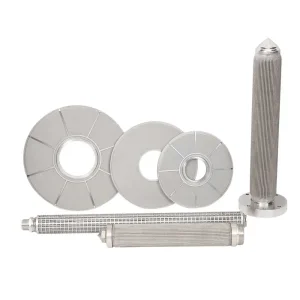
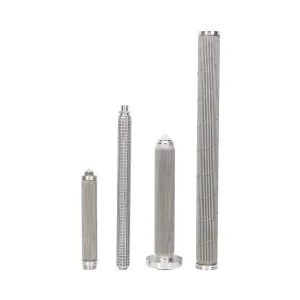
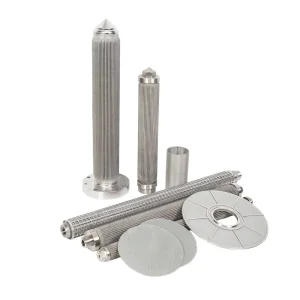
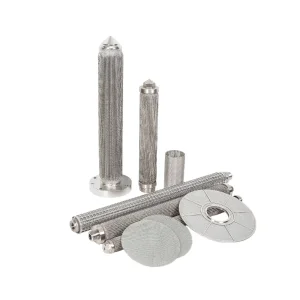
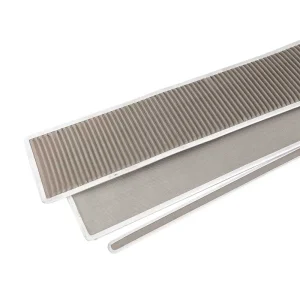
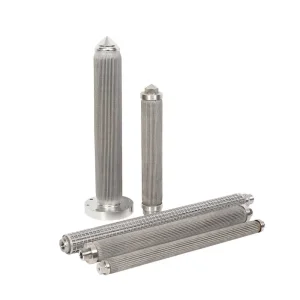
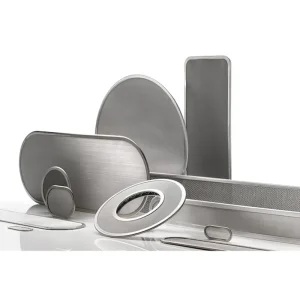
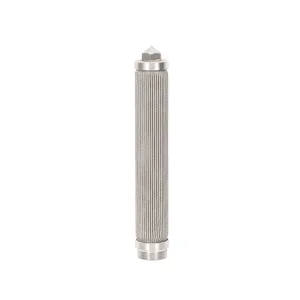
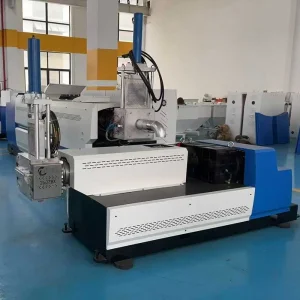
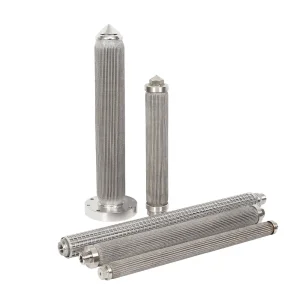
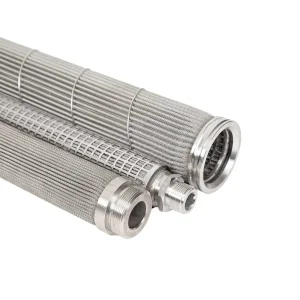
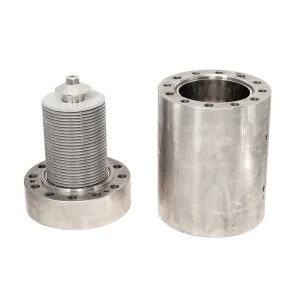
Explore our primary manufacturing lineup for polymer candle filters, extruder mesh packs, and custom sintered wire cloth elements tailored for high-temperature and high-pressure industrial applications.
In modern thermoplastic processing, synthetic fiber spinning, and continuous film extrusion, melt quality is inextricably tied to filtration integrity. As a leading specialized manufacturer, Pujiang HG Plastic Machinery Co., Ltd. engineers high-precision stainless steel screen mesh filters designed to operate reliably under extreme differential pressures (up to 250 bar) and elevated temperatures reaching 350°C.
We utilize premium Grade 304 and Grade 316L stainless steel wire stock. 316L contains 2-3% Molybdenum, providing superior resistance to intergranular corrosion and pitting from chlorinated additives, fire retardants, or acidic residual monomers present in post-consumer recycled (PCR) resins.
From standard Square Plain Weave for minimal pressure drop to Plain Dutch Weave (PDW) and Reverse Dutch Twill Weave (RDTW), our geometry engineering balances permeability, mechanical strength, and contaminant loading capacity for optimal operational life.
For high-stress continuous melt changers, single-layer mesh can deform under pressure. Our vacuum-sintered 3 to 7-layer wire mesh structures fuse wire contact points into a rigid, non-migrating porous matrix that prevents wire displacement under high viscosity melt flow.
| Weave / Construction Type | Micron Rating Range (μm) | Porosity Rate (%) | Structural Fatigue Resistance | Primary Industrial Application |
|---|---|---|---|---|
| Plain Weave Square Mesh | 50μm – 500μm | 45% – 68% | Moderate | Coarse Granulation, PE/PP Extrusion Screens |
| Twill Weave Mesh | 25μm – 150μm | 35% – 52% | High | Fine Polymer Compounding, Sheet Extrusion |
| Plain Dutch Weave (PDW) | 10μm – 100μm | 28% – 42% | Very High | BOPP / BOPET Film Melt Filtration |
| Reverse Dutch Twill (RDTW) | 10μm – 80μm | 30% – 45% | Extreme (Tensile Load) | Continuous Auto-Belt Screen Changers |
| 5-Layer Sintered Wire Cloth | 2μm – 50μm | 32% – 50% | Ultra-High Rigidity | Spunbond Nonwoven, Polymer Candle Filters |
In high-viscosity non-Newtonian polymer melt flows, the pressure drop across a screen mesh pack is governed by Darcy's Law modified for shear-thinning fluids: $\Delta P = \frac{\eta_{eff} \cdot v \cdot L}{k_p}$. By optimizing the pore distribution density and choosing a multi-layer sintered structure with high open porosity ($k_p$), our custom OEM screens achieve up to a 28% reduction in initial $\Delta P$, extending process run-times and reducing energy draw on extrusion gear pumps.
Global enterprise buyers require more than just low unit prices; they demand absolute metallurgical consistency, reliable lead times, and seamless CAD/CAM integration. Pujiang HG Plastic Machinery Co., Ltd. combines 20+ years of local manufacturing expertise in Zhejiang with automated German weaving looms and CNC rim fabrication.
Our state-of-the-art facility operates high-precision shuttleless looms capable of weaving ultra-fine stainless steel wire down to 0.02mm diameter with strict mesh count tolerances (±1%), ensuring uniform pore aperture across millions of square meters.
We control every production phase under one roof: from wire drawing quality inspection, custom mesh weaving, ultrasonic degreasing, and laser cutting to spot-welding multi-layer pack edges and aluminum/stainless rim binding.
Our QA laboratory utilizes Automated Optical Inspection (AOI) to scan screen surfaces for wire breaks or pore irregularities, combined with Bubble Point Testing (ASTM E1282) to confirm absolute micron filtration ratings before dispatch.
For procurement directors in North America, Europe, Southeast Asia, and the Middle East, filter replacements represent an ongoing operational expenditure. Selecting lower-grade wire mesh leads to frequent pack blinding, catastrophic blowouts, high scrap rates, and unplanned extruder downtime.
Cheap screen mesh often suffers from inconsistent wire diameter and poor alloy purity, leading to localized stress concentrations and wire fatigue under thermal expansion. When a screen ruptures, un-filtered gel particles or metal shavings pass directly into high-precision gear pumps or spinneret dies, causing thousands of dollars in mechanical damage and wasted resin compounding batches.
By partnering with HG Plastic Machinery for direct factory OEM sourcing, enterprise buyers secure premium 316L mesh packs that yield up to 35% longer continuous filtration cycles while reducing overall annual consumables expenditure by 20% - 30% compared to local reseller markup.
Different polymer chemistries and extrusion formats demand distinct mesh architectures. Here is how our OEM stainless steel screen mesh filters perform across real-world industrial environments.
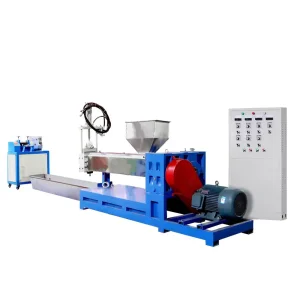
In masterbatch compounding and post-industrial plastic pelletizing (PP, PE, ABS, PET), recycled feedstocks carry heavy dirt, paper, and cross-contaminated polymer gels. Multi-layer spot-welded screen packs with 40/80/120 mesh combinations remove coarse contaminants while maintaining continuous melt throughput without excessive backpressure.
Ultra-thin capacitor films and optical packaging films require absolute gel filtration down to 5–10 microns. Leaf Disc filters and high-density Dutch weave stainless mesh prevent micro-voids, optical defects, and film tears during high-speed transverse orientation stretching.
Medical-grade nonwoven meltblown lines demand spotless polymer melt purity to avoid spinning nozzle blockages. Our 316L candle filter cartridges and pleated mesh packs deliver maximum filtration area in compact housings, guaranteeing continuous fiber spinning without strand breakage.
As global environmental regulations accelerate the shift toward circular plastic economies and high-content PCR processing, polymer filtration systems must adapt to increasingly aggressive operating conditions.
Post-consumer recycled resins contain unpredictable organic residues, cross-linked gels, and microscopic mineral fillers. Next-generation screen mesh packs utilize multi-stage gradient porosity layers that trap large particles on the surface while capturing sub-micron gels inside deep sintered felt layers.
To reduce industrial waste and operational cost, high-grade 316L candle filters and sintered mesh elements are engineered to withstand repeated cleaning cycles via vacuum calcination furnaces, TEG hydrolysis tanks, or ultrasonic baths without structural degradation.
Automated continuous melt filtration systems rely on precision-woven Reverse Dutch Twill wire mesh belts. Our custom continuous screen belt rolls feature high tensile strength selvedges designed to prevent edge tearing during automated index indexing under extreme extrusion pressures.
Navigating international trade and strict industry standards requires comprehensive compliance documentation. Pujiang HG Plastic Machinery Co., Ltd. provides full regulatory support to streamline customs clearance and ensure seamless plant integration worldwide.
Our stainless steel screen mesh elements for food packaging extrusion (PET sheet, PP containers) comply fully with FDA 21 CFR 177.2600 standards, as well as European Union REACH (EC 1907/2006) and RoHS Directive 2011/65/EU regulations, ensuring zero heavy metal leaching.
We provide rapid CAD drawing verification within 24 hours, custom prototyping, and direct technical consultations with our metallurgy engineers. With global logistics partners, we guarantee expedited air-freight delivery for urgent factory maintenance turnarounds.
Get detailed, engineering-level answers to common procurement, operational, and structural questions regarding OEM stainless steel screen mesh filters.
SUS 304 is a cost-effective standard stainless steel suitable for non-corrosive polymers such as virgin PE and PP. SUS 316L contains Molybdenum (2-3%) and lower carbon content, offering far superior resistance to chemical pitting, high temperatures, and corrosive additives often found in post-consumer recycled (PCR) plastics and PET processing.
Multi-layer mesh packs arrange wire screens in a gradient structure (e.g., Coarse / Fine / Coarse). The outer coarse mesh acts as a rigid support grid and pre-filter, while the inner fine mesh performs precision particle capture. This prevents single fine screens from collapsing or blinding prematurely under high head pressure.
Yes. We engineer customized screen packs in circular, oval, kidney, and rectangular geometries bound with aluminum, copper, or stainless steel rims. We can manufacture exact replacements matching major OEM screen changer specifications (e.g., Nordson, Maag, Kreyenborg, Gneuss).
Reverse Dutch Twill Weave (RDTW) is the industry standard for auto-belt continuous screen changers. RDTW features thick warp wires positioned close together, providing exceptional longitudinal tensile strength to resist pulling forces while maintain precision transverse filtration apertures.
Standard woven mesh consists of overlapping wires that can shift under fluctuating pressure. Sintered mesh undergoes a high-vacuum diffusion bonding process that permanently welds wire contact points together, creating a rigid structure with non-deformable pore apertures and zero risk of wire strand displacement into the polymer melt.
We utilize Automated Optical Inspection (AOI) for screen weave uniformity alongside Bubble Point Testing compliant with ASTM E1282 standards. This measures the pressure required to force air bubbles through a liquid-saturated mesh, verifying maximum pore size and absolute filtration rating.
Yes, 316L sintered stainless steel candle filter elements can be thermal-cleaned using vacuum calcination ovens, TEG solvent cleaning, or ultrasonic baths. Depending on operating pressure and cleaning methods, premium 316L candle filters can be reused 10 to 20 times before replacement.
Standard mesh specifications have no strict MOQ and can ship within 5-7 business days. Custom OEM stamped packs or custom-engineered candle filters typically require 10-15 business days for precision tooling, fabrication, ultrasonic cleaning, and export packaging.
Explore our broader industrial suite, including high-viscosity melt filter elements, recycling pelletizing lines, and spunbond nonwoven filter cartridges.