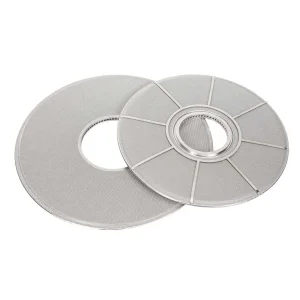
Engineered for extreme viscosity melt filtration, high differential pressure integrity, and extended continuous continuous-run extrusion cycles.
Understanding the rheological dynamics, structural shear resilience, and filtration media selection for critical polymer melt purification lines.
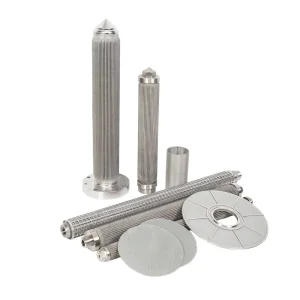
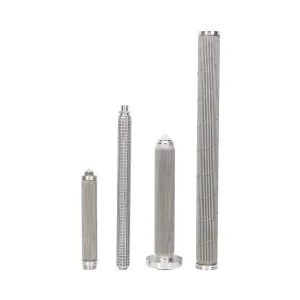
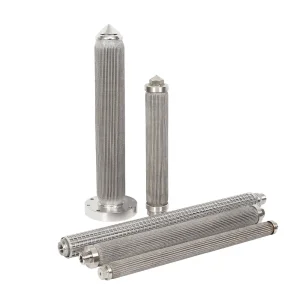
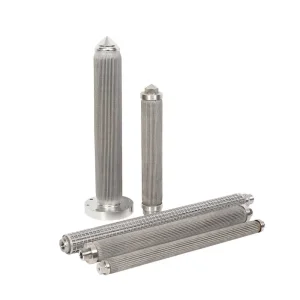
OEM plastic candle filters utilize an elongated cylindrical geometry designed to maximize surface area within compact continuous polymer filter housings (CPF). This design reduces local melt flow velocity, preventing gel breakdown under high shear stress and maintaining thermal uniformity across viscous polymer streams.
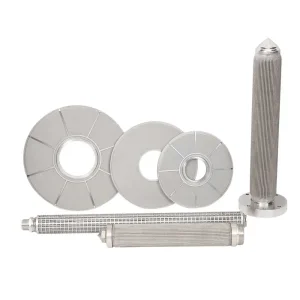
High-end OEM candle filters integrate multi-layer 316L sintered metal fiber felt, delivering up to 80% porosity compared to 30-40% for conventional woven mesh. This yields low initial differential pressure ($\Delta P$), higher dirt holding capacity (DHC), and reduced operational power consumption.
Featuring precision-welded internal perforated support cores and outer protective mesh sleeves, candle filter elements withstand extreme hydraulic shocks, pressure spikes during screen changing, and continuous thermal expansion in temperature regimes up to 350°C.
Evaluating performance vectors across Sintered Metal Fiber Felt, Multi-Layer Wire Mesh, and Metal Powder Sintered Cartridges for OEM deployment.
| Performance Parameter | Sintered Metal Fiber Felt Candle | Multi-Layer Wire Mesh Candle | Sintered Metal Powder Cartridge |
|---|---|---|---|
| Porosity Range (%) | 75% - 85% (Optimal) | 35% - 50% | 40% - 55% |
| Filtration Rating (µm Absolute) | 3 µm - 60 µm | 10 µm - 250 µm | 0.5 µm - 20 µm |
| Dirt Holding Capacity (DHC) | Very High (Depth Effect) | Moderate (Surface Effect) | High (Tortuous Path) |
| Initial Differential Pressure ($\Delta P$) | Ultra Low | Moderate | High |
| Gel Capture Efficiency | Superior (99.2%) | Fair (Elongation Leakage) | High (Prone to Clogging) |
| Regenerability & Cleanability | Excellent (TEG / Calcination) | Excellent (Ultrasonic) | Moderate (Difficult Backwash) |
| Primary OEM Application | PET Film, Spunbond, Nylon Spinning | Plastic Recycling, Extruders | High-Purity Gas & Monomer Lines |
Selecting the optimal stainless steel alloy grade is crucial to prevent premature corrosion, thermal fatigue, or polymer degradation during long-term continuous extrusion:
How leading Chinese OEM plastic candle filter suppliers deliver world-class precision filtration equipment with unmatched economic efficiency and rapid prototyping agility.
Zhejiang filtration manufacturing clusters feature complete in-house value chains—from wire drawing and vacuum sintering furnaces to automated plasma welding and bubble-point test laboratories.
Scale economics allow Chinese suppliers to offer premium-grade 316L sintered metal candle filters at 35% - 50% lower Total Cost of Ownership (TCO) compared to European or North American counterparts.
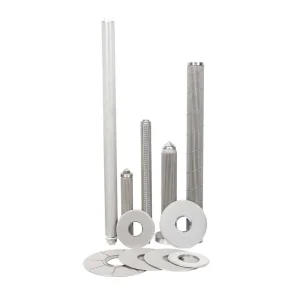
Custom candle filter lengths, end-cap connection threads (M24, M30, NPT, hex bolts), and pleated configurations can be engineered from customer CAD drawings within 7 to 14 business days.
Every OEM production batch undergoes ISO 4003 bubble point validation, ISO 2942 structural integrity verification, and hydrostatic pressure testing to prevent operational melt bypass.
How multinational procurement directors evaluate supplier capability, calculate lifecycle ROI, and establish thermal-ultrasonic cleaning protocols.
When evaluating OEM Plastic Candle Filter suppliers, procurement teams must look beyond unit pricing. Essential technical verification criteria include:
High-quality 316L candle filter cartridges can be cleaned and regenerated between 10 to 20 times when handled under standardized chemical and thermal protocols:
Tailored filter architectures engineered for demanding manufacturing processes across global industrial hubs.
Post-consumer rPET flakes contain paper fibers, metal traces, and glue gels. OEM pleated candle filters provide maximum surface area to trap particulate contamination without stopping high-capacity pelletizing lines.
Ultra-thin optical and packaging films require absolute filtration down to 5 microns. Sintered metal fiber felt candle filters remove micro-particles, eliminating film tears and surface pinhole defects.
High-speed PP nonwoven lines demand consistent melt pressure to feed spinnerets. OEM candle filters stabilize rheological distribution and protect precision micro-holes from clogging.
In continuous filament production, candle filter elements trap unmelted polymer crystals and catalyst residue, ensuring uniform fiber tensile strength and high break-resistance.
Meeting international quality standards, environmental mandates, and technical service requirements across global export markets.
Factories adhere to certified Quality Management Systems and Environmental Management Standards, guaranteeing dimensional repeatability and eco-friendly manufacturing processes.
Stainless steel candle filter elements dedicated to food packaging film and pharmaceutical plastic processing comply fully with US FDA 21 CFR 177.2600 and EU Regulation 10/2011.
Direct engineering assistance for housing retrofits, custom thread matching, emergency spare deliveries, and global express shipment to over 80 countries worldwide.
Next-generation innovations driving energy reduction, circular economy integration, and smart continuous filtration systems.
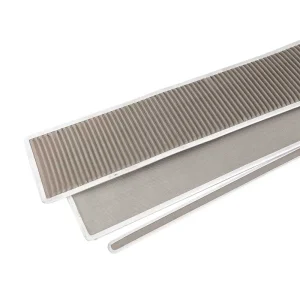
Advanced pleating machinery allows up to 2.5x greater filtration surface area within the same cylindrical footprint, enabling lower flow velocities, reduced pressure drop, and doubling filter operational lifespan.
Utilizing sub-micron metal fibers to achieve absolute sub-3-micron filtration without compromising void volume, critical for next-generation micro-denier nonwovens and optical grade PET films.
With global mandates for Post-Consumer Recycled (PCR) content, candle filters are optimized with gradient multi-depth layers to accommodate volatile contamination loads in recycled polymer melts.
Expert answers to key technical, sourcing, and operational questions for purchasing directors and plant engineers.
Direct OEM/ODM supply from certified China manufacturing facilities with custom dimensional and alloy options.