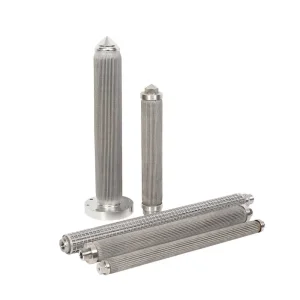
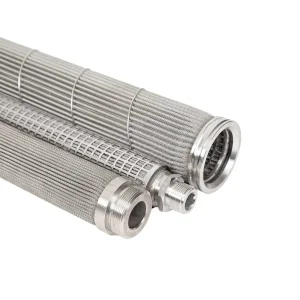
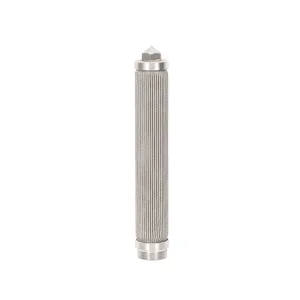
Direct factory supply featuring SUS304 / SUS316L high-temperature filter cartridges engineered for seamless integration into continuous screen changers and melt pump systems.
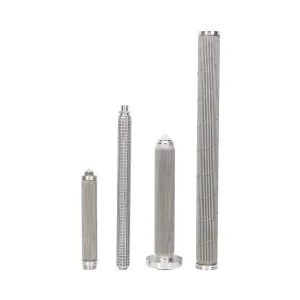
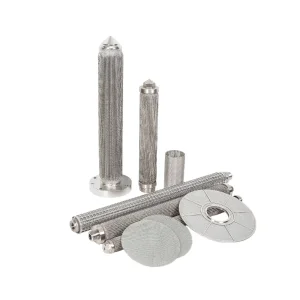
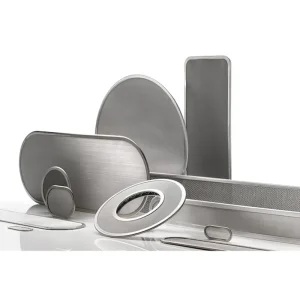
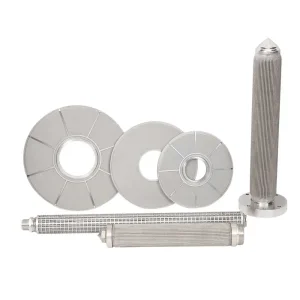
A deep dive into fluid dynamics, structural stress distribution, and porosity optimization in high-temperature, high-viscosity polymer melt systems.
In modern polymer extrusion, synthetic fiber spinning, and chemical processing lines, the candle filter medium serves as the critical line of defense against mechanical impurities, micro-gels, and degraded polymer cross-links. Unlike standard cartridge filters used in low-viscosity liquid clarification, polymer candle filters must maintain absolute structural integrity under extreme operating conditions—frequently enduring temperatures up to 350°C (662°F) and differential pressures ($\Delta P$) exceeding 200 bar (2900 psi).
Constructed by diffusion bonding multiple layers of woven stainless steel wire cloth. Delivers precise pore ratings (3 µm to 100 µm), exceptional mechanical strength, and easy backwashing capabilities.
Non-woven 3D labyrinth structure featuring up to 85% high porosity. Provides up to 3x higher dirt-holding capacity ($g/m^2$) compared to conventional mesh, significantly extending on-stream operational cycles.
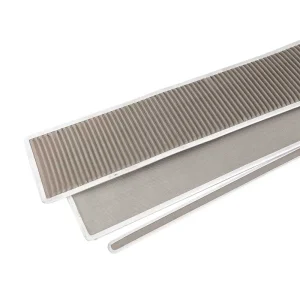
Deep longitudinal pleating expands effective filtration surface area by 250% to 400% within the same cylindrical housing footprint, minimizing flux rate ($m^3/m^2\cdot h$) and shear-induced melt degradation.
Polymer melts such as Polyethylene Terephthalate (PET), Polypropylene (PP), Polyamide (Nylon 6/66), and Polycarbonate (PC) exhibit non-Newtonian, pseudoplastic flow behavior. As melt passes through the micro-porous structure of the candle filter medium, high shear rates can cause semi-rigid polymer gels to elongate and "squeeze" through pore apertures larger than their equilibrium diameter.
To counteract gel passage, leading wholesale candle filter manufacturers utilize asymmetrical multi-stage sintered media. The outer guard layer captures large inorganic contaminants (e.g., $TiO_2$ agglomerates, catalyst residues), while the dense inner filtration layer traps deformational micro-gels via depth filtration mechanics and pore interception.
Selecting the correct stainless steel alloy or superalloy grade to resist chemical corrosion, thermal oxidation, and repeated cleaning cycles.
| Material Grade | Chemical Composition Highlights | Max Temp (°C) | Corrosion Resistance Profile | Primary Industrial Applications |
|---|---|---|---|---|
| SUS 304 / EN 1.4301 | 18% Cr, 8% Ni | 300°C | Standard organic resins, non-corrosive polymers | PP/PE packaging film, masterbatch granulating |
| SUS 316L / EN 1.4404 | 17% Cr, 12% Ni, 2.5% Mo (Low Carbon) | 380°C | High resistance to intergranular corrosion & organic acids | PET bottle resin, Polyester spinning, PTA plants |
| Hastelloy C-276 | 57% Ni, 16% Cr, 16% Mo, 4% W | 500°C | Exceptional in harsh chlorides, wet chlorine, acidic melts | Fluoropolymers (PVDF/PTFE), Specialty Elastomers |
| Inconel 600 / 625 | 72% Ni, 15.5% Cr, 8% Fe | 600°C | Extreme oxidation & high-temperature creep resistance | High-temperature chemical processing & synthetic rubber |
A major advantage of premium metal candle filter media over polymer or fiberglass disposable elements is their cleanability and reusability. A single SUS316L candle filter element can undergo 15 to 20 thermal-chemical cleaning cycles when operated within recommended metallurgical limits.
Standard industrial cleaning procedures involve:
Why tier-1 global resin producers and OEM extrusion machine builders partner directly with specialized Chinese candle filter medium factories.
From raw wire drawing and vacuum sintering furnaces to automated CNC end-fitting machining and robotic TIG welding, Chinese clusters deliver unrivaled production agility.
Every candle filter batch undergoes 100% Bubble Point Testing according to ISO 4003 and flow fatigue resistance testing under ISO 3724 to guarantee zero bypass defects.
Direct factory sourcing eliminates trading markups while maintaining 100% compatibility with OEM filter housings (Cuno, Maag, BKG, Nordson, Seebach equivalents).
Global procurement teams in Europe, North America, and Southeast Asia increasingly seek direct factory manufacturing partners capable of delivering drop-in dimensional replacements for legacy OEM systems. China's leading candle filter factories utilize precision laser scanning and CMM (Coordinate Measuring Machine) verification to replicate thread specs (e.g., M24, M30, NPT, bayonet quick-locks) and surface gaskets (e.g., copper, silver-plated nickel, PTFE-coated viton) down to sub-millimeter tolerances.
How chemical recycling, post-consumer resin (PCR) processing, and smart predictive monitoring are reshaping candle filter design.
With global mandates forcing packaging manufacturers to incorporate 30% to 50% Post-Consumer Recycled (PCR) content into plastic films and bottles, continuous melt filtration faces unprecedented contamination loads. PCR melt contains heterogeneous contaminants—aluminum foil flakes, paper fibers, cross-linked rubber, and mixed polymer degradation products.
To meet this challenge, factory engineers have developed Gradient-Pore Sintered Metal Felt Candle Media. The pore size tapers progressively from 120 µm on the exterior down to 10 µm at the inner core, preventing surface blind-off and allowing deep-bed gel entrapment.
Next-generation candle filters incorporate ultra-fine stainless steel nanofibers (diameter < 2 µm). This technical breakthrough boosts specific surface area by over 300% without increasing housing diameter, enabling ultra-fine filtration down to 1 µm absolute for optical-grade polycarbonate (CD/DVD/display panels) and high-orientation BOPET solar backsheet films.
Modern smart extrusion plants integrate continuous $\Delta P$ pressure transducers upstream and downstream of the candle filter vessel. Industrial AI algorithms analyze real-time viscosity fluctuations and pressure ramp-up curves to predict exact media clogging limits, scheduling automated backwashing or duplex filter changeovers without stopping production lines.
Tailored filtration configurations for specific high-demand production lines.
Application: PP hygiene nonwovens, medical drapes.
Filter Media: 25 µm to 40 µm Pleated SUS316L Sintered Mesh Candle.
Key Metric: Eliminates spinneret hole blockage and filament breakage during high-speed spinning (>2000 m/min).
Application: Ultra-thin capacitor & flexible packaging films.
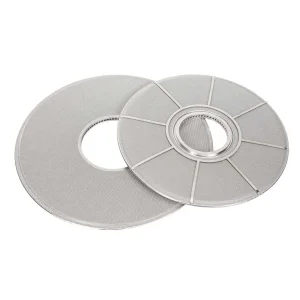
Filter Media: 10 µm Sintered Metal Fiber Felt Candle & Leaf Disc.
Key Metric: Prevents pinholes, micro-tears, and optical haze across 10-meter wide tenter frames.
Application: Continuous polymerization reactors.
Filter Media: Hastelloy C-276 Sintered Fiber Candle.
Key Metric: Resists severe acidic catalyst corrosion at elevated temperatures up to 330°C.
Comprehensive global logistics, regulatory certifications, and technical field service.
Procuring industrial filtration components from China requires strict adherence to international engineering standards and seamless logistics execution. Top-tier manufacturers provide end-to-end quality assurance documentation with every shipment:
Full heat-lot traceability for all raw stainless steel wire cloth and sintered felt batches.
Certified safe for direct food contact packaging film lines and pharmaceutical polymer extraction.
Strict pressure vessel component compliance under European PED (Pressure Equipment Directive 2014/68/EU).
Leading factories maintain localized field engineering contacts and quick-response air freight options for critical emergency changeouts. Under customs tariff HS Code 8421.99.0000 (Parts of Filtering or Purifying Machinery), standardized export packing in vacuum-sealed moisture-proof foil bags inside reinforced wooden crates prevents transit oxidation and corrosion across ocean freight routes.
Expert answers to common engineering, procurement, and maintenance questions regarding wholesale candle filter elements.
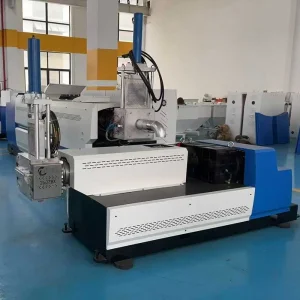
High-performance stainless steel mesh, polymer leaf discs, and recycling equipment direct from ISO-certified manufacturing facilities.