Precision Micro-Weaving Metallurgy, Advanced Polymer Melt Filtration Engineering, Industry 4.0 Manufacturing Solutions & Global OEM/ODM Supply Chain Authority
Directly sourced from our ISO-certified manufacturing facility. Designed for extreme pressure, high-viscosity melt retention, and long cycle operational efficiency.
An authoritative engineering breakdown of fluid rheology, particulate retention mechanisms, micro-mesh weaving dynamics, and thermal-pressure resilience.
In modern high-viscosity polymer processing, continuous extrusion, film blowing, spunbond nonwoven production, and recycled pelletizing, the performance of the melt filtration system dictates both product yield and operational downtime. Custom filter wire mesh serves as the critical kinetic barrier against gel specks, un-melted resin inclusions, degraded carbonaceous particles, and foreign inorganic contaminants. As a premier custom filter wire mesh manufacturer and advanced engineering factory, our focus centers on optimizing fluid dynamics, shear stress mitigation, and absolute particle capture efficiency under extreme hydraulic loads.
When non-Newtonian polymer melts (such as PP, PET, PE, PA66, or PC) pass through a filter screen pack, the localized shear rate increases sharply within the micro-apertures. Excessive shear stress can trigger polymer chain degradation, altering the intrinsic viscosity (IV) of the final extrudate. By engineering specific Dutch weave geometries (such as Reverse Dutch Twill or Broad Mesh Dutch Weaves), our factory optimizes the open area ratio ($A_o$), ensuring smooth pressure transitions, uniform fluid velocity vectors, and minimal dead zones where thermal polymer degradation typically initiates.
Pioneering innovations in micro-metallurgy, surface functionalization, and smart automated backwashing filtration architectures.
Transitioning from conventional woven wire mesh to non-woven metallic fiber felt (sintered SS 316L fibers down to 1.5 microns). Offers up to 80% porosity, delivering 3x higher dirt-holding capacity and drastically lower initial pressure drop ($\Delta P_0$).
Application of Physical Vapor Deposition (PVD) TiN, CrN, and DLC coatings directly onto the wire mesh weave. Reduces melt friction coefficient, prevents organic polymer carbonization, and enables 40% faster TEG / ultrasonic cleaning cycles.
Integration of smart differential pressure and acoustic wave sensors into candle filter housings. Real-time predictive analytics determine exact filter cake saturation levels, preventing catastrophic filter medium breach.
Select the precise alloy grade, weave style, and structural configuration tailored to your chemical medium, operating temperature, and pressure threshold.
| Alloy Grade | Metallurgical Composition | Max Temp (°C) | Corrosion Resistance | Tensile Yield (MPa) | Primary Industry Application |
|---|---|---|---|---|---|
| AISI 304 / 304L | 18% Cr / 8% Ni (Low Carbon) | 550°C | Standard / Organic Resins | 210 - 240 | Standard Polyolefin Extrusion (PE, PP) |
| AISI 316 / 316L | 16% Cr / 10% Ni / 2% Mo | 650°C | High / Acidic & Chlorinated Media | 240 - 290 | BOPET, PET Spinning, Packaging Film |
| AISI 904L / UNS N08904 | 20% Cr / 25% Ni / 4.5% Mo / 1.5% Cu | 700°C | Severe / Sulfuric & Phosphoric Acid | 220 - 260 | Specialty Fluoropolymers (PVDF, PTFE) |
| Hastelloy C-276 | 57% Ni / 16% Cr / 16% Mo / 4% W | 815°C | Extreme / Wet Chlorine, Chlorides | 355 - 380 | Petrochemical Intermediates, Corrosive Melt |
| Inconel 625 | 58% Ni / 21% Cr / 9% Mo / 3.6% Nb | 980°C | Extreme High-Temp Oxidation | 460 - 500 | High-Temperature Polymer Synthesis |
• Plain Square Weave: Uniform square apertures, optimal for screen packs requiring maximum open area ($A_o$ up to 65%) and minimal pressure restriction.
• Twilled Dutch Weave (DTW): Heavy warp wires paired with dense, fine weft wires woven in a twill pattern. Delivers rigid depth filtration down to 5 µm with extreme burst resistance.
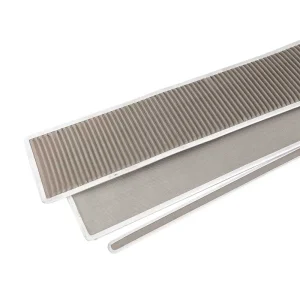
• Reverse Dutch Weave (RDW): High-density warp wires and larger diameter weft wires. Exceptional structural stability under continuous automatic ribbon screen changers (auto-belt filters).
Our factory strictly tests and validates filter media according to ISO 2942 (Bubble Point Test) and ISO 16889 (Multi-Pass Filtration Performance). Unlike nominal ratings which indicate average pore size, our Absolute Micron Rating guarantees that 99.98% ($\beta_{ratio} \ge 5000$) of spherical particles exceeding the specified micron threshold are physically retained, preventing downstream spinneret or die block clogging.
Customized filtration architectures engineered for high-throughput continuous manufacturing across diverse global sectors.
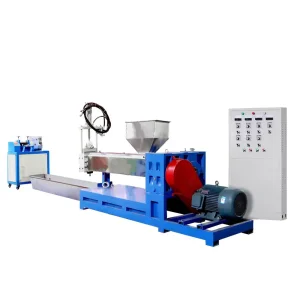
Recycling heavily contaminated PCR/PIR plastics (HDPE, LDPE, PP, PET flakes) presents severe challenge due to paper fibers, wood dust, aluminum specs, and degraded polymer gels. Our continuous Auto-Belt Reverse Dutch Wire Mesh Screens and Multi-Layer Sintered Extruder Packs provide continuous filtration up to 300 bar pressure, enabling continuous screen changers to operate without stopping production lines, boosting daily output by 25-30%.
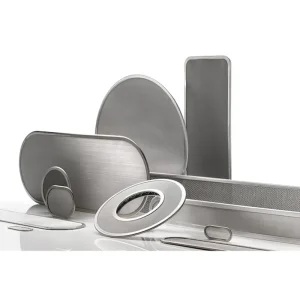
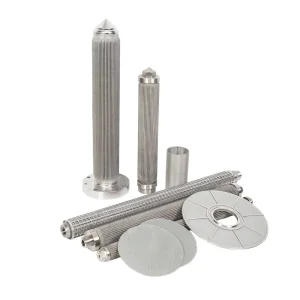
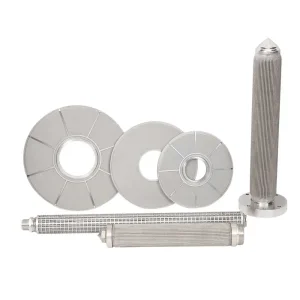
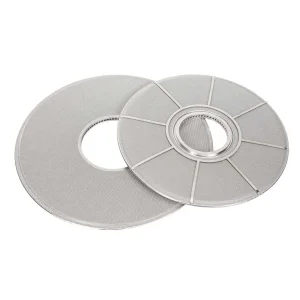
High-speed biaxially oriented film stretching lines running at speeds up to 500 m/min require zero particulate defects above 5-10 µm to prevent catastrophic web snaps. Our High-Surface-Area Leaf Disc Filters (Hard & Soft Seal Win-Series) utilize 316L sintered mesh and fiber felt elements, offering perfectly flat surface parallelism (<0.05mm) and non-deforming hub geometry to maintain seal integrity under 200°C melt temperatures.
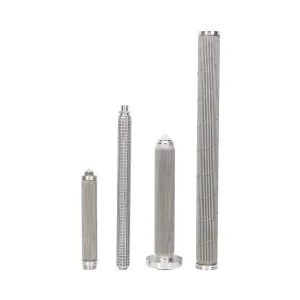
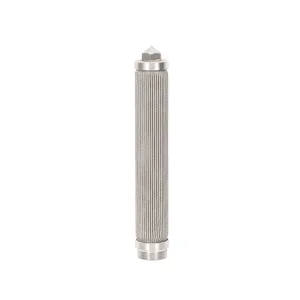
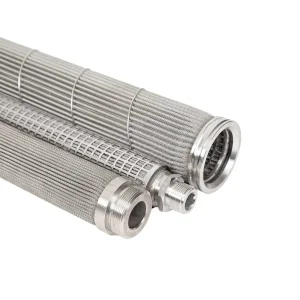
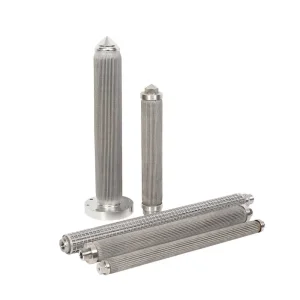
For POY, FDY filament yarn extrusion, and hygiene-grade PP spunbond nonwovens, gel particles cause filament breakage and uneven web distribution. Our Pleated Polymer CPF Candle Filter Elements maximize active filtration surface area within compact filter housings, offering extended operational life up to 60-90 continuous days per cycle and capability for 5+ thermal cleaning iterations.
In high-pressure hydrocarbon cracking, monomer purification, and catalyst recovery units, filter media must withstand highly acidic fluids and aggressive thermal cycling. Our Sintered Metal Mesh Tubes & Cylindrical Cartridges manufactured from Hastelloy C-276 and SS 316L deliver total structural rigidity, zero chemical leaching, and complete pressure seal integrity up to 400°C.
How our modernized manufacturing facility combines advanced automation, rigorous quality control, and scale economies to deliver unmatched value to global OEMs.
Equipped with 50+ heavy-duty computer-controlled micro-weaving looms capable of maintaining uniform warp tension up to 15,000 N/m. Guarantees tight aperture tolerance (±3%) across every square meter of stainless steel wire cloth produced.
100% material verification via Thermo Scientific Niton Portable XRF Spectrometer (PMI test). Every batch undergoes ISO 2942 bubble point integrity testing, optical wire diameter measurement, and CMM dimension verification prior to dispatch.
Direct factory-to-enterprise model eliminates intermediary margins. Combined with localized raw stainless steel wire drawing and vacuum sintering infrastructure in Zhejiang, we offer premier OEM quality at highly competitive global price points.
Step-by-step technical methodology for specifying custom filter wire mesh products to ensure maximum operational synergy.
Identify polymer fluid viscosity ($\eta$), operating temperature ($T$), volumetric flow rate ($Q$), and allowable initial pressure drop ($\Delta P_{max}$).
Determine contaminant nature (hard inorganic silica vs. soft elastic polymer gels) to select depth vs. surface filtration media.
Calculate required effective filtration surface area ($A_{filt}$) to maintain fluid velocity below critical shear thresholds ($v \le 0.05\text{ cm/s}$).
Submit technical drawings for custom hub adapter threading, rim spot welding, or specialized gasket seating rings.
Full alignment with international industrial standards, environmental regulations, and global logistics service level agreements (SLAs).
Our factory operates under fully audited ISO 9001:2015 Quality Management Systems. All stainless steel wire mesh products comply strictly with EU REACH regulations, RoHS 3 hazardous substance directives, and FDA 21 CFR 177.2600 food-contact suitability for food-grade packaging film applications.
We offer rapid engineering sample fabrication within 48 hours for standard screen packs and 5 business days for custom-machined leaf disc adapters. Global air-express dispatch ensures your engineering team can test and validate prototype fitment with minimal lead time.
Metal filter elements represent a highly sustainable alternative to disposable synthetic media. Designed for multiple thermal cleaning cycles (pyrolysis burnout, TEG solvent bath, and ultrasonic cavitation), our metallic filter elements reduce industrial hazardous waste creation by up to 90%.
Expert engineering responses to critical questions regarding design, material selection, maintenance, and ordering parameters.
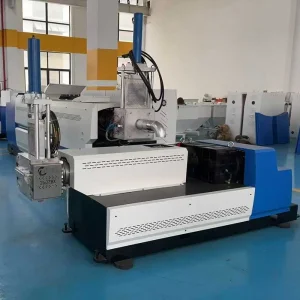
Select from our specialized line of candle elements, leaf discs, extruder screens, and plastic granulating recycling machinery.