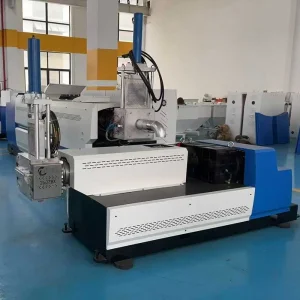
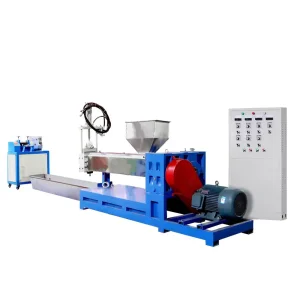
Explore our high-performance filtration hardware and pelletizing systems tailored for ODM PET plastic recycling plants worldwide.
The transition toward a circular plastics economy has shifted Polyethylene Terephthalate (PET) recycling from a low-margin scrap business into a highly engineered, capital-intensive manufacturing sector. Driven by stringent international mandates—such as the European Union’s Single-Use Plastics Directive requiring 30% recycled content in PET beverage bottles by 2030, and North American state-level recycled content laws—the demand for high-purity recycled PET (rPET) has outstripped standard washing and extrusion capabilities. As a result, industrial global buyers are increasingly partnering with specializing Original Design Manufacturers (ODM) to construct custom-tailored recycling factories.
Traditional off-the-shelf recycling systems often fail to address the heterogeneous nature of modern post-consumer waste streams. Post-consumer PET bottles, thermoforms, and industrial strapping contain varying degrees of contaminants, including PVC flakes, polyolefin cap remnants, adhesive residue, aluminum foils, and embedded degradation gels. ODM PET Plastic Recycling Factories provide bespoke system architecture—incorporating advanced washing hydromechanics, multi-stage solid-state polymerization (SSP), and ultra-fine melt polymer filtration systems designed specifically to safeguard the Intrinsic Viscosity (IV) of the polymer melt.
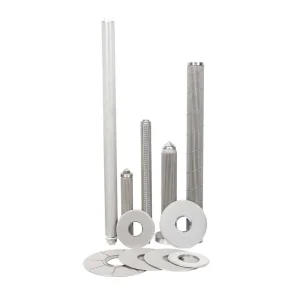
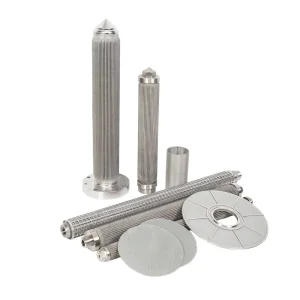
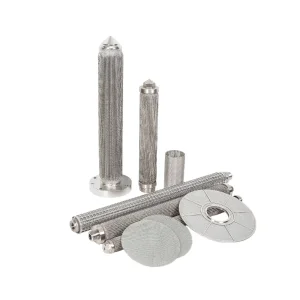
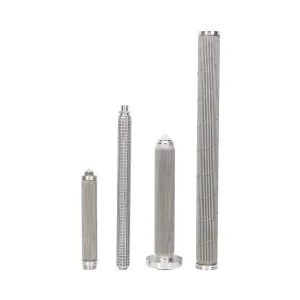
Building an ODM PET plastic recycling factory requires deep alignment between mechanical equipment and polymer rheology. Modern bottle-to-bottle lines and high-tenacity fiber spinning facilities can no longer afford frequent screen changes, pressure spikes, or black speck contamination. Consequently, precision melt filtration elements—such as continuous polymer filter (CPF) candle cartridges and pleated leaf disc filters—have become the core determinant of operational profitability and final pellet quality.
To achieve virgin-grade physical properties from post-consumer PET waste, ODM factories rely on a multi-phase technological roadmap. The primary challenge in PET reprocessing is preventing hydrolytic and thermal degradation while filtering out particulate contaminants down to micro-meter tolerances.
Utilizing high-resolution optical NIR (Near-Infrared) sorting coupled with friction washing and dynamic hydro-classifiers to isolate PET flakes from PVC, PE/PP caps, and metallic debris to under 50 ppm impurities.
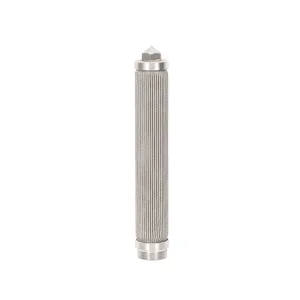
High-torque twin-screw extruders integrated with multi-vent vacuum degassing eliminate moisture and volatile organic compounds (VOCs). The melt passes through Continuous Polymer Filters (CPF) fitted with 316L stainless steel pleated candle cartridges.
Pelletized rPET undergoes long-residence thermal vacuum treating to rebuild the polymer chain length, elevating the Intrinsic Viscosity (IV) from 0.65 dL/g to >0.80 dL/g for bottle-grade and industrial yarn applications.
In high-purity ODM recycling, traditional single-layer screen meshes are rapidly being replaced by multi-layer sintered metal fiber felts and pleated candle filter elements. The table below highlights key performance differences during continuous high-pressure PET melt extrusion:
| Filtration Parameter | Standard Wire Mesh Screens | Multi-Layer Sintered Wire Mesh | 316L Stainless Steel Sintered Felt (CPF) |
|---|---|---|---|
| Dirt Holding Capacity | Low (Surface filtration only) | Medium (Layered gradient trapping) | Exceptionally High (3D depth matrix) |
| Pressure Drop (ΔP) Growth | Rapid increase; frequent stop/change | Moderate stability | Linear, ultra-slow growth rate |
| Micron Rating Accuracy | 100μm - 500μm | 40μm - 150μm | 3μm - 25μm (Sub-micron gel trapping) |
| Cleanability & Reusability | Disposable / Non-reusable | Limited ultrasonic cleaning cycles | Fully Reusable (Pyrolysis / TEG washing) |
| Shear Stress Impact on IV | High local shear stress | Moderate shear stress | Minimized shear; uniform melt velocity |
The structural requirements for an ODM PET recycling factory vary dramatically depending on the downstream application of the reclaimed polymer. Customized engineering ensures that melt filtration and purification hardware align with specific regional market demands.
In regions like North America and Western Europe, recyclers must meet strict EFSA and US FDA standards. ODM plants utilize SUS316L pleated candle filter cartridges capable of trapping particulates down to 20 microns while enduring operating pressures up to 250 bar. Zero gel bypass is required to ensure preform optical clarity and prevent micro-bursting during high-pressure blow molding.
Major textile manufacturing hubs across Southeast Asia and East Asia utilize rPET for POY, FDY, and micro-denier staple fibers. Filtration systems must remove non-melting microscopic particles down to 10-15 μm. Polymer leaf disc filters and high-surface-area CPF elements prevent spinneret clogging, reduce filament breakage rates, and lower overall downtime.
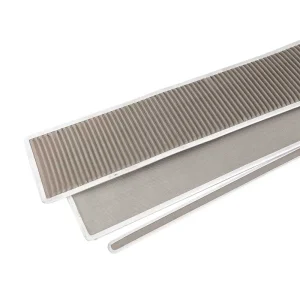
For industrial packaging sheet (APET / RPET thermoformed trays) and high-tensile PET strapping, cost efficiency and continuous operation are critical. ODM lines utilize automated dual-piston or continuous hydraulic screen changers fitted with heavy-duty stainless steel extruder mesh filters to handle higher contamination loads without stopping the line.
As global market volatility places pressure on capital expenditure, China’s specialized plastic machinery manufacturing clusters—specifically located in Zhejiang Province—offer unmatched structural advantages for international buyers seeking ODM PET recycling equipment and filtration components.
From raw 316L stainless steel wire drawing and specialized vacuum sintering furnaces to high-precision CNC micro-hole machining, China's localized supply chain reduces ODM component lead times by up to 60% compared to traditional European suppliers.
Leading manufacturers such as Pujiang HG Plastic Machinery Co., Ltd. leverage over 20 years of technical expertise. Custom ODM designs undergo 100% pressure-integrity testing, bubble-point testing for pore size verification, and precise dimensional verification before global export.
By combining high-capacity automated production with competitive material sourcing, Chinese ODM factories provide global enterprises with premium-tier polymer filtration hardware at significantly lower operational capex, accelerating payback periods on plant retrofits.
Deploying equipment in global markets requires complete adherence to regional environmental and food-safety regulations. Reliable ODM partners build compliance directly into equipment specifications:
Intense differential pressure across clogged filters causes high shear rates, triggering thermal and mechanical degradation of PET polymer chains. By utilizing high-surface-area 316L sintered felt candle filters with optimized flow geometries, the pressure drop (ΔP) remains stable and low. This minimizes shear heating, preserves molecular weight, and stabilizes the melt's Intrinsic Viscosity (IV) during extrusion.
Stainless steel candle filters (316L) are designed for multiple reuse cycles. The standardized cleaning protocol involves: 1) Thermal Pyrolysis in a vacuum burn-off oven at 450°C to degrade residual PET into ash; 2) Triethylene Glycol (TEG) solvent bath boiling at 280°C to dissolve micro-residues; 3) Ultrasonic bath cleaning with neutral detergents; and 4) High-pressure reverse water/air flushing followed by a bubble-point integrity test prior to re-installation.
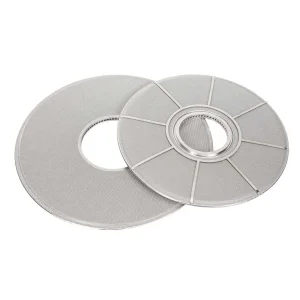
Polymer Leaf Disc Filters offer an exceptional surface-area-to-volume ratio within high-pressure filter housings. Unlike flat screen meshes, leaf discs feature rigid internal drainage hubs surrounded by fine multi-layer sintered media. This construction supports massive contaminant loads under pressures up to 300 bar while maintaining dynamic flow channel symmetry, which is essential for uniform thickness control in BOPET film lines.
For standard 3D/7D hollow conjugated staple fiber production, a filtration rating of 40μm to 60μm is typically sufficient. However, for micro-denier spinning (<1.2 denier) or high-speed filament yarn (POY/FDY), engineers must specify 15μm to 25μm sintered fiber felt elements to prevent spinneret hole blockage and filament breaks.
Yes. Our ODM engineering capability includes reverse-engineering and custom dimension fabrication. We manufacture candle filters, leaf discs, and screen elements to match exact bolt patterns, connection flanges, hex fittings, and seal geometries of existing European, North American, or Japanese filter housings without requiring equipment retrofit.
Discover specialized filter elements designed for high viscosity melt polymer purification, chemical fiber spinning, and continuous recycling operations.