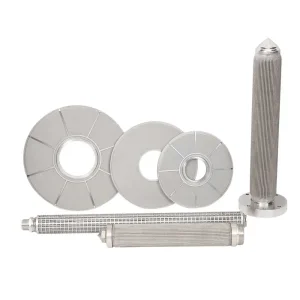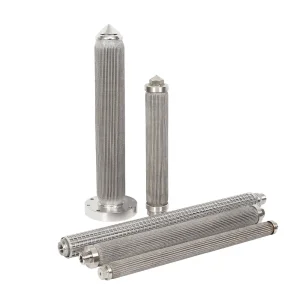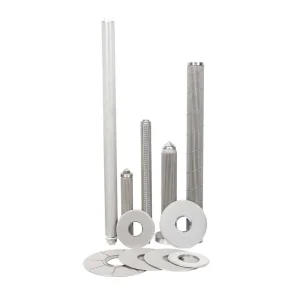
In modern industrial polymer processing, the demand for precise micro-scale purity has escalated from an operational preference to a stringent production imperative. High-viscosity polymer melt filtration represents a key technological link across chemical fiber spinning (POY, FDY, DTY), biaxially oriented polypropylene (BOPP), polyester (BOPET) film extrusion, and high-performance polyolefin recycling. At operating temperatures exceeding 300°C and melt pressures rising above 200 bar, even microscopic gels, cross-linked degraded polymers, metal particulates, or carbonized residues can trigger filament breaks, film pinholes, melt-blown voiding, or rapid die head wear.
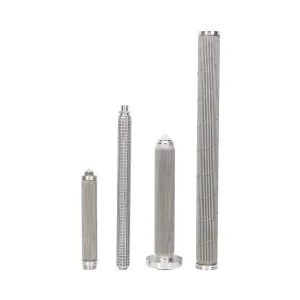
As global polymer manufacturing transitions toward thinner films, ultra-fine denier synthetic yarns, and higher percentages of post-consumer recycled (PCR) resin, traditional single-layer woven screens or standard depth media can no longer meet operational standards. Tier-one global resin converters and OEM system integrators now rely heavily on specialized micron filter cartridges—specifically multi-layer pleated stainless steel (SUS 316L/304) candle filter elements and sintered metal fiber felts—to guarantee continuous production cycles spanning thousands of operating hours without unplanned downtime.
The strategic role of the OEM micron filter cartridge manufacturer is not merely supplying wire mesh replacement items; it encompasses fluid dynamics optimization, stress-strain engineering under high pressure differentials ($\Delta P$), micro-porous matrix construction, and surface energy modulation to prevent polymer degradation during long residence times.
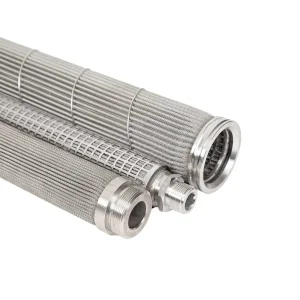
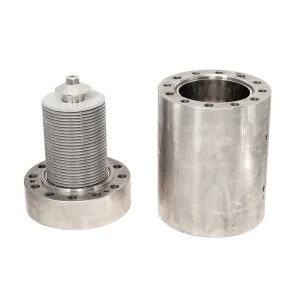
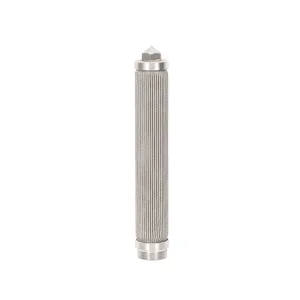
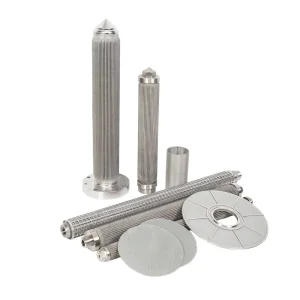
The structural integrity and filtration efficacy of an OEM candle filter cartridge depend directly on its architectural layer arrangement. High-performance filtration elements employ a multi-tiered construction designed to balance mechanical support, depth filtration, and absolute surface capture.
Built using heavy-walled SUS 316L stainless steel tubing, precision-drilled or laser-slotted to withstand extreme collapsing forces ($\Delta P \ge 210\text{ bar}$) without structural deformation or hydraulic cross-flow restriction.
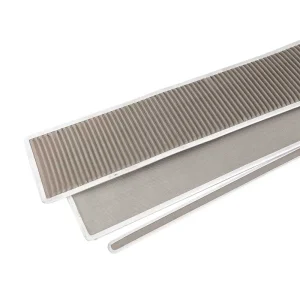
Utilizing non-woven random matrices of micro-denier stainless steel fibers, vacuum-sintered to form a highly porous (up to 85% void volume) depth structure that delivers high Dirt Holding Capacity (DHC) at low pressure drops.
Heavy square-weave wire cloth configured in deep longitudinal pleats to expand effective filtration area by 300% to 500% compared to smooth cylindrical elements, dramatically extending line service life.
Choosing between sintered metal fiber felt, multi-layer sintered wire mesh, and standard woven wire cloth requires evaluating process parameters such as viscosity, melt velocity, shear sensitivity, and cleaning cycle expectations:
| Engineering Attribute | Sintered Metal Fiber Felt | Multi-Layer Sintered Wire Mesh | Standard Woven Wire Cloth |
|---|---|---|---|
| Primary Mechanism | 3D Depth Filtration + Surface Capture | Rigid 2D Precision Surface Capture | Simple 2D Surface Strainer |
| Porosity (Void Volume) | 75% – 85% | 35% – 50% | 30% – 40% |
| Dirt Holding Capacity (DHC) | Very High (2.5x to 4x of Mesh) | Moderate | Low |
| Initial Pressure Drop ($\Delta P_0$) | Extremely Low | Moderate | Moderate to High |
| Cleanability & Reusability | Excellent (TEG / Calcination / Ultrasonic) | Excellent (Backwash / Ultrasonic) | Limited (Warping Risk) |
| Mechanical Strength | High (Supported by Core) | Exceptional (Sintered Integrity) | Moderate |
The global industrial filtration market has experienced a structural transformation over the past decade. China’s advanced manufacturing ecosystem—exemplified by precision filtering engineering hubs in Zhejiang Province—now provides global procurement directors and original equipment manufacturers (OEMs) with an optimal balance of structural quality, fast turnaround times, and competitive unit economics.
Direct supply partnerships with premium stainless steel mills ensure certified chemical compositions for SUS 316L, 316, and 304 alloys. Every melt batch undergoes spectral analysis to verify chromium, nickel, and molybdenum content, preventing intergranular corrosion under high thermal exposure.
China-based OEM factories utilize high-vacuum sintering furnaces capable of multi-temperature zone control up to 1300°C. Automated CNC circumferential TIG welding ensures leak-free joints between filter media, end caps, and adapter fittings without introducing thermal distortion.
From custom candle length dimensions, specialized hex fittings, and bayonet quick-coupling adapters to proprietary pleat geometry, Chinese manufacturing hubs provide rapid CAD-to-prototype production schedules in 7 to 14 days.
PMI spectro-analysis & ultrasonic wire mesh integrity check prior to fabrication.
Servo-controlled mechanical pleating ensuring uniform fold spacing and zero mesh pinching.
High-vacuum thermal fusion creating permanent metallurgical bonds at wire crossover points.
100% Bubble Point Pressure Testing to verify absolute micron rating and pore uniformness.
Micron filter cartridges are engineered for diverse fluid dynamics across key industrial segments. Understanding these application nuances ensures optimized media selection and component longevity.
Processes: Polyester (PET), Polyamide (PA6 / PA66), Polypropylene (PP) POY, FDY, and Micro-denier Filament Spinning.
Engineering Role: Filters out micro-gel particles down to 5–15 µm to prevent spinneret hole clogging, maintaining consistent filament tension and zero filament breaks during high-speed take-up winding (>6000 m/min).
Processes: High-clarity packaging films, capacitor dielectric films, optical display sheets.
Engineering Role: Deployed inside continuous polymer filter (CPF) systems to eliminate pinholes, gels, and fish-eye defects, ensuring uniform gauge thickness and optical transparency across wide-die lines.
Processes: Post-consumer & post-industrial bottle flake recycling, film flake regrind granulation.
Engineering Role: Provides high dirt capacity screens capable of trapping heavy organic impurities, paper residues, and foreign materials while preserving melt pressure stability across screen changers.
Evaluating micron filter cartridge suppliers requires looking beyond initial unit purchase prices. Plant managers, engineering leads, and procurement teams evaluate Total Cost of Ownership (TCO), factoring in operational lifetime, cleaning cycle durability, differential pressure rise curves, and shipment reliability.
Direct sourcing from Chinese OEM manufacturers lowers unit procurement costs by 35% to 50% compared to European or North American regional distributors, without compromising raw material specifications or quality control metrics.
High-integrity SUS 316L sintered fiber candle elements support repeated cleaning cycles (Triethylene Glycol TEG vapor bath, pyrolysis off-gas calcination, solvent immersion, and ultrasonic bath treatments), achieving up to 20+ cleaning regenerations per cartridge.
Flexible manufacturing schedules and standardized product packaging options support vendor-managed inventory programs, reducing warehouse holding costs for global plant networks.
| Evaluation Parameter | Traditional Single-Use Mesh | Standard OEM Wire Screen | Premium Sintered Fiber Candle Filter |
|---|---|---|---|
| On-Stream Life per Cycle | 24 - 72 Hours | 7 - 14 Days | 30 - 90 Days |
| Regeneration Potential | Zero (Discard Only) | Low (1 - 2 Times) | High (15 - 25 Times) |
| Line Downtime Impact | High Maintenance Frequency | Moderate Maintenance | Minimal Line Interruption |
| 3-Year Total Cost Impact | Baseline (High Replacement) | -25% Overall Savings | -60% TCO Savings |
As the global polymer industry adapts to circular economy directives, decarbonization targets, and increasingly stringent material specifications, filtration engineering is evolving rapidly. Next-generation micron filter cartridges are advancing across several key technology fronts:
Constructed with progressively finer fiber diameters from the upstream side to the downstream core. This gradient design traps larger contaminants on the outer boundary while securing microscopic gels deeper within the matrix, maximizing dirt capacity and reducing pressure buildup.
Advanced chemical vapor deposition (CVD) coatings reduce polymer melt adhesion to stainless steel surfaces. This minimizes thermal degradation and gel formation during long dwell times while simplifying offline cleaning cycles.
Specialized filter elements engineered to manage high contaminant loads in recycled PET flakes and polyolefin regrinds, enabling steady production rates despite feed stock variability.