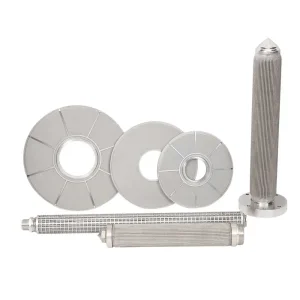
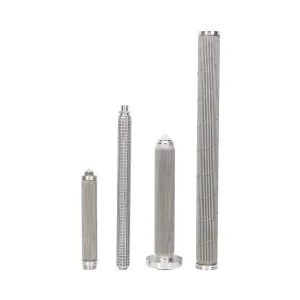
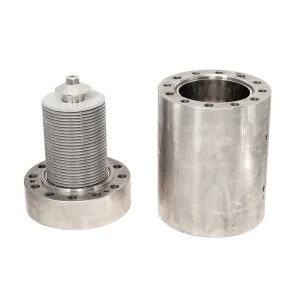
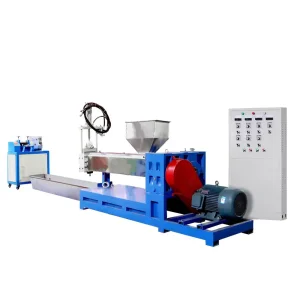
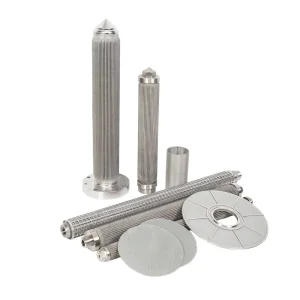
Direct OEM factory solutions engineered for continuous melt extrusion, nonwoven fiber spinning, and high-pressure resin purification.
In modern polymer processing—spanning synthetic fiber spinning (PET, PA66), biaxially oriented film manufacturing (BOPP, BOPET), and recycled resin purification—melt filtration acts as the core barrier ensuring continuous production stability and ultimate product purity.
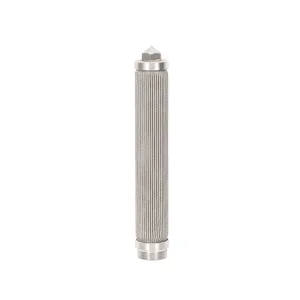
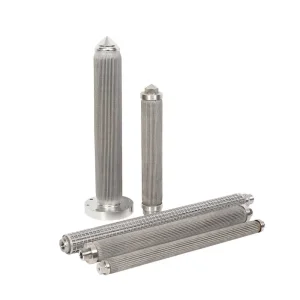
Polymer melt streams operated at temperatures between 240°C and 340°C exhibit non-Newtonian pseudoplastic flow. Gelatinous cross-linked degradation products ("soft gels") tend to deform and shear-thin under high differential pressure (ΔP). Premium OEM polymer candle filters utilize multi-layered graded micro-porous sintered wire felt to achieve high shear resistance, capturing soft gels through depth filtration mechanisms before they extrude through spinnerets or film dies.
Hard contaminants such as titanium dioxide (TiO2) agglomerates, catalyst residue, degradation carbon specks, and metallic fragments present high risks of yarn breakage or film pinhole defects. Candle filter elements employ precise aperture square mesh and sintered fiber media that maintain absolute pore size integrity under continuous hydraulic pressure spikes exceeding 250 bar.
Dead zones inside filter housings cause thermal stagnation and polymer degradation (charring). Engineered candle filters incorporate custom hex-core perforated support tubes and tapered end-cap transitions to optimize fluid flow paths, ensuring uniform residence time distribution (RTD) and eliminating polymer thermal degradation during long continuous production campaigns.
The pressure drop ($\Delta P$) across a cylindrical candle filter element in high-viscosity melt flow is governed by Darcy's Law modified for non-Newtonian fluids: $\Delta P = \frac{\mu \cdot Q \cdot \ln(R_o / R_i)}{2 \pi \cdot K \cdot L}$, where $\mu$ represents dynamic melt viscosity, $Q$ is volumetric flow rate, $R_o/R_i$ are outer and inner radii, $L$ is effective filter length, and $K$ is permeability coefficient of the sintered media layer. Optimizing media porosity ($K$) while maximizing effective surface area ($L$) directly extends operational lifespan by up to 300%.
A comprehensive technical matrix detailing material grades, geometric structural variations, and performance parameters manufactured at our specialized China factory facility.
| Parameter / Characteristic | Sintered Metal Fiber Felt Type | Multi-Layer Woven Wire Mesh Type | Sintered Metal Powder Compact Type |
|---|---|---|---|
| Primary Alloy Metallurgy | 316L Stainless Steel / Hastelloy C-276 | 304 / 316L Stainless Steel | 316L Stainless Steel / Inconel 600 |
| Absolute Filtration Rating | 3 Micron – 60 Micron ($\mu m$) | 10 Micron – 250 Micron ($\mu m$) | 0.5 Micron – 20 Micron ($\mu m$) |
| Porosity Percentage (%) | 75% – 85% High Porosity | 35% – 50% Standard Porosity | 40% – 55% Controlled Micro-Pore |
| Maximum Operating Pressure (ΔP) | 210 Bar Continuous (250 Bar Peak) | 160 Bar Continuous | 300 Bar Ultra-High Pressure |
| Max Thermal Endurance | 360°C (680°F) Melt Fluid Temp | 300°C (572°F) Melt Fluid Temp | 450°C High Temp Chemical Process |
| Cleaning & Reusability Cycle | 8 – 15 Pyrolysis / TEG Cycles | 10 – 20 Ultrasonic / Solvent Cycles | 5 – 10 Chemical Acid Wash Cycles |
| Core Structural Construction | Pleated geometry over perforated SS core | Cylindrical spiral wrap over slotted core | Isostatically pressed seamless rod |
| End-Cap Connection Styles | Threaded M24/M30, NPT, Snap-in, Flange | Threaded, Flat Gasket, Double O-Ring | Custom Machined Taper / Quick-Connect |
Pleated candle filters increase the available active filtration area by 250% to 400% compared to smooth cylindrical elements of equal outer dimensions. This dramatic expansion lowers surface flux velocity ($m^3/m^2/hr$), significantly reduces initial pressure drop, and extends contaminant dirt-holding capacity (DHC) during critical polymer extrusion runs.
Structural integrity at end-cap joins is essential under high melt pressure differentials. Our factory utilizes robotic TIG and electron-beam welding without filler flux, preventing thermal stress distortion and guaranteeing joint strength that exceeds the bursting threshold of the underlying filter mesh media.
Real-world engineering implementations across high-demand polymer processing, extrusion, and recycling facilities worldwide.
Challenge: Micro-denier PP spunbond nonwoven lines require continuous removal of sub-15 micron gels to prevent spinneret hole clogging and filament breakage.
OEM Solution: High-porosity 316L sintered metal fiber candle elements rated at 10$\mu m$ absolute. Ensures non-stop spinning operation for up to 60 days per filter campaign, yielding superior nonwoven tensile strength and uniform web formation.
Challenge: Ultra-thin biaxially oriented polypropylene and polyester packaging films demand absolute elimination of carbon specs and fisheye gel flaws.
OEM Solution: Custom pleated SUS 316L candle filter assemblies with protective outer wire mesh cage. Eliminates film pinholes, enables high-line speeds exceeding 500 m/min, and drastically reduces film break rates during transverse orientation stretching.
Challenge: High intrinsic viscosity (IV) PET melt under extreme pressure (200+ bar) requires low hydraulic resistance and zero media deformation.
OEM Solution: Heavy-duty corrugated stainless steel candle elements with reinforced internal support cores. Engineered to withstand high thermal cycling during continuous polyester polycondensation processes.
Challenge: High particulate contamination in recycled PP/PE plastic melt causes rapid screen blinding on continuous pelletizing machines.
OEM Solution: Multi-layer square weave SUS 304 wire mesh candle cartridges designed for continuous backwash auto-pack changers, minimizing resin waste during back-flushing cycles.
Combining localized raw material integration, high-precision automated production, and direct OEM factory pricing to deliver unmatched value to global OEMs and processing facilities.
Located in China's prime industrial manufacturing hub (Zhejiang), our facility maintains direct strategic relationships with premier stainless steel and specialty nickel alloy suppliers. We stock certified SUS 304, 316L, and Hastelloy raw materials, guaranteeing complete batch traceability and shielding global clients from international supply chain disruptions.
Our manufacturing floor is equipped with automated high-speed pleating machinery, CNC laser tube cutting systems, and high-vacuum sintering furnaces. Standard OEM prototype requests are executed in as short as 7 to 10 working days, with full-scale production orders fulfilled in 2 to 3 weeks.
By eliminating middleman distributor markups, our OEM factory pricing reduces filtration consumable costs by 30% to 50% for international equipment builders without compromising metallurgical purity, bubble-point testing standards, or dimensional tolerances.
Driving next-generation filtration through additive manufacturing, nano-engineered ceramic/metal hybrids, and Industry 4.0 real-time telemetry.
Additive manufacturing using laser powder bed fusion (LPBF) allows the creation of non-uniform graded pore structures within a single monolithic metallic candle element. This eliminates weld seams completely, maximizes dirt-holding capacity, and optimizes internal fluid micro-channels to minimize pressure drops by up to 35%.
Applying ultra-thin titanium nitride (TiN) or hydrophobic/oleophobic chemical vapor deposition (CVD) coatings on stainless steel wire mesh reduces polymer carbonization during high-temperature thermal cleaning cycles, extending reusability cycles from 10 to over 25 cleaning rounds.
Embedding high-frequency acoustic emission sensors and differential pressure micro-transmitters directly into filter housing manifolds allows predictive AI modeling of filter blinding, giving operators precise maintenance schedules before gel break-through occurs.
Ensuring complete peace of mind for international OEMs through strict international standards adherence and localized technical support.
Every polymer candle filter batch undergoes mandatory First Bubble Point Pressure Testing in accordance with ISO 4003 to confirm absolute pore rating accuracy. Dirt holding capacity and flow permeability are verified on specialized hydraulic test rigs adhering to ISO 16889 guidelines.
Materials utilized in food packaging polymer lines (such as PET bottle resin or PP food container film) comply fully with FDA 21 CFR 177.1630 and European Regulation (EU) No 10/2011, ensuring zero heavy metal leaching or chemical migration under high operating temperatures.
Our multilingual engineering team provides 24/7 technical consultation, failure analysis, dynamic flow CAD/FEA simulation support, and localized on-site installation assistance for major plant commissionings across Europe, North America, Southeast Asia, and the Middle East.
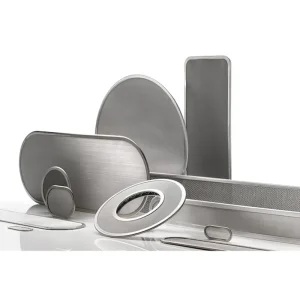
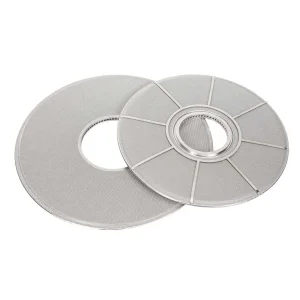
Explore our complete product range for high-viscosity melt filtration, leaf disc elements, and plastic recycling lines.
In-depth technical answers regarding selection, sizing, cleaning protocols, and OEM manufacturing customization.
The choice depends primarily on your melt cleanliness requirements and gel content. Sintered Metal Fiber Felt provides a 3D depth-filtration structure with porosity up to 85%, making it ideal for capturing compressible gelatinous gels in fine fiber spinning (PET, PA66) and optical BOPET films at filtration ratings from 3$\mu m$ to 40$\mu m$. In contrast, Multi-Layer Woven Wire Mesh provides surface filtration with high mechanical rigidity and fixed pore dimensions, making it best suited for removing rigid inorganic particles, heavy recycled plastic contaminants, or applications requiring frequent back-flushing.
Stainless steel candle filter elements can be regenerated 10 to 20 times using a standard multi-stage thermal and chemical cleaning process:
For standard polyolefins (PP, PE) and polyesters (PET), SUS 316L (1.4404) stainless steel is the benchmark standard due to its excellent molybdenum-enhanced pitting corrosion resistance. However, for fluoro-polymers (PVDF, PTFE), high-temperature polyamides generating acidic off-gases, or processing involving halide additives, we recommend upgrading to Hastelloy C-276 or Inconel 600 alloys, which prevent chloride-induced stress corrosion cracking up to 450°C.
Our OEM technical team provides complete reverse-engineering and custom manufacturing services based on your physical sample or technical drawings. We offer complete flexibility in: