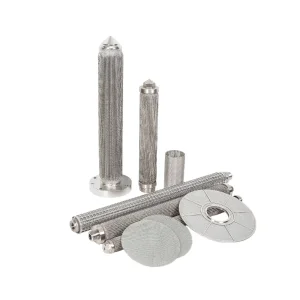
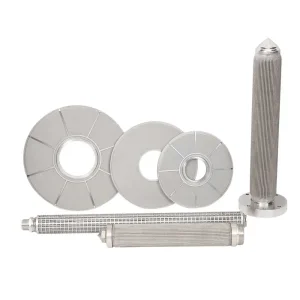
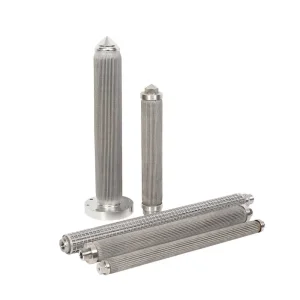
Engineered for high temperature, extreme differential pressure, and ultra-fine micron rating standards across polymer, film, and fiber lines.
In modern high-viscosity polymer processing, continuous extrusion, film blowing, and synthetic fiber manufacturing, the reliability of filtration systems directly governs final product purity, mechanical integrity, and operational profitability. Industrial procurement teams seeking wholesale mesh filter factories and companies face complex technical choices involving differential pressure ($\Delta P$) management, shear degradation mitigation, media longevity, and overall total cost of ownership (TCO).
As polymer melts operate under extreme pressure (frequently exceeding 20–30 MPa) and elevated temperatures ($200^\circ\text{C}$ to $350^\circ\text{C}$), even microscopic particulate contaminants, cross-linked gels, or carbonized degraded polymers can cause catastrophic line breaks, spinneret clogging, or optical defects in biaxially oriented films (such as BOPP, BOPET, and BOPA). This executive whitepaper establishes a comprehensive technical framework for evaluating mesh filter engineering, manufacturing capabilities, and global procurement strategies.
The evolution of industrial filtration media has transitioned from simple woven wire mesh single-layer discs to highly engineered composite structures, including multi-layer vacuum sintered wire mesh, metal fiber sintered felt, and hybrid multi-density media. Understanding this technical roadmap allows procurement managers to align equipment specifications with specific rheological demands.
Traditional plain, twill, and Dutch weave wire cloth. Ideal for standard plastic recycling, granulating, and low-viscosity polymer extrusions requiring frequent automatic screen changes.
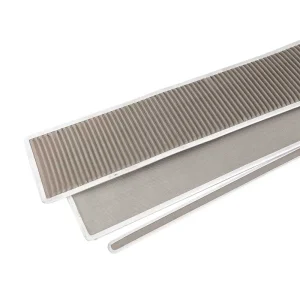
Diffusion-bonded stainless steel wire layers under high heat and pressure. Offers non-deformable pore structures, high burst strength, and zero wire migration under high pressure surges.
Non-woven 3D random matrix composed of micro-grade stainless steel fibers. Delivers exceptionally high porosity (up to 85%), lower initial differential pressure, and maximum dirt-holding capacity.
| Filter Media Technology | Porosity (%) | Dirt Holding Capacity | Cleanability & Reusability | Primary Application Profile |
|---|---|---|---|---|
| Square Woven Mesh (SUS 304) | 30% – 45% | Standard | Limited (Ultrasonic) | Polymer Recycling, Masterbatch Pelletizing |
| Reverse Dutch Weave (RDBW) | 35% – 50% | Moderate | Good (Backwash Compatible) | Continuous Belt Screen Changers |
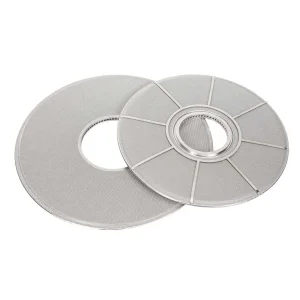
| 5-Layer Sintered Wire Mesh | 50% – 60% | High | Excellent (Chemical / Thermal) | Leaf Disc Filters, BOPP/BOPET Film Extrusion |
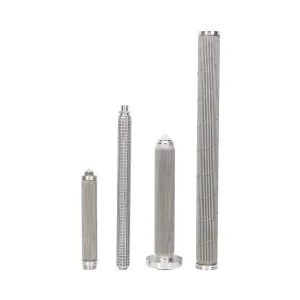
| 316L Sintered Fiber Felt | 75% – 85% | Ultra-High | Superior (Calcination & TEG bath) | Polymer Candle Filters, Chemical Fiber Spinning |
Targeted filtration solutions for high-performance industrial processes demanding zero downtime and uncompromising purity.
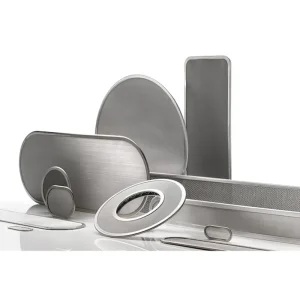
Biaxially oriented films require precise filtration down to 5–10 microns to prevent micro-voids, optical haze, or web breakages. Custom-engineered Leaf Disc Filters utilize high-surface-area configurations to reduce shear stresses and maintain uniform flow velocity.
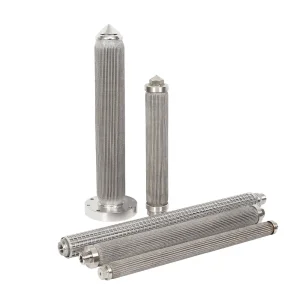
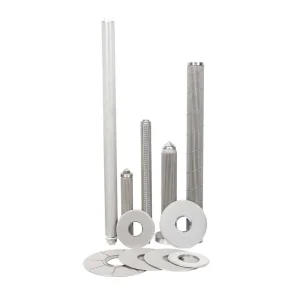
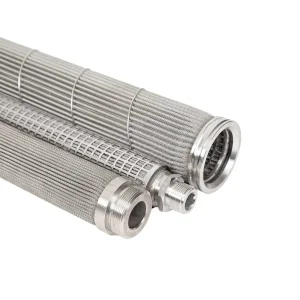
Spunbond nonwoven, PET filament, and nylon fiber production lines demand high-porosity Polymer Candle Filter Cartridges. Made with 316L sintered stainless steel felt, these elements remove soft gel deformation particles, ensuring stable spinneret operation.
Post-consumer (PCR) and post-industrial (PIR) waste streams carry heavy contamination levels (paper fibers, aluminum flakes, high-melt impurities). Robust, multi-layered Extruder Screen Mesh Filters provide high mechanical strength to prevent media rupture during screen changes.
Combining automated heavy weaving looms, high-vacuum hydrogen sintering furnaces, and rigorous Quality Control (QC) protocols to deliver tier-one filtration products globally.
Advanced CNC wire-weaving technology guarantees uniform aperture spacing, precise mesh counts per inch, and zero warp/weft distortion across thousands of meters.
High-vacuum, ultra-clean hydrogen sintering furnaces create molecular-level diffusion bonds between wire layers without oxidation, retaining pristine chemical resistance.
Robotic TIG and seam welding lines eliminate weld slag and burrs, creating seamless structural connections for candle filter caps and leaf disc outer rims.
Standardized raw material buffer inventories (SUS 304, 316L, 904L, Hastelloy) ensure rapid OEM sample prototyping within 48 hours and reliable bulk delivery deadlines.
Procuring industrial filtration components from China’s leading manufacturers requires a clear verification model covering raw material traceability, structural testing, and regulatory certifications. For multinational polymer producers, validating these standards mitigates operational risk.
Every batch of stainless steel wire, mesh, or fiber felt must undergo Positive Material Identification (PMI) testing using X-ray fluorescence (XRF) analyzers. Premium suppliers provide complete Mill Test Certificates (MTC) conforming to EN 10204 3.1, verifying exact Chromium, Nickel, and Molybdenum ratios necessary to resist corrosive additives (e.g., flame retardants, acidic catalysts).
Top-tier wholesale manufacturers operate under ISO 9001:2015 Quality Management Systems and ISO 14001:2015 Environmental Management Systems. Products intended for food-contact packaging applications (such as PET preform recycling or food-grade film blowing) comply with US FDA standards and European Union REACH/RoHS Directives.
Direct technical answers to common queries raised by filtration engineers, plant operations directors, and procurement specialists.
Sintered Wire Mesh offers high mechanical strength, rigid pore geometry, and excellent pressure surge resistance, making it ideal for leaf disc filters and screen changers. Sintered Fiber Felt provides significantly higher porosity (up to 85%) and 3D depth filtration, offering superior dirt-holding capacity and lower differential pressure for high-viscosity applications like synthetic fiber spinning.
SUS 304 is suitable for standard, non-corrosive polymers (such as pure PP and PE). However, for processes operating above 300°C or handling corrosive resins (such as fluoropolymers, PET with acidic catalysts, or recycling streams with halogenated contaminants), SUS 316L or special alloys like Hastelloy C-276 and Inconel 600 are strongly recommended due to superior pitting and crevice corrosion resistance.
Yes. Premium stainless steel candle filters and leaf discs are fully reusable. Cleaning procedures typically involve Triethylene Glycol (TEG) solvent baths to dissolve remaining polymers, followed by high-temperature calcination in fluid bed furnaces, ultrasonic water baths, and chemical pickling. Properly cleaned elements restore up to 95–98% of their original flow permeability.
Leading OEM manufacturers can customize outer diameter, overall length, micron rating (from 1μm up to 500μm), structural support core thickness, end-cap connection style (e.g., NPT, threaded, bayonet, double O-ring 222/226), weave patterns, and multi-layer stack sequences to fit any proprietary housing system.
Mesh count refers to the number of openings per linear inch. Conversion depends on both mesh count and wire diameter. For example, a 100 mesh plain weave with a standard wire diameter typically yields a ~150 micron opening, while a 400 mesh plain weave offers ~37 micron retention. For precise retention, Dutch weave and sintered felt use absolute bubble point micron ratings rather than nominal mesh counts.
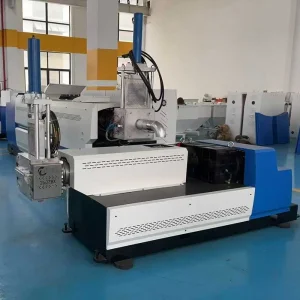
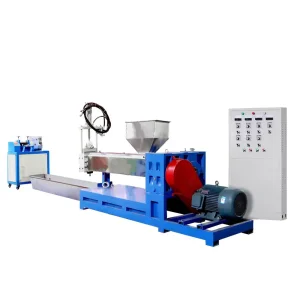
Explore our extended series of SUS 304/316 candle filters, wire mesh packs, and industrial recycling machinery.