Polyethylene Terephthalate (PET) stands as the premier thermoplastic polymer across global rigid packaging, technical textiles, and industrial film manufacturing. As global regulatory bodies enforce strict circular economy targets, wholesale PET recycling machinery suppliers are undergoing a paradigm shift toward food-grade re-granulation, IV preservation, and zero-degradation thermal processing.
Historically, post-consumer PET waste was downcycled into low-grade staple fibers or industrial strapping tape. Today, the global marketplace demands true closed-loop recycling: converting post-consumer PET bottles back into food-contact safe container resins (Bottle-to-Bottle) or high-tenacity filament yarn (Bottle-to-Yarn).
Achieving food-grade certification under European Food Safety Authority (EFSA) and US FDA regulations requires complete elimination of volatile contaminants, limonene, and non-intentionally added substances (NIAS). This places unprecedented demands on mechanical recycling machinery—demanding integrated high-vacuum degassing extruders, continuous multi-stage washing plants, and ultra-fine polymer melt filtration.
PET is a condensation polymer subject to hydrolytic, thermal, and oxidative degradation during re-melting. Water content as low as 0.02% (200 ppm) causes catastrophic chain scission, dropping Intrinsic Viscosity (IV) from 0.80 dL/g to below 0.60 dL/g.
As a premier wholesale PET recycling machine manufacturer, Pujiang HG Plastic Machinery solves IV loss through multi-screw degassing extruders combined with Solid-State Polycondensation (SSP) reactors. By maintaining inert atmosphere conditions and high vacuum (<1 mbar), our machinery restores IV to virgin levels while maintaining thermal stability.
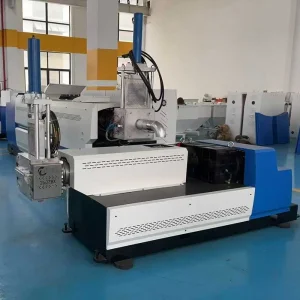
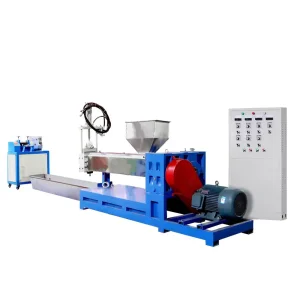
A complete industrial PET recycling production line integrates mechanical pre-treatment, hydrodynamic surface purification, melt extrusion degassing, and multi-stage micro-filtration.
Bale opening and de-labeling lead directly into multi-spectral Near-Infrared (NIR) and optical color sorters to remove non-PET plastics (PVC, PE/PP caps, PS, PLA) and off-color PET flakes. The material enters high-shear friction washers and steam-heated hot washing tanks operating at 85°C–90°C with 1.5% sodium hydroxide (NaOH) and surfactant formulation. This strips residual adhesives, milk protein film, and organic contaminants, achieving flake purity exceeding 99.8%.
Cleaned PET flakes are fed into specialized single-screw or co-rotating twin-screw extruders featuring optimized length-to-diameter (L/D) ratios ranging from 40:1 to 52:1. Dual-zone high-vacuum degassing domes maintain negative pressures below 5 mbar. This continuously extracts residual moisture, volatile monomers, and trapped gases without requiring energy-intensive crystallization pre-drying systems, safeguarding polymer molecular weight.
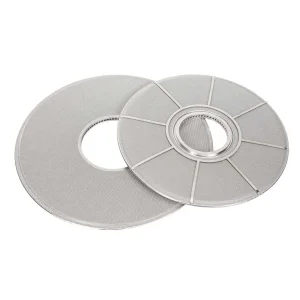
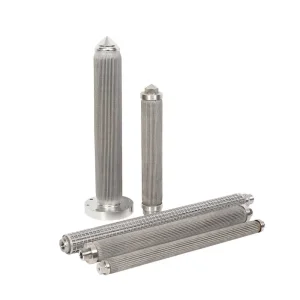
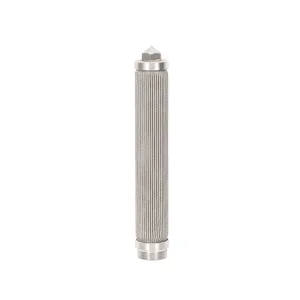
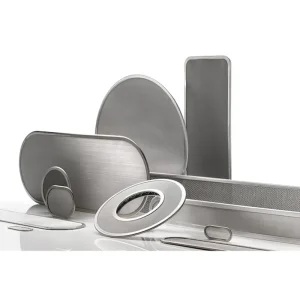
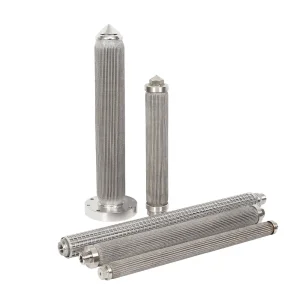
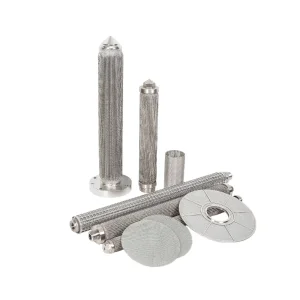
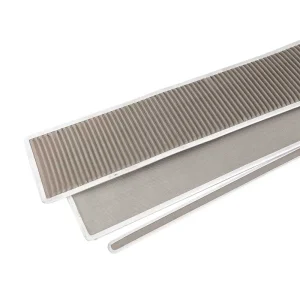
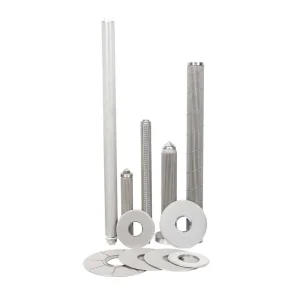
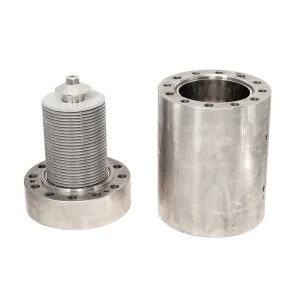
The heart of premium re-granulation lies in high-viscosity polymer melt filtration. Melt pumps force the molten PET through multi-piston continuous backflush screen changers, SUS 316L sintered metal felt candle filter elements, or high-surface-area polymer leaf disc filters. Filtration precision down to 15–40 microns isolates microscopic degraded gels, aluminium specks, and paper ash, ensuring zero spinneret clogging or film tear downstream.
Filtered melt passes through precision multi-orifice die plates into an underwater pelletizer or automatic strand granulator, producing uniform spherical or cylindrical rPET pellets. For food-grade Bottle-to-Bottle applications, pellets enter a continuous SSP vertical reactor operating at 200°C–220°C under heavy vacuum or nitrogen purge, increasing intrinsic viscosity up to 0.84 dL/g while fully decontamination-certifying the polymer resin.
As an ISO 9001:2015 certified manufacturer with 20+ years of specialty filtration production, Pujiang HG Plastic Machinery maintains strict engineering tolerances across all recycling systems.
Barrel & Screw Substrate: Nitrided steel 38CrMoAlA or Bimetallic Nickel-based alloys (W6Mo5Cr4V2 high-speed tool steel liners).
Surface Hardness: HRC 62–65, providing maximum protection against abrasive silica and PET additives.
Materials: AISI 316L stainless steel multi-layer woven wire mesh, sintered metal fiber felt.
Micron Ratings: 5 µm to 250 µm with up to 85% void volume, allowing maximum throughput with low initial pressure drop (ΔP < 15 bar).
Energy Intensity: 0.22 – 0.32 kWh/kg (Line dependent).
Vacuum Integrity: System vacuum leakage rate < 0.5 mbar·L/s, maintaining inert reaction zones for zero oxidation.
Our PET recycling lines and melt filter assemblies are custom-configured for specific downstream polymer converted products.
Engineered for beverage brand owners seeking 100% rPET carbon footprint reduction. Incorporates pre-degassing, precise viscosity stabilization, and EFSA/FDA decontamination compliance. The resulting pellets match virgin resin clarity, color (L*a*b* parameters), and mechanical toughness.
High-speed polyester fiber spinning (POY, FDY, PSF) requires zero particulate contamination to prevent filament breaks. Our SUS 316L polymer candle filters extract gel particles and sub-micron ash down to 15 microns, maximizing spinneret pack lifetime.
Direct flake-to-sheet extrusion lines eliminate double-thermal processing, feeding hot degassed melt straight into 3-layer co-extrusion feedblocks for thermoforming food trays, clam shells, and blister packaging.
Strict mandates under the Packaging and Packaging Waste Regulation require 25% recycled content in PET beverage bottles by 2025, scaling to 30% by 2030. Systems exported to the EU feature CE safety marking, Siemens S7-1500 PLC automation, and full energy metering.
US recyclers prioritize high-capacity lines (2000–4000 kg/h) with documented challenge test performance. Machinery incorporates dual-zone vacuum systems capable of passing FDA Non-Objection Letter (NOL) protocol criteria.
Focus centers on versatile lines handling mixed-quality post-industrial and post-consumer bottle flakes, with heavy emphasis on robust mechanical filtration elements and low capital operational expense.
Pujiang HG Plastic Machinery continues to invest in smart sensing, predictive filtration control, and chemical recycling pre-treatment technologies.
Integrating inline rheometers and acoustic emission sensors directly into the filter manifold. Machine learning algorithms dynamically adjust screw speed, vacuum depth, and screen-backflushing frequency based on real-time melt viscosity variations.
New generation barrier screw profiles engineered using computational fluid dynamics (CFD) minimize peak shear rates while optimizing thermal conductivity, maintaining intrinsic viscosity without high power consumption.
Developing high-temperature, high-pressure continuous filtration vessels designed to filter depolymerized PET oligomer streams prior to re-polymerization, bridging mechanical and chemical recycling infrastructure.
Detailed technical guidance provided by our senior engineering team to support your equipment procurement decisions.
IV drop is primarily caused by hydrolytic degradation (reaction of moisture with molten PET chains at temperatures above 260°C) and thermal-oxidative degradation due to excessive shear or long residence times. Our wholesale PET recycling machines mitigate IV loss through two engineered methods: first, high-efficiency vacuum degassing zones (<5 mbar) that continuously purge moisture and volatiles directly from the melt without needing energy-heavy pre-dryers; second, precision-engineered low-shear screw profiles that minimize viscous dissipation heating.
Traditional slide-plate or piston screen changers offer limited active filtration area, requiring frequent screen replacements when processing contaminated post-consumer flakes. In contrast, SUS 316L polymer candle filter elements incorporate pleated or sintered wire felt geometry, providing up to 8 to 10 times more active filtration surface within the same footprint. This drastically reduces melt differential pressure (ΔP), extends continuous filter life from hours to weeks, and improves melt homogeneity—essential for high-tenacity yarn spinning and film casting.
Yes. When integrated with our optional continuous Solid-State Polycondensation (SSP) decontamination reactors and deep vacuum degassing twin-screw extruders, our rPET pelletizing systems meet EFSA and US FDA 100% rPET food-contact challenge protocol standards. The process removes volatile organic compounds (VOCs) and migratory contaminants below regulated threshold limits.
Under standard operating conditions with proper backwashing cycles, our SUS 304/316/316L sintered mesh candle filters and leaf discs can undergo 20 to 30 ultrasonic chemical cleaning cycles. Depending on feed flake purity, an element set typically delivers a service life of 12 to 36 months before replacement is required, offering exceptionally low cost-per-ton filtration economics.
Absolutely. We possess full in-house tooling, CNC machining, laser welding, and vacuum sintering facilities. We can design and manufacture replacement polymer candle filters, leaf discs, or screen mesh packs according to your technical drawings, sample parts, or specific micron accuracy and flow rate requirements.