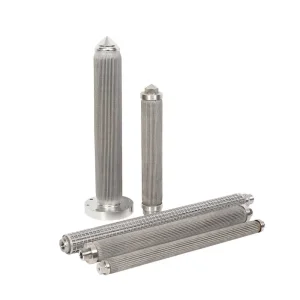
Engineering high-durability SUS316L sintered melt filter elements for ultra-pure polymer extrusion, PET recycling, and high-viscosity chemical processing plants across New York and North America.
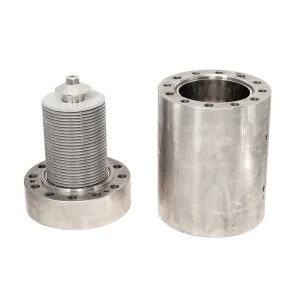
Send Inquiry NowPrecision-engineered continuous melt filtration elements constructed from sintered stainless steel web and multi-layer wire mesh.
Analyzing regional supply chain mandates, advanced polymer film production hubs, and post-consumer plastic recycling trends.
The industrial landscape of New York State—extending from the historic manufacturing corridors of Rochester and Buffalo to the tech-centric Capital Region (Albany)—is undergoing a massive structural transformation. As a major North American center for high-performance optical films, specialty barrier packaging, and engineering plastics, New York manufacturing plants require robust polymer filtration solutions. Standard woven wire mesh screens frequently fail under the high shear stress and thermal fluctuations characteristic of continuous 24/7 extrusion lines. Our custom polymer candle filter elements are explicitly re-engineered to provide maximum surface area and minimal residence time distribution (RTD), guaranteeing defect-free melt flow in high-speed biaxially oriented polyethylene terephthalate (BOPET) and polypropylene (BOPP) production lines.
Under the New York State Climate Leadership and Community Protection Act (CLCPA) and New York Department of Environmental Conservation (NYS DEC) circular economy mandates, regional compounding and recycling facilities face unprecedented pressure to incorporate high ratios of Post-Consumer Recycled (PCR) resin. Processing recycled PET, HDPE, and PP introduces severe contaminant challenges, including cross-polymer degradation, gels, paper fibers, and metallic micro-particles. OEM Polymer Candle Filters utilizing multi-layer SUS316L sintered stainless steel fiber media act as the critical defense line. By trapping contaminants down to 3 microns while maintaining low differential pressure ($\Delta P$), our filter cartridges allow New York re-processors to maintain high throughput without risking extrusion die blockages or film tears.
Understanding melt rheology, flow mechanics, shear stress mitigation, and dirt-holding capacity (DHC) under extreme operating conditions.
In high-viscosity polymer melt systems operating at temperatures up to 350°C and fluid pressures exceeding 250 bar (3,625 psi), traditional surface filtration media experience rapid structural fatigue and gel passage. Continuous Polymer Filter (CPF) systems demand sintered metal fiber felt media or multi-layer wire mesh webs mounted on heavy-duty perforated support cores (SUS316L / SUS304).
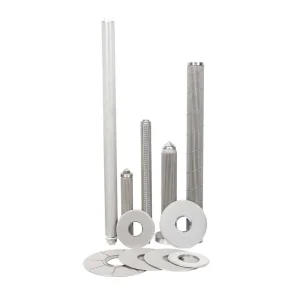
The primary engineering goal of a polymer candle filter cartridge is to maximize active filtration surface area within a compact housing while maintaining low initial differential pressure ($\Delta P_0$). Pleated candle design increases the active surface area by 250% to 400% compared to smooth cylindrical filter tubes of identical external dimensions. This geometric gain reduces local melt velocity across the media, mitigating shear degradation of sensitive polymers such as Polyamide (PA66), Polycarbonate (PC), and Polyethylene Terephthalate (PET).
| Media Technical Specification | Sintered Metal Fiber Felt (SUS316L) | Multi-Layer Sintered Wire Mesh | Powder Metallurgy Metal Media |
|---|---|---|---|
| Porosity Rating (%) | 75% - 85% (Ultra-High Void Volume) | 50% - 65% (Structured Pore Geometry) | 35% - 50% (Dense Porous Structure) |
| Dirt-Holding Capacity (DHC) | Exceptional (Deep Bed Retention) | Moderate (Surface & Depth Blend) | Low-Moderate (Surface Trapping) |
| Pressure Drop ($\Delta P$) Trajectory | Slow Linear Rise (Extended Life) | Steep Exponential Curve | Rapid Rise under Gel Loading |
| Micron Rating Range ($\mu m$) | 3 $\mu m$ to 60 $\mu m$ Absolute | 5 $\mu m$ to 200 $\mu m$ Absolute | 0.5 $\mu m$ to 20 $\mu m$ Absolute |
| Cleanability & Pyrolysis Cycles | up to 20+ TEG / Calcination Loops | up to 15+ TEG / Ultrasonic Loops | Restricted (Pore Clogging Hazard) |
| Primary New York Application | BOPET/BOPP Film, Spunbond Fiber | Heavy Extrusion & PCR Compounds | Specialty Chemical High-Pressure Fluid |
How global supply chains, energy costs, and circular polymer initiatives shape OEM procurement strategies in the Eastern United States.
Recent global logistics disruptions have forced North American extrusion manufacturers to seek OEM candle filter suppliers capable of delivering precision-engineered SUS316L filter elements with guaranteed metallurgical integrity and short lead times. Upstate New York production facilities cannot afford unexpected downtime caused by delayed filter element deliveries during scheduled maintenance turnarounds.
With industrial electricity prices in the Northeast US remaining above national averages, reducing extruder head pressure is a top operational metric. Sintered fiber candle filters exhibit up to 30% lower initial hydraulic resistance ($\Delta P_0$) compared to standard woven mesh stacks, directly reducing motor amperage consumption on high-horsepower extruder drives.
New York’s pharmaceutical and medical packaging hubs require absolute filtration integrity down to 3 microns to eliminate micro-voids, gel spots, and pinholes in barrier films. Standardized quality control protocols, including ISO 4003 bubble point testing and dimensional inspection, ensure complete operational reliability.
Engineered innovation: AI-guided pleating configurations, sub-micron nanofiber webs, and smart IoT melt pressure monitoring.
Computational Fluid Dynamics (CFD) modeling calculates melt shear stress inside individual pleat valleys. By variable spacing and parabolic pleat root geometry, stagnation zones are eliminated, reducing thermal degradation and polymer discoloration during long extrusion runs.
Integrating sub-micron stainless steel fibers into traditional sintered felt structures allows absolute filtration retention down to 1 micron without sacrificing overall dirt-holding capacity, opening new possibilities for optical-grade medical polymers and ultra-thin capacitor films.
Next-generation CPF housing systems integrated with real-time pressure transducers feed differential pressure growth curves into predictive AI models. Plant engineers receive automated alerts predicting exact filter blinding windows, allowing perfect synchronizing with plant maintenance schedules.
Tailored filter architectures optimized for high-temperature melt, aggressive solvent environments, and intense particulate loads.
Engineered for high-volume film manufacturing plants in Rochester and Central New York. Our pleated SUS316L candle filters offer high surface area-to-volume ratios, minimizing pressure drop spikes during resin lot transitions and ensuring uniform film gauge control down to sub-gauge tolerances.
Specially constructed heavy-mesh support cores withstand severe pressure surges caused by degraded post-consumer plastic loads. High dirt-holding capacity (DHC) extends operational life by 200% compared to conventional screen discs in Hudson Valley and Capital District recycling plants.
Ultra-fine continuous filtration media designed to trap micro-gels and rigid cross-linked contaminants prior to spinneret pack entry. Prevents filament breakage, maintains denier uniformity, and reduces costly spinning line stoppages across Northeast textile operations.
Manufactured in strict compliance with ISO 9001 quality management systems. 100% pass bubble point testing guarantees absolute retention specs required for long-island bio-medical polymer extrusion lines producing intravenous tubing and catheter components.
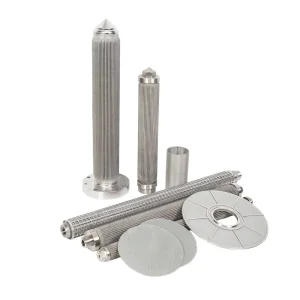
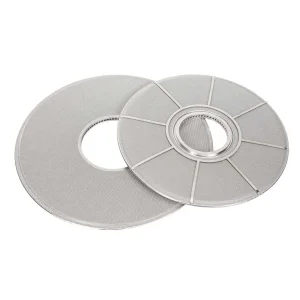
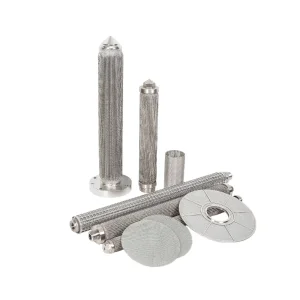
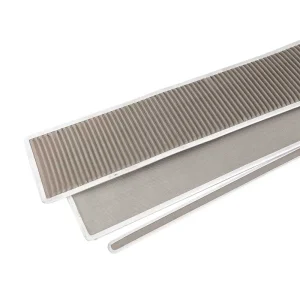
Explore our full line of stainless steel pleated elements, leaf disc filters, and extruder screens engineered for continuous polymer processing.
In-depth technical answers addressing material grades, micron selection, cleaning protocols, and local New York supply logistics.
We manufacture OEM candle filter elements in both SUS304 and SUS316L stainless steel grades. SUS304 is highly cost-effective for standard, non-corrosive polyolefin extrusion processes (such as virgin PP and LLDPE film lines). However, for aggressive thermal processing, high-temperature polyamides, fluoropolymers, or post-consumer recycled (PCR) melt containing acidic degradants, SUS316L is strongly recommended due to its molybdenum content, which provides superior resistance to pitting, intergranular corrosion, and thermal degradation up to 350°C.
Sintered metal fiber felt consists of randomly laid non-woven stainless steel micro-fibers metallurgically bonded through high-temperature vacuum sintering. It offers a extremely high porosity (up to 85%), providing a significantly higher dirt-holding capacity (DHC) and lower initial differential pressure ($\Delta P$) compared to woven wire mesh of equivalent micron rating. Woven wire mesh provides precise, rigid pore dimensions making it ideal for surface filtration, but fiber felt excels in depth filtration, trapping deformable polymer gels and fine particulate impurities without rapid clogging.
Our SUS316L candle filter elements are fully reusable through established industrial cleaning cycles. Standard regeneration procedures include:
1. Triethylene Glycol (TEG) Hydrolysis / Pyrolysis: Dissolves residual polyesters (PET/PBT) or polyamides at temperatures between 280°C and 330°C.
2. Vacuum Calcination / Fluidized Bed Furnaces: Safely thermal-degrades remaining carbonized organic deposits under controlled atmospheres.
3. Ultrasonic Bath Cleansing with Mild Alkaline Solutions: Removes inorganic ash particles trapped within the depth matrix.
4. High-Pressure Reverse Flow Water Rinsing & Drying: Restores initial differential pressure ($\Delta P_0$) prior to bubble point testing validation.
Selection depends on finished product thickness and critical defect limits:
• BOPET / BOPP Ultra-Thin Optical & Capacitor Films: Typically specify 3 $\mu m$ to 10 $\mu m$ absolute sintered fiber felt to eliminate micro-pinholes.
• High-Viscosity PET Bottle Resin & Engineering Strapping: Utilize 20 $\mu m$ to 40 $\mu m$ multi-layer mesh or fiber media to balance flow rates and gel retention.
• PCR Plastic Compounding & Pelletizing: Range from 40 $\mu m$ to 150 $\mu m$ to manage heavy particulate contaminant loads while extending online stream life.
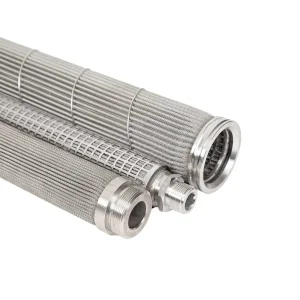
Yes. We specialize in exact-fit OEM replacement filter elements. Our engineering department works directly from customer technical drawings or physical sample cartridges to match end-cap connection geometry (including NPT threaded, hexagonal tie-rod, knife-edge seal, and flat-gasket interfaces) ensuring 100% mechanical compatibility with major European and American continuous polymer filter (CPF) housings.
Every production batch undergoes rigorous Quality Control (QC) in accordance with international standards. We perform:
1. ISO 4003 Bubble Point Testing: Verifies maximum pore size and guarantees zero structural defects or seam bypass.
2. ISO 2942 Fluid Compatibility & Pressure Collapse Testing: Ensures high structural collapse resistance (up to 210 bar differential pressure).
3. Spectrometric Material Verification (XRF): Confirms exact SUS316L / SUS304 metallurgical composition prior to manufacturing.
Standard prototype and OEM custom production orders are typically fabricated within 2 to 3 weeks. Express air freight to major New York logistics centers (JFK, ALB, ROC, BUF) delivers products within 5 business days after factory dispatch, ensuring minimal lead time for urgent maintenance shutdowns or line retrofits.
Consult with our senior technical filtration engineers to request detailed engineering drawings, custom micron rating configurations, or instant competitive pricing for New York industrial operations.
Send Inquiry Now